

EN ISO 11148-1 Handheld Non-Electric Power Tools - Safety Requirements - Part 1: Assembly Power Tools for Threadless Mechanical Fasteners
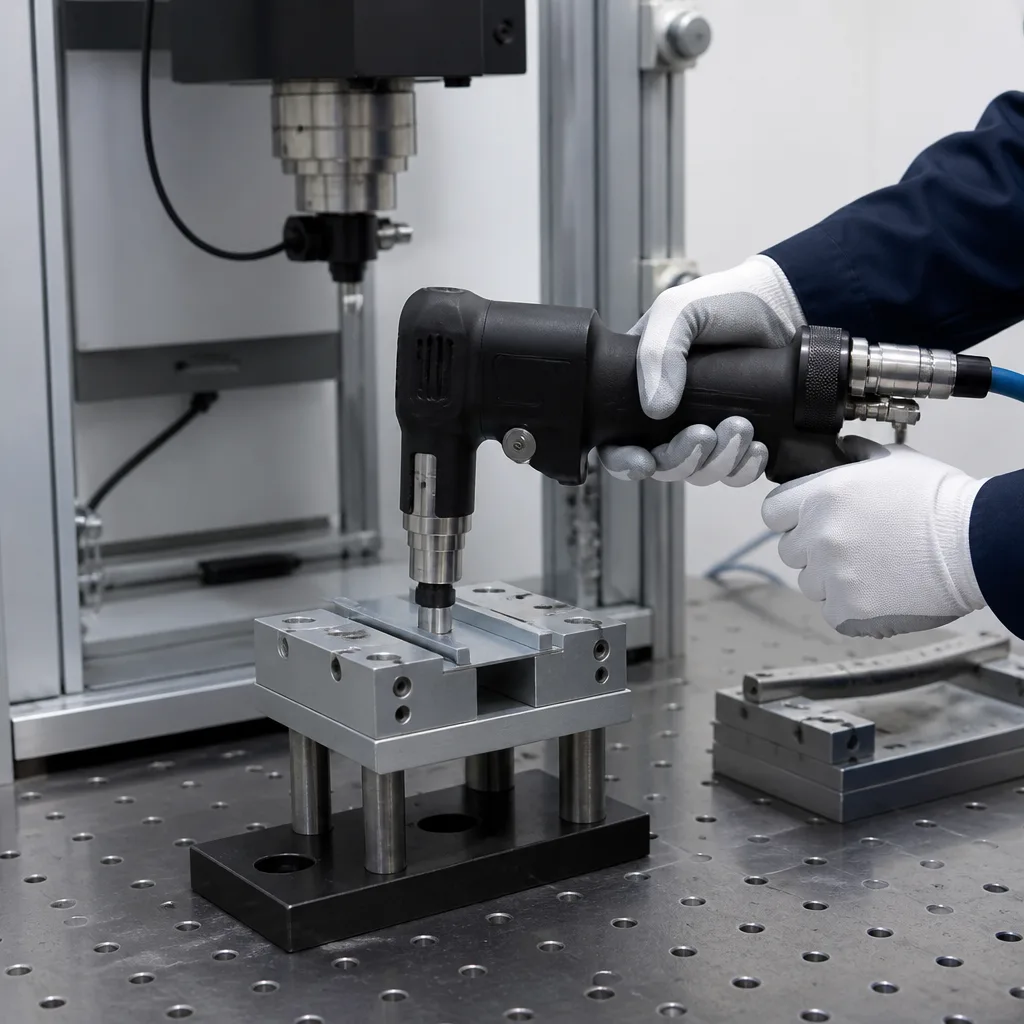
The standard “EN ISO 11148-1 Handheld non-electric power tools - Safety requirements - Part 1: Assembly power tools for threadless mechanical fasteners”, developed by the International Organization for Standardization (ISO) and later published as a European standard within the scope of harmonization efforts, describes the safety requirements for handheld non-electric power tools (assembly power tools for threadless mechanical fasteners) designed for inserting, tightening or removing rivets, bolts, plugs and fasteners with both breakable and non-breakable bodies from one side of a workpiece into metal, plastic and other materials. This standard states that assembly power tools for threadless mechanical fasteners can be operated by compressed air, hydraulic fluid or internal combustion engines and are designed to be used by an operator and supported by the operator's hand or hands, with or without suspension, e.g. by a stabilizer.
This standard applies to:
Examples of assembly power tools for threadless mechanical fasteners are included in the standard annex (Annex B).
The ISO 11148 standard does not apply to specific requirements and modifications made for mounting handheld power tools to a fixture.
This standard addresses all significant hazards, hazardous situations, or dangerous incidents associated with assembly power tools for threadless mechanical fasteners when used as intended and under conditions of misuse reasonably foreseeable by the manufacturer, excluding the use of power tools in potentially explosive atmospheres.
EN 13463-1 standard specifies the requirements for non-electrical equipment for potentially explosive atmospheres.
The EN ISO 11148-1 standard specifies safety requirements for a particular category of handheld, non-electric power tools used in assembly operations. These tools are generally called assembly power tools for threadless mechanical fasteners. They are typically powered by compressed air, hydraulic fluid, or internal combustion engines and are designed for an operator to use them by hand (with or without a suspension system such as a stabilizer).
This standard applies to tools that install or adjust threadless mechanical fasteners without making a single rotation. Examples include:
This standard does not cover continuously rotating tools, power tools, or other handheld power tools (these are covered in other parts of the ISO 11148 series of standards).
EN ISO 11148-1 is a Type-C standard, as defined in ISO 12100. This means it provides detailed, product-specific safety requirements that take precedence over more general (Type-A or Type-B) machine safety standards.
This standard focuses on identifying and mitigating the significant hazards associated with these devices. The main areas covered are:
This standard addresses single-shot tools that install fasteners such as rivets, lock bolts, or plugs without requiring rotational movement.
The EN ISO 11148-1 standard is part of the multi-part ISO 11148 series of standards, covering various families of non-electric handheld power tools. This standard specifically targets assembly tools for threadless fasteners.
Manufacturers use this standard to design, test, and certify equipment to meet essential health and safety requirements (e.g., under the EU machinery directive).
Users and employers rely on this standard to select safe tools, provide appropriate training, and maintain equipment to minimize risks such as repetitive strain, noise-induced hearing loss, vibration-related discomfort, or ejection hazards from fasteners.
In short, the EN ISO 11148-1 standard contains general safety requirements for handheld non-electric power tools. These tools typically operate using compressed air, hydraulics, or internal combustion engines instead of electricity. This standard provides common rules applicable to grinders, drills, sanders, saws, and all similar tools.
This standard applies to:
However, the following are excluded:
The main objectives of this standard are:
The basic security requirements have been defined as follows:
In conclusion, the EN ISO 11148-1 standard is a fundamental safety standard that ensures the safe design and use of non-electric hand power tools. By addressing mechanical risks, ergonomics, noise, and vibration, it plays a crucial role in protecting workers and improving tool reliability.
For many years, our organization, with its competent and experienced staff, has been understanding the needs of its clients, providing the advanced testing services they require, and assisting them in the establishment, implementation, and improvement of management systems. Within this framework, we also provide testing services in accordance with the EN ISO 11148-1 standard.
To get an appointment, to get more detailed information or to request an evaluation, you can ask us to fill in our form and reach you.

