

The European standard “ EN 13036 Road and airport surface characteristics - Test methods” consists of the following sub-sections published under the same title:
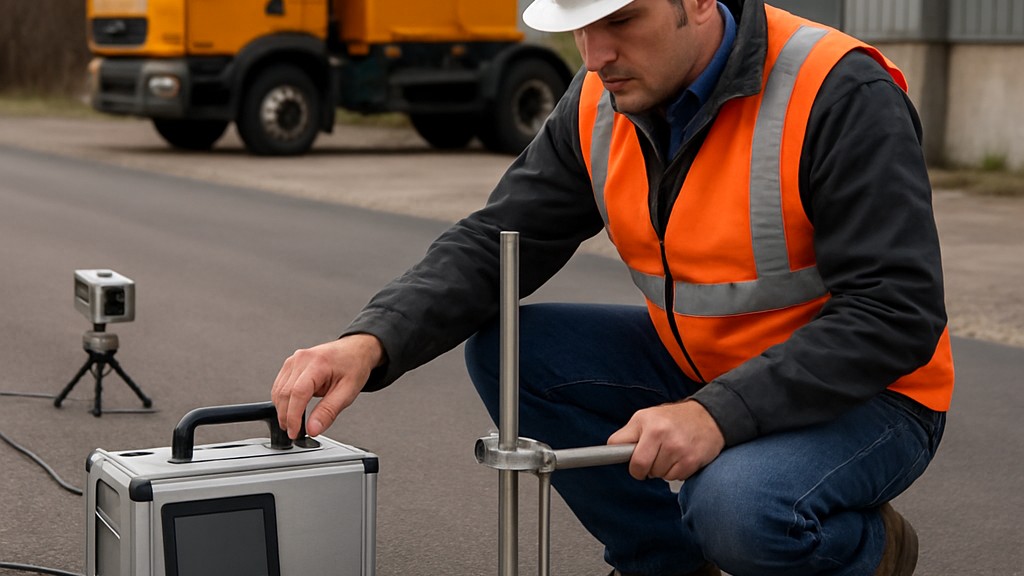
This method is designed to provide only the average depth of the pavement macrotexture and is considered insensitive to pavement microtexture characteristics. This test method is suitable for field testing to determine the average macrotexture depth of a pavement surface. When used in conjunction with other physical tests, the macrotexture depth values derived from this test method can be used to determine pavement slip resistance capacity, noise characteristics, and the suitability of pavement materials or finishing techniques. When used in conjunction with other tests, care should be taken to ensure that all tests are conducted at the same location.
This method describes a process for comparing friction results from a range of devices. By combining friction and texture data from separate measurement devices, it allows the slip resistance determined by different dynamic methods to be expressed on a common scale, the slip resistance index. Because its accuracy has not been established, the method should not be used in specifications for surface materials. This standard excludes surfaces for winter road conditions. It also excludes road marking surfaces.
This method provides a measure of drainage ability in the road/tire contact patch for use on all smooth, non-porous road surfaces (average profile depth less than 0,4 mm) in the field or laboratory. Because this method measures the horizontal drainage ability of only a small area of the surface, the selection of the test area should be carefully considered to ensure it is representative of the overall area where measurements will be made.
Sliding/friction resistance is measured by means of a slider mounted at the end of a pendulum arm. The method provides a field or laboratory measure of a surface's sliding/friction resistance properties. This method measures the sliding/friction resistance of a small area (approximately 0,01 m2) of a surface. This should be considered when determining its applicability to surfaces that may have non-uniform surface characteristics, such as those containing ridges or grooves or having a rough texture (average texture depth exceeding 1,2 mm). Because the results from this test were taken at a single small location, they cannot be compared with results obtained from devices (e.g., mobile devices) that measure sliding/friction resistance over a long length of a surface.
The purpose of this standard is to provide a standard practice for calculating and reporting road smoothness estimates from digitized longitudinal profiles. It also facilitates comparison of smoothness measurement results performed with different profiling devices in European countries.
The smoothness range covered in this standard is defined as a wavelength range of 0,5 m to 50 m. It is noted that both shorter and longer wavelengths can affect ride comfort, but these are not addressed in this standard. The quantitative smoothness indices derived from this standard are a useful support for road management systems. The output can also be used for type approval and performance control of new and existing pavements. The indices can be used on hard, flexible, and gravel road surfaces. This standard does not define the location at which the longitudinal profile should be obtained on the road. The derived indices are portable in the sense that they can be obtained from longitudinal profiles measured with various instruments.
Verification and calibration recommendations are included. Profiling devices are equipment used to measure the evenness of pavements in the transverse or longitudinal direction. Highway agencies, airport authorities, equipment manufacturers, and other organizations can use this standard to define the measurement capabilities of surveying equipment that collects data necessary to characterize surface conditions. Evenness measurements can be made using either static or dynamic devices. This standard includes high-speed, low-speed, and stationary equipment. A dynamic measurement is a measurement performed using a device operating at or above the minimum speed acceptable in normal traffic flow (high speed).
This test method is not applicable for providing information on the profile or overall irregularity. Individual irregularities are random in nature, and therefore routine sampling rates or sensitivity data are not specified.
The indices are defined essentially independently of the measuring instrument. This standard focuses on transverse irregularity measurements for the following purposes:
Our organization, which has been supporting businesses across all sectors for years through a wide range of testing, measurement, analysis, and evaluation activities, has a strong team of employees who closely follow global developments in science and technology and are constantly improving themselves. In this context, we also provide testing services in accordance with the EN 13036 Road and Airport Surface Properties - Test Methods standard.
To get an appointment, to get more detailed information or to request an evaluation, you can ask us to fill in our form and reach you.

