EN IEC 61386-1 Conduit Systems for Cable Management - Part 1: General Requirements
The standard "EN IEC 61386-1 Piping systems for cable management - Part 1: General requirements", which is based on a European standard and subsequently published by the International Electrotechnical Commission (IEC), describes the requirements and test methods for the protection and management of insulated conductors or cables in electrical installations or communication systems up to 1000 Volts alternating current or 1500 Volts direct current, including piping systems, pipes and pipe fittings.
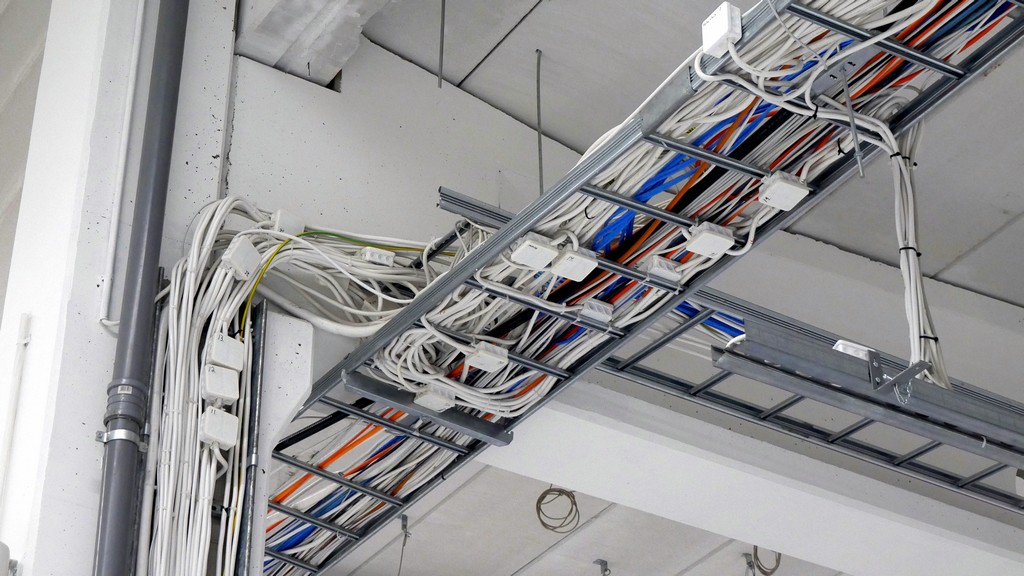
This standard applies to metallic, non-metallic, and composite piping systems, including threaded and non-threaded entries that terminate the system. This standard does not apply to enclosures and junction boxes covered by IEC 60670. Some piping systems may also be suitable for use in hazardous environments. Consideration must then be given to the additional requirements required for equipment installed in such environments. Grounding conductors may or may not be insulated.
In the latest update of this standard, changes were made to the length of the test specimen between the connecting parts for tensile testing and updates were made to the editorial and normative references.
Pipes and pipe fittings must be designed and manufactured to provide reliable performance in normal use and to provide protection to the user or the environment. When installed as part of a piping system in accordance with the manufacturer's instructions, pipes and pipe fittings must provide mechanical and, where necessary, electrical protection for the insulated conductors and cables contained within them.
The protective properties of the joint between the pipe and the fitting must not be less than those specified for the piping system. Pipes and fittings must be resistant to stresses that may occur during transportation, storage, recommended installation practices, and application. Compliance is verified by performing all specified tests.
In this standard, general test conditions are specified as follows:
- The tests performed according to this standard are type tests. Piping systems with the same classification, which may only differ in color, must be of the same product type.
- Unless otherwise stated, tests should be carried out at an ambient temperature of 20 degrees plus/minus 5 degrees.
- Unless otherwise specified, each test should be performed on three new samples of the same length. Some tests, such as checking dimensions, do not result in a change in the sample properties. Therefore, these samples are considered new samples and can be used for subsequent testing.
- Samples of nonmetallic and composite pipes and pipe fittings should be conditioned for at least 240 hours at a temperature of 23°C (plus or minus 2°C) and a relative humidity of 40 to 60 percent. All tests should be performed immediately following general conditioning.
- Unless otherwise specified, samples for each test must be clean and in new condition, with all parts in place and assembled as in normal use. After dimensioning in accordance with this standard, and unless otherwise specified in the relevant test, pipe fittings must be joined with sufficient lengths of pipe of the type for which they are intended. Particularly where joint strength is required, due regard must be paid to the manufacturer's instructions. Where similarities are claimed, the selection of representative fittings for testing purposes may be agreed upon between the manufacturer or responsible vendor and the test station.
- When pipe inlets are part of separable or loose type pipe fittings, the separable pipe fitting shall be capable of being reassembled after testing, in accordance with the manufacturer's instructions, without loss of the properties declared in accordance with this standard.
- Unless otherwise specified, three samples are tested and the requirements are met if all three tests are met. If only one sample fails a test due to an assembly or manufacturing error, that test and any previous tests that may have affected the test result must be repeated, and subsequent tests must be performed in the required order on another complete set of samples, all of which meet the requirements. If the additional set of samples is not submitted simultaneously, the failure of a sample will result in rejection. The applicant may submit an additional set of samples at the same time as the initial set of samples, which can be used in the event of a sample failure. The testing station will then test the additional set of samples without further request and will only reject them if another failure occurs.
- When toxic or hazardous processes are used, due consideration must be given to the safety of persons in the test area.
- Piping systems used as an integral part of other equipment must also be tested in accordance with the relevant standard for that equipment.
The classification coding format for the declared properties of the piping system is as follows according to mechanical properties:
- Resistance to compression (very light, light, medium, heavy, very heavy)
- Impact resistance (very light, light, medium, heavy, very heavy)
- Resistance to bending (tough, elastic, flexible/self-recovering), resilient)
- Tensile strength (very light, light, medium, heavy, very heavy)
- Sling load capacity (very light, light, medium, heavy, very heavy)
The classification coding format of the piping system according to temperature is as follows:
- Low temperature range (transport, installation and application - lowest temperature):
- 1: Plus 5 degrees
- 2: Minus 5 degrees
- 3: Minus 15 degrees
- 4: Minus 25 degrees
- 5: Minus 45 degrees
- High temperature range (application and installation - highest temperature:
- 1:60 degrees
- 2:90 degrees
- 3:105 degrees
- 4:120 degrees
- 5:150 degrees
- 6:250 degrees
- 7:400 degrees
The classification coding format according to the electrical properties of the piping system is as follows:
- Having electrical continuity properties
- Has electrical insulation properties
- Having electrical continuity and insulation properties
The classification coding format of the piping system according to its resistance to external effects is as follows:
- Protection against ingress of solid objects: At least IP3X protection according to IEC 60529 standard
- Protection against ingress of water: at least IPX0 protection according to IEC 60529 standard
- Resistance to corrosion (unprotected or with protection as detailed in the table)
The classification coding format of the piping system according to resistance to flame propagation is as follows:
- Flame retardant
- The flame spread
Our organization, which has been supporting businesses across all sectors for years through a wide range of testing, measurement, analysis, and evaluation activities, has a strong team of employees who closely follow global developments in science and technology and are constantly improving themselves. In this context, we also provide testing services in accordance with the EN IEC 61386-1 Conduit systems for cable management - Part 1: General requirements standard.



