

The “EN IEC 62262 Degrees of protection of enclosures for electrical equipment against external mechanical impacts (IK code)” standard, developed by the International Electrotechnical Commission (IEC) and later published as a European standard as part of harmonization efforts, focuses on classifying the degrees of protection provided by enclosures against external mechanical impacts when the nominal voltage of the protected equipment does not exceed 72,5 kV. This standard is only applicable to equipment enclosures for which a specific standard defines the degree of protection of the enclosure against mechanical impacts.
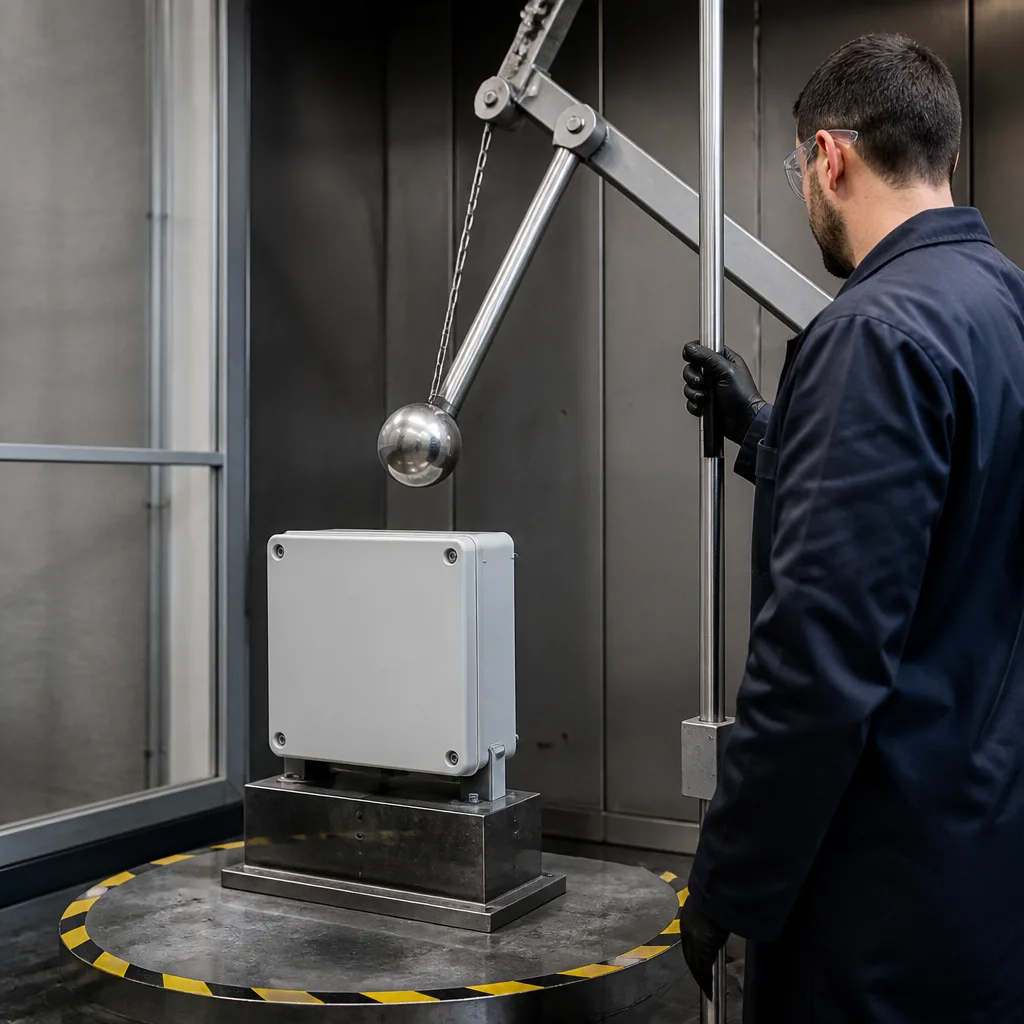
The purpose of this standard is to:
It is the responsibility of the relevant technical committees to decide to what extent and how the classification will be used in their own standards and how the enclosure will be applied to their own equipment. However, it is recommended that the tests for a particular classification do not differ from those specified in this standard. If necessary, supplementary requirements can be added to the relevant product standard.
For a specific type of equipment, the product committee may specify different requirements, provided that at least the same level of safety is ensured.
This standard relates only to enclosures that, as specified in the relevant product standard, are in all other respects suitable for their intended use and that, in terms of materials and workmanship, ensure the maintenance of the claimed degrees of protection under normal conditions of use.
The EN IEC 62262 standard is an international benchmark used to measure how well electrical enclosures, such as lighting fixtures, control panels, or security cameras, can withstand external mechanical impacts. While IP ratings (ingress protection) indicate resistance to dust and water, the IK rating defined by this standard indicates how much physical impact the device can withstand before breaking.
The “IK” in the rating stands for impact protection. This is followed by two digits from 00 to 10, measuring the impact energy in Joules (J).
The HR rating reference table is as follows:
For example, IK10 means the enclosure can withstand a 20 J impact. This is roughly equivalent to a 5 kg mass dropped from a height of 40 cm.
Standardized tests ensure that the “IK10” rating means the same thing regardless of the country where the product is manufactured.
According to the EN IEC 62262 standard, the following conditions must be met:
Choosing the right HR degree is about striking a balance between cost and security:
While the EN IEC 62262 standard defines the classification (IK codes), the EN 60068-2-75 standard details the actual test procedures and technical specifications for hammers. Engineers often refer to both standards simultaneously when setting up laboratory testing.
In short, the EN IEC 62262 standard is an international standard that classifies the degree of protection provided by enclosures against external mechanical impacts. It defines how durable an appliance's outer casing is when subjected to physical shocks such as impacts, drops, or vandalism.
The main objectives of this standard are:
This is especially important in the environments to which the equipment is exposed:
EN IEC 62262 is widely applied in industries such as the following:
For example, outdoor lighting in dense urban areas typically requires IK08 to IK10 ratings for resistance to vandalism and accidental impacts.
The EN IEC 62262 standard is considered important for the following reasons:
In conclusion, the EN IEC 62262 standard plays a crucial role in modern engineering by standardizing how mechanical impact resistance is measured and transmitted.
For many years, our organization, with its competent and experienced staff, has been understanding the needs of its clients, providing the advanced testing services they require, and assisting them in the establishment, implementation, and improvement of management systems. Within this framework, we also provide testing services compliant with the EN IEC 62262 standard.
To get an appointment, to get more detailed information or to request an evaluation, you can ask us to fill in our form and reach you.

