
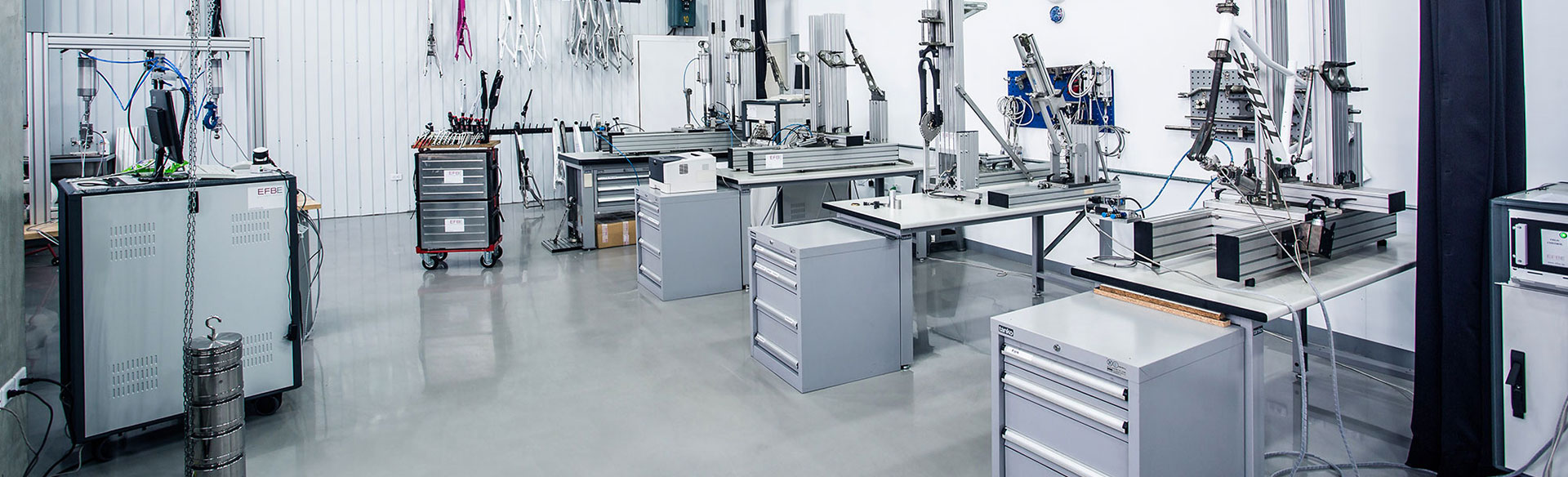
A very important aspect for the passive safety of two-wheeled vehicles in traffic is good recognizability at dawn or at night. To ensure this, it is necessary to ensure that the reflectors work and will operate smoothly. To ensure your security EUROLAB offers reflector testing services on bicycle tires.
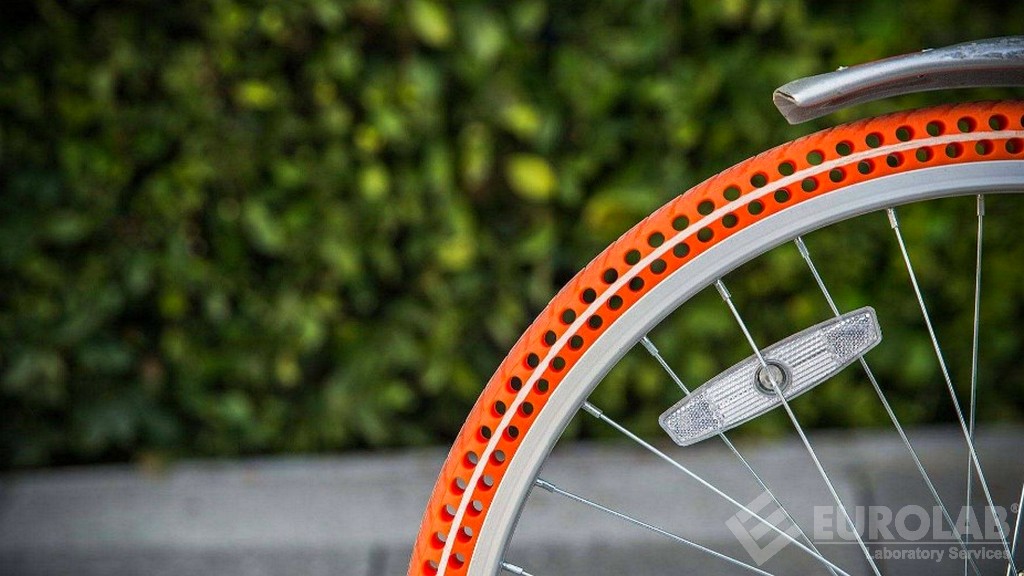
EUROLAB offers the relevant tests in its accredited laboratories. These cover various areas, from the labeling of the tire to the general specifications to the resistance of the reflective strip to external influences and, above all, its reflective capacity.
Generally, tests are carried out as follows: After labeling according to regulations - including the manufacturer's name, recommended fill pressure, and area for the test mark - engineers check general properties such as heat resistance or maintenance options. The reflective material should be permanently attached to the tire as a continuous circular ring. Impact resistance and resistance to external influences such as resistance to oils, fuels and water are applied.
Tires are conditioned in climatic chambers where they are exposed to temperatures up to 65 ° C and -20 ° C. Impact tests with standard test bodies and defined forces are also part of the test program. To determine the reflective capacity significantly reliably under very critical conditions, test engineers use instruments containing a goniometer, where the rotated wheel can be tested at various angles from both sides. In the process, the relationship between the lowest and the highest values is determined as well as the location of the reflective strip on the tire wall. If the strip is too close to the edge edge, ie too far from the horizontal axis, it no longer produces the projected reflection image at an inclined position.
EUROLAB, with its highly expert team and internationally accredited laboratories, Reflector Tests on Bicycle Tires It performs all test, analysis, measurement, evaluation and report generation services completely and reliably.
To get an appointment, to get more detailed information or to request an evaluation, you can ask us to fill in our form and reach you.

