

The EN 12899 Fixed, vertical road traffic signs standard, a European standard, is designed for use by road authorities. It can also be used by private developers who wish to use signs similar to those used on public roads on their own land.
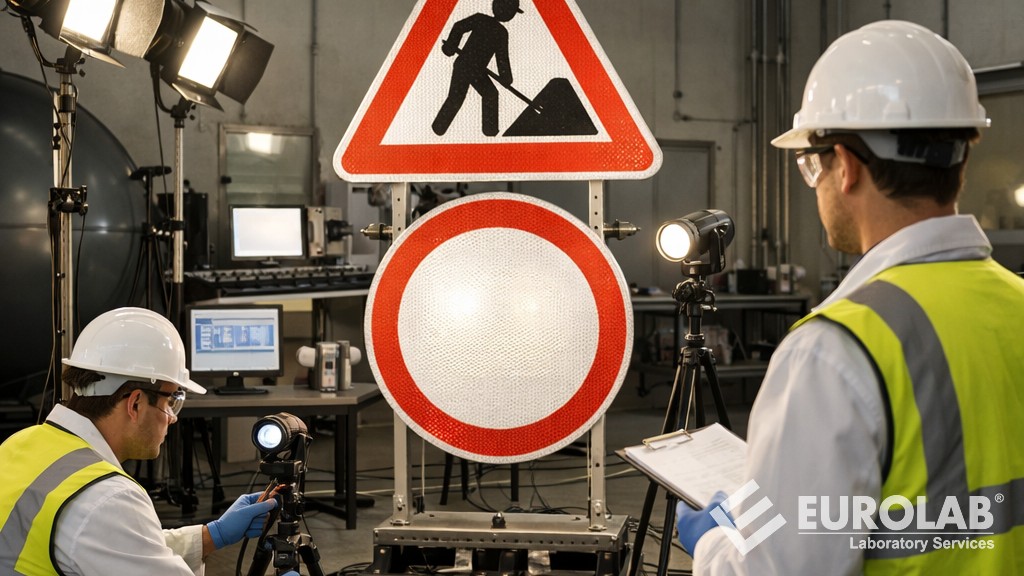
This standard can be used in the application of type approval and certification tests. It covers performance requirements and test methods. It defines performance limits and a range of performance classes. It includes color measurement and retroreflective properties, as well as brightness and illumination.
The EN 12899 standard consists of the following sub-sections published under the same title:
Topics not covered under this standard:
This standard ensures the consistency, safety, and visibility of traffic signs on public and private roads. In line with EU construction products regulation (CPR) 305/2011, it promotes the free movement of these products within the European Union. Manufacturers are required to apply the CE mark to appropriate fixed vertical signs. This mark confirms that they meet essential health, safety, and performance criteria. This mandatory marking enables legal marketing and use throughout the EU.
This standard focuses on durability, visibility (especially at night), and structural integrity to withstand environmental conditions and potential impacts.
The EN 12899-1 standard applies to:
This standard includes the following:
This standard does not cover signage scaffolding, cantilever structures, variable message signage, and certain specialized applications such as underground mining. This standard defines performance classes and limits in various critical areas:
The color measurement, retroreflective properties, and brightness of illuminated parts are specified taking into account CIE recommendations. Structural requirements for TTBs include performance under static and dynamic loading. Safety of use, including vehicle impact, is ensured. Devices with similar functionality but without illumination or with a height of less than 600 mm are excluded.
The foundations are not specified in this standard, but they must be sufficient to support the loads to be carried. Unless otherwise stated, the provisions in this standard apply to both type 1 and type 2 TTBs.
Lighted traffic barriers (TTBs), commonly known as illuminated “left-side” or island barriers, direct traffic around hazards such as roundabouts, islands or center lanes, especially in low visibility conditions. This standard ensures their reliability, visibility and safety across Europe. Like Part 1, it complies with the Construction Products Regulation (CPR) No. 305/2011 (EU), which requires CE marking for products placed on the market since 1 January 2013. CE marking facilitates free trade within the EU by confirming compliance with essential safety, durability and performance criteria.
The EN 12899-2 standard applies to new illuminated traffic barriers (TTBs) with a minimum height of 600 mm, including fasteners. Two types of definitions are provided:
This standard covers barriers used in traffic areas but excludes the following:
Road markers and reflectors help guide drivers by marking road edges, curves, lanes or hazards, and improve visibility, especially at night, through reflection (the reflection of light back to the source). This standard ensures their effectiveness, durability and safety throughout Europe. As a compliant standard under the EU Construction Products Regulation (CPR) 305/2011, compliant products must bear the CE mark, which promotes uniform quality and road safety.
This standard applies to:
This standard covers both freestanding retroreflectors and combined systems. It does not specify requirements for the colours, dimensions or tolerances of poles and retroreflectors, which are generally determined by national regulations. Exceptions include temporary or portable devices and some special applications.
Factory production control is crucial to ensure that every product leaving the manufacturing facility consistently meets the performance requirements specified in other parts of the EN 12899 series. This standard supports the EU construction products regulation (CPR) 305/2011, for which factory production control forms a critical part of the certificate of conformity. For products within this series, manufacturers must have a certified factory production control system in order to apply the CE mark, demonstrate conformity, and allow free circulation in the EU market. Independent notified bodies audit and certify the factory production control process, thus ensuring consistent quality and traceability.
This standard applies to the production of all products included in the EN 12899 series. It specifies the procedures that manufacturers must follow during production, but does not cover the initial type test (EN 12899-5 standard).
Initial type testing is a critical one-off verification process carried out on representative samples before series production begins. It verifies that a product's design meets all specified performance criteria for visual characteristics, structural integrity, and durability. This standard supports the EU construction products regulation (CPR) 305/2011, providing objective evidence of compliance. For mandatory CE marking, a successful initial type test, usually conducted or witnessed by an authorized body, is required in conjunction with factory production control (EN 12899-4 standard). This process contributes to consistent road safety across Europe by guaranteeing the reliable operation of road signs, barriers, and dividers.
This standard applies to initial type testing for the following products:
This standard defines what initial type testing (ITT) means, specifies sampling requirements, and details the necessary tests for each product type. Tests are generally performed in accredited laboratories and refer to methods from CIE publications, ISO standards, and other EN documents.
For many years, our organization, with its competent and experienced staff, has been understanding the needs of its clients, providing the advanced testing services they require, and assisting in the establishment, implementation, and improvement of management systems. Within this framework, we also provide testing services in accordance with the "EN 12899 Fixed, vertical road traffic signs" standard.
To get an appointment, to get more detailed information or to request an evaluation, you can ask us to fill in our form and reach you.

