

TT-B-1325D Federal Specification: Retro-Reflective Beads (Glass Spheres)
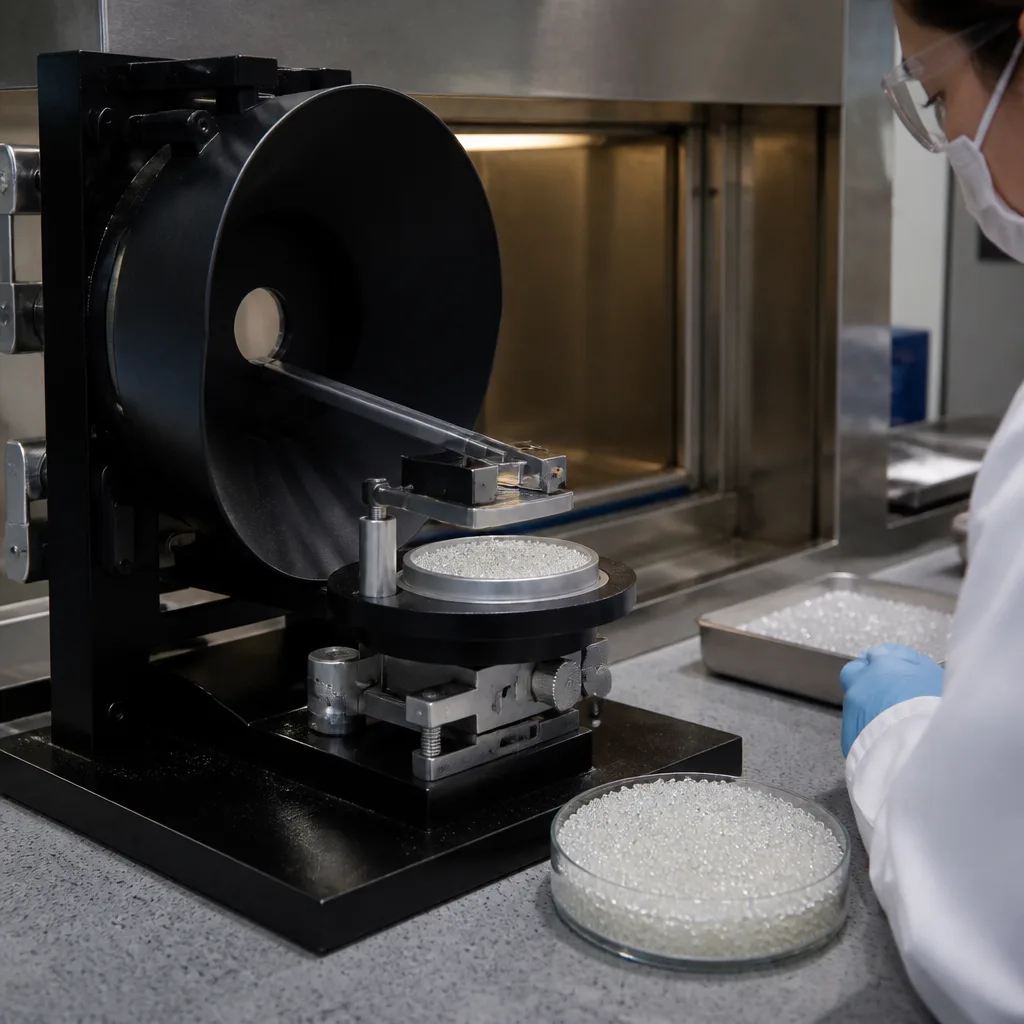
Developed by the U.S. General Services Administration for use by all federal agencies, the “TT-B-1325D Federal Specification: Retro-reflective Beads (Glass Spheres)” covers three types of retro-reflective beads used to reflect traffic and airport marking paints.
Reflective road markings are vital for road safety, airport runway guidance, and navigation in low-visibility conditions. TT-B-1325D sets uniform requirements for the manufacture, composition, physical properties, classification, and testing of the glass spheres used in these markings.
This standard applies to:
The primary goal is to ensure that the beads provide the following:
According to the specifications, the beads must be transparent, clean, dry, fluid, and largely free of bubbles or contaminants.
The TT-B-1325D standard defines various bead categories based on refractive index, manufacturing process, and intended application:
Type I application areas include:
Refractive index requirement: between 1,50 and 1,55.
According to this standard, the roundness must be at least 80 percent.
Their refractive indices are significantly higher: between 1,90 and 1,93.
These types of beads have the following characteristics:
The FAA study cited the use of Type III beads in runway markings due to their improved reflective performance.
Typical uses include:
According to this standard, the roundness must be at least 85 percent.
Type IV beads are designed primarily for large, coarse drip applications requiring improved retro-reflective performance.
In short, the TT-B-1325D federal specification is a United States government standard covering retro-reflective glass beads used in traffic and airport road markings. These beads are embedded or sprinkled into road marking paints to improve nighttime visibility by reflecting vehicle headlights toward drivers and pilots.
The basic technical requirements have been defined as follows:
The specifications refer to the following:
Real spheres are essential for effective reflection.
Field validation masses are also specified:
Larger beads generally provide longer-range visibility, while finer beads are suitable for pre-mixed systems.
The beads should not become cloudy, dull, or deteriorate under test conditions. This ensures long-term performance in challenging outdoor environments, including winter road maintenance conditions.
The TT-B-1325D standard defines the following laboratory procedures:
Refractive index measurement is performed using the immersion method under a microscope. Sampling and inspection protocols are also included to maintain production consistency.
Reflective beads play a crucial role in reducing nighttime accidents by improving the visibility of lane markings and runway guidance systems. Their main benefits include:
The FAA refers to the TT-B-1325D standard in its assessments of airport marking visibility and runway safety systems.
This standard is often used in conjunction with the following standards:
Many manufacturers produce beads that meet multiple international standards simultaneously.
Consequently, the TT-B-1325D standard remains a significant federal specification for retroreflective glass beads used in transportation infrastructure. By defining stringent requirements for bead composition, refractive index, roundness, particle size, and durability, it ensures consistent reflective performance for standard highways and airports.
The importance of this standard lies in the following:
Although newer regional and international standards are being developed today, the TT-B-1325D standard continues to serve as a reference specification for retro-reflective pavement marking materials in many engineering and transportation applications.
For many years, our organization, with its competent and experienced staff, has been understanding the needs of its clients, providing the advanced testing services they require, and assisting them in the establishment, implementation, and improvement of management systems. Within this framework, we also provide testing services compliant with the TT-B-1325D standard to businesses.
To get an appointment, to get more detailed information or to request an evaluation, you can ask us to fill in our form and reach you.

