
ASTM E424 Standard Test Methods for Solar Transmittance and Reflection (Terrestrial) of Sheet Materials

ASTM E424 Standard Test Methods for Solar Transmittance and Reflection (Terrestrial) of Sheet Materials

The standard "ASTM E424 Standard Test Methods for Solar Energy Transmittance and Reflectance (Terrestrial) of Sheet Materials" developed by the American Society for Testing and Materials (ASTM) describes test methods that include the measurement of solar energy transmittance and reflectance (Terrestrial) of sheet materials.
ASTM E424 Standard Test Methods for Solar Transmittance and Reflection (Terrestrial) of Sheet Materials

The ASTM E424 test procedure includes two test techniques for measuring solar energy transmittance and reflectance in sheet materials. Both test techniques produce essentially the same results for the materials investigated by the drafting task force:

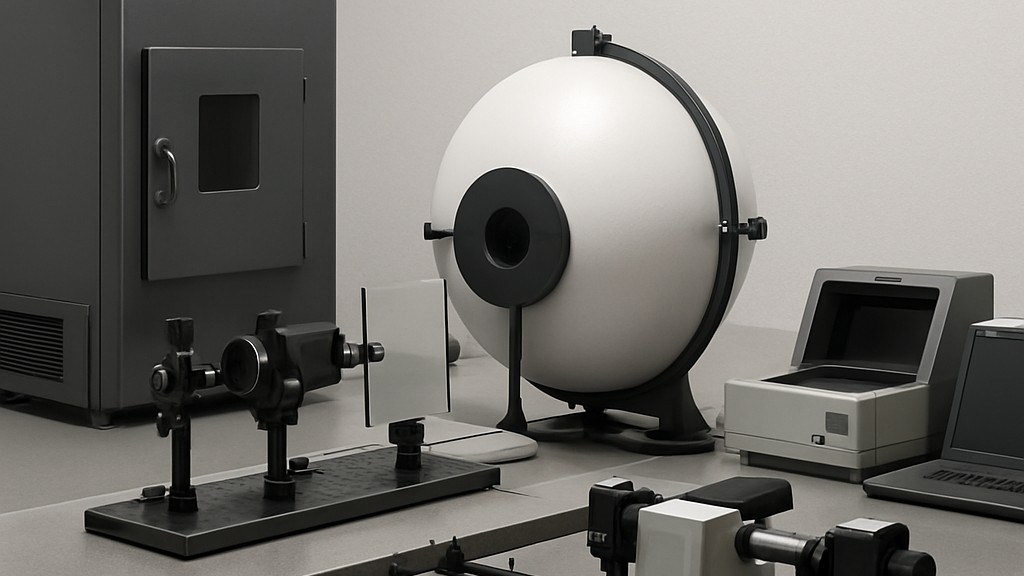
  • Method A: Spectral transmittance or reflectance measurements against a magnesium oxide standard are made using an integrating sphere spectrophotometer in the spectral range of 350 to 2500 nm. The illumination and imaging mode should be either normal-diffused or diffuse-normal. The transmitted or reflected solar energy is obtained by integrating over a standard solar energy distribution curve using weighted or selected ordinates for the appropriate solar energy distribution. The distribution at sea level, with an air mass of 2, is used. Method A, using a spectrophotometer, is valid for both transmittance and reflectance and is the referee method.
  • Method B: The sun is used as the source and a pyranometer as the detector, and the sample is placed on the lid of an enclosure with its plane perpendicular to the incident radiation. Transmittance is measured as the ratio of transmitted energy to incident energy. Instruments using this method have been used to measure solar energy reflectance, but there is currently insufficient experience with this technique to standardize it.

For Method A, the size of the samples is limited by the geometry of the spectrophotometer, while for Method B, 0,61 m2 of sample is required. For the materials examined by the drawing task group, both test methods yield essentially equivalent results.

Solar transmittance and reflectance are important factors in heat transmission through windows, mostly through glass or plastics. These methods provide a way to measure these factors under constant incident and viewing conditions. While these data can assist designers in selecting and specifying glazing materials, solar transmittance and reflectance alone are insufficient to define heat transfer rates without information on other important factors. These methods have been found to be practical for both transparent and translucent materials, as well as for materials whose transmittance is reduced by highly reflective coatings. Method B is particularly suitable for measuring the transmittance of non-homogeneous, patterned, or corrugated materials, because the transmittance is averaged over a large area.

For the purposes of this standard, the following terms and definitions apply:

  • Solar absorptance: It is the ratio of absorbed radiant energy to incident radiant energy (equal to the value obtained by subtracting the reflectance and transmittance to unity).
  • Solar admittance: Solar heat transfer that takes into account re-radiated and transported energy.
  • Solar energy: For these methods, it is the direct radiation intensity from the sun at sea level across the solar spectrum. It is expressed in watts per unit area.
  • Solar reflectance: The percentage of solar radiation reflected by a material (watts/unit area).
  • Solar spectrum: For the purposes of these methods, this is the solar spectrum extending from 350 to 2500 nm at sea level.
  • Solar transmittance: The percentage of solar radiation transmitted by a material (watts/unit area).

In short, ASTM E424 is particularly valuable in fields such as architecture, materials science, and energy efficiency design, where understanding how materials interact with solar radiation is crucial. The primary goal of this standard is to provide a consistent and repeatable method for measuring:

  • Solar transmittance: The fraction of solar radiation that passes through a material.
  • Solar reflectance: The fraction of solar radiation reflected from the surface of a material.

These measurements are made using an integrating sphere spectrophotometer, which ensures accuracy by capturing scattered light – something that traditional measurement tools might miss.

This standard is designed for terrestrial applications, meaning it applies to conditions experienced on the Earth's surface, not in space.

The main features of this standard are:

  • Use of an integrating sphere: The integrating sphere is at the heart of the test. It provides a comprehensive measurement of a material's optical properties by accurately collecting both specular and scattered radiation.
  • Wavelength range: The method focuses on the solar spectrum, typically in the range of approximately 300 to 2500 nanometers (nm), encompassing ultraviolet (UV), visible (VIS), and near-infrared (NIR) radiation. This is consistent with the ASTM G173 standard reference solar spectrum, which models solar radiation reaching the Earth.
  • Material types: The ASTM E424 standard is applicable to a wide variety of transparent, translucent, or opaque sheet materials, such as:
    • Architectural glass
    • Polycarbonate sheets
    • Sun control films
    • Coated surfaces used in building or automotive applications

ASTM E424 standard test results are critical to many industries:

  • Construction and structure: Selection of materials that allow daylight to pass through while reducing solar heat gain.
  • Automotive: Evaluation of window films and coatings to improve thermal comfort and energy efficiency.
  • Solar energy: Material design for solar collectors or photovoltaic systems.
  • Green building certification: Supporting compliance with standards such as LEED by documenting energy-efficient material choices.

The advantages of complying with the ASTM E424 standard include:

  • It provides precision and reliability thanks to standardized methodology.
  • Improved material performance insights help developers select or design better products.
  • Regulatory and certification support provides test data compliant with international building and energy codes.

On the other hand, although it is a comprehensive standard, this standard also has some limitations:

  • It does not take into account long-term degradation of materials or exposure to weathering.
  • It is designed primarily for flat sheet materials, not for complex geometries or multi-layer assemblies.
  • Proper use requires specialized equipment and trained personnel.

As a result, ASTM E424 is a vital standard for evaluating how sheet materials interact with solar radiation and making informed decisions about energy performance and environmental impact. Its use in materials testing supports innovations in sustainable architecture, automotive design, and renewable energy technologies. For designers, understanding and implementing this standard not only ensures that products perform as expected under sunlight but also contributes to a more energy-efficient and sustainable future.

Our organization, which has been supporting businesses across all sectors for years through a wide range of testing, measurement, analysis, and evaluation activities, boasts a strong team of employees who closely follow global developments in science and technology and are constantly improving themselves. In this context, we also provide testing services in accordance with ASTM E424 Standard Test Methods for Solar Energy Transmittance and Reflectance (Terrestrial) of Sheet Materials.

WhatsApp

