

The standard “DIN 12554 Glass laboratory equipment - Three-way conical valves with T-port”, published by the German Institute for Standardization (DIN), applies to interchangeable three-way conical glass valves with T-port. They have nominal sizes of 3, 4, and 62 and can be used with solid or hollow plugs and bent pipe fittings.
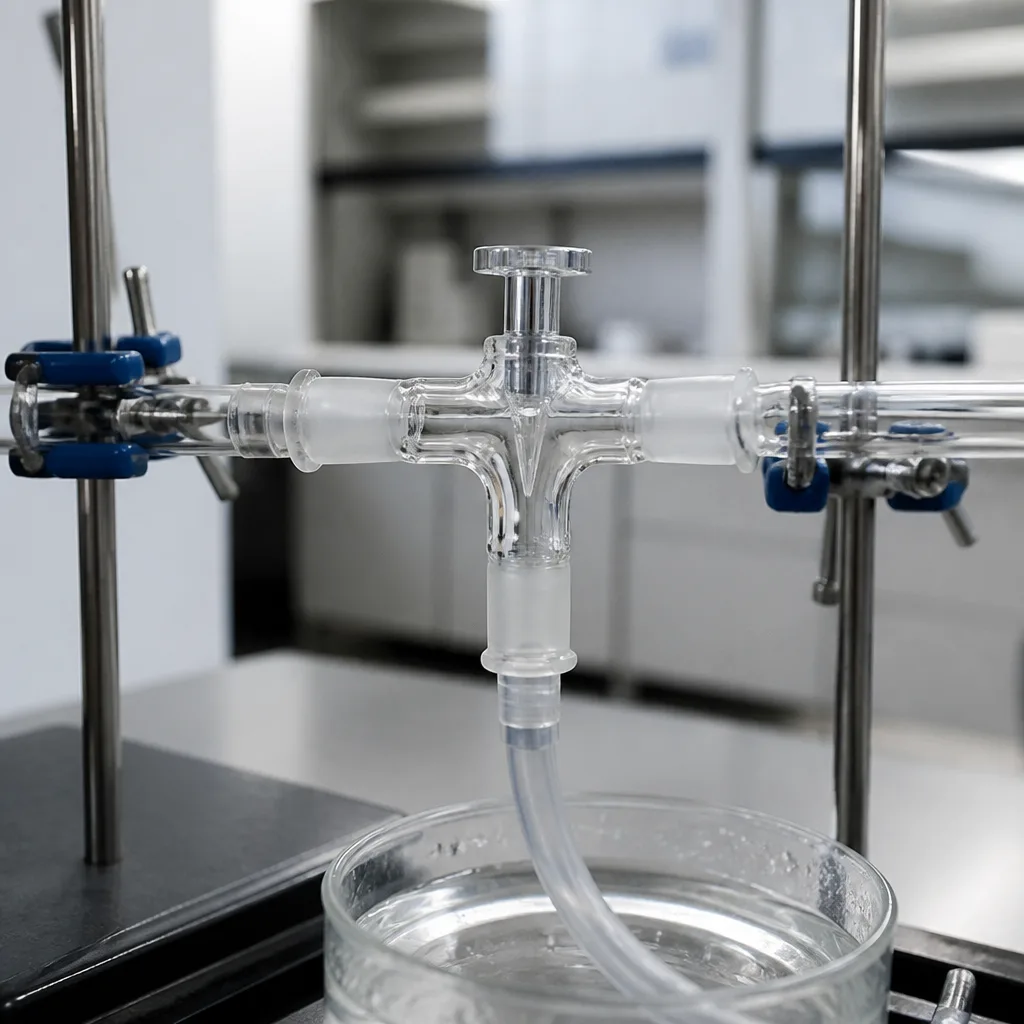
DIN 2554 valves are commonly used in the following areas:
These devices allow technicians to redirect gases or liquids through different routes without disassembling the equipment.
T-port conical valves are a type of three-way valve commonly used in laboratory glassware and liquid handling systems. These valves feature a rotating plug with a T-shaped internal passage that allows the operator to control the direction of liquid or gas flow between three ports.
T-port conical valves consist of the following:
The T-shaped gateway can connect different combinations of three ports depending on the plug position. For example,
T-shaped valves are commonly used in the following areas:
The advantages offered by this type of valve are as follows:
In laboratory systems, particularly in vacuum and gas handling equipment, operators often need to switch flow between multiple lines without separating tubing or glassware. A T-shaped valve provides a simple and reliable way to control these paths while maintaining system integrity and minimizing contamination or leakage. Therefore, DIN 12554 and similar standards specify the dimensions and performance requirements for T-shaped valves, ensuring compatibility, safety, and interchangeability among laboratory equipment manufacturers.
In short, the precision and reliability of modern laboratory equipment largely depend on rigorous standardization. The DIN 12554 standard is one of these fundamental standards in the field of scientific glassware. This standard defines the dimensional and functional requirements for three-way glass taps with a T-shaped configuration.
In laboratory chemistry, a valve is a type of valve used to control the flow of liquids or gases through glass tubes. While a standard straight-bore valve only opens or closes a single path, a three-way T-shaped valve acts as a central point for directing liquids. The plug (or switch) inside the valve body contains a T-shaped channel arrangement. By rotating this plug, liquids can be directed in various configurations. Essentially, the function of T-shaped valves is as follows:
The DIN 12554 standard provides a clear framework that ensures components from different glass manufacturers can be seamlessly assembled without liquid leakage or mechanical stress:
To ensure safety under positive pressure or vacuum conditions, this standard includes specifications for a thread retention device (typically using polypropylene caps and washers) to prevent plug slippage during operation.
This latest revision of the standard ensures that modern automated and manual liquid handling systems maintain strict geometric tolerances, solidifying its position as a fundamental pillar of chemical equipment design.
For many years, our organization, with its competent and experienced staff, has been understanding the needs of its clients, providing the advanced testing services they require, and assisting them in the establishment, implementation, and improvement of management systems. Within this framework, we also provide testing services in accordance with the EN 12554 standard.
To get an appointment, to get more detailed information or to request an evaluation, you can ask us to fill in our form and reach you.

