
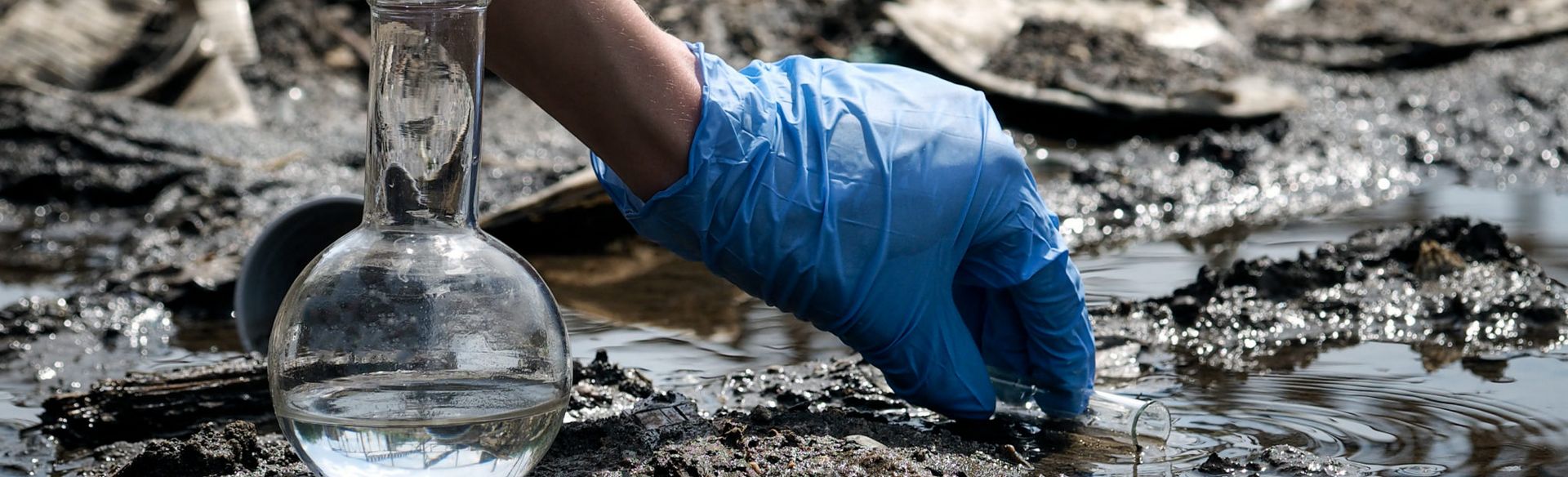
The European standard "EN 14582 Characterization of wastes - Halogen and sulfur content - Oxygen combustion in closed systems and methods for their determination" describes a combustion method for determining halogen and sulfur contents in materials by combustion in a closed system containing oxygen (calorimetric bomb) followed by analysis of the combustion product using various analytical techniques. This method is applicable to solid, pasty, and liquid samples containing more than 0,025 g/kg of halogen or 0,025 g/kg of sulfur. The detection limit depends on the element, matrix, and determination technique used. Insoluble halides and sulfate present in the sample or produced during the combustion step are not completely determined by these methods.

For the purposes of this standard, the following terms and definitions apply:
In principle, the sample is oxidized by combustion in a closed system (a bomb containing oxygen under pressure). Halogenated and sulfur-containing compounds are converted to fluoride, chloride, bromide, iodide, and sulfate, which are absorbed or dissolved in an absorption solution. Various methods can be used to determine halide and sulfate concentrations in the absorption solution. In general, this method is applicable for concentrations above 0,025 g/kg, depending on the element, matrix, and determination technique. It can be used for aqueous samples or samples that burn with difficulty, including the use of a combustion enhancer.
The table provided in the standard provides examples of control substances that provide complete (90 to 110 percent) recovery of halogens and sulfur. To create a suitable control mixture, control substances are selected so that all elements to be determined are represented in the samples. The halogen and sulfur contents should be in the same range as the elemental contents of the samples and approximately in the middle of the working range of the determination techniques. If necessary, dilute with cellulose or aluminum oxide to achieve a suitable elemental content. The mixture of control substances and cellulose or aluminum oxide should be homogenized, for example, using a gravel mill.
Co-combustion of iodine and sulfur may interact to enhance the reduction of iodine to iodide and the oxidation of sulfur to sulfate. A combined control mixture may provide false assurance of method capacity if actual samples contain only one element.
Biologically active laboratory samples should be stored at 4°C, and halogen and sulphur analyses should be performed within seven days of collection. If this is not possible, samples should be stored further, for example frozen, if possible, to minimise biodegradation and loss of volatile halogenated and sulphurous compounds.
The test sample is prepared in accordance with EN 15002. For solid materials, the particle size should be less than 200 µm. The use of halogenated polymers, such as PVC gloves, should be avoided during sample preparation.
Drying of a laboratory sample may be performed for homogenization purposes if, depending on the accuracy of the method, the sample contains negligible amounts of halogen and sulfur compounds that are volatile at the intended drying temperature. The dry matter is determined according to EN 14346 on a separate subsample (the result is used for calculation).
Heterogeneous moist or paste-like samples can be mixed with aluminum oxide until granular material is obtained and then reduced to a granular powder, preferably with a particle size of less than 200 pm.
Equipment used in the tests includes:
The bomb must be free of any organic residue (vapors of organic solvents, grease, etc.). The manufacturer's instructions must be observed, particularly the oxygen pressure inside the bomb and the maximum allowable calorific value of the test section.
The halogen and sulfur content of waste is important because these elements can have significant environmental, health, and operational impacts when waste is processed, particularly when incinerated, landfilled, or used for materials recovery. Monitoring and managing these contents is therefore considered critical.
For example, when waste containing halogens (chlorine, fluorine) or sulfur is incinerated, it can form acid gases such as hydrogen chloride and hydrogen fluoride, which are corrosive and toxic. Sulfur forms sulfur dioxide, a gas that contributes to acid rain, respiratory problems, and smog. If both halogens and hydrocarbons are present, there is a risk of forming dioxins and furans, which are highly toxic persistent organic pollutants (POPs). In landfills, sulfur can be converted by bacteria into hydrogen sulfide, a toxic and flammable gas. Halogenated compounds tend to persist in the environment and bioaccumulate, causing long-term ecological damage.
Our organization, which has been supporting businesses across all sectors for years through a wide range of testing, measurement, analysis, and evaluation activities, boasts a strong team of employees who closely follow global developments in science and technology and are constantly improving themselves. In this context, we also provide testing services in accordance with the standard "EN 14582 Characterization of waste - Halogen and sulfur content - Oxygen combustion in closed systems and determination methods."
To get an appointment, to get more detailed information or to request an evaluation, you can ask us to fill in our form and reach you.

