
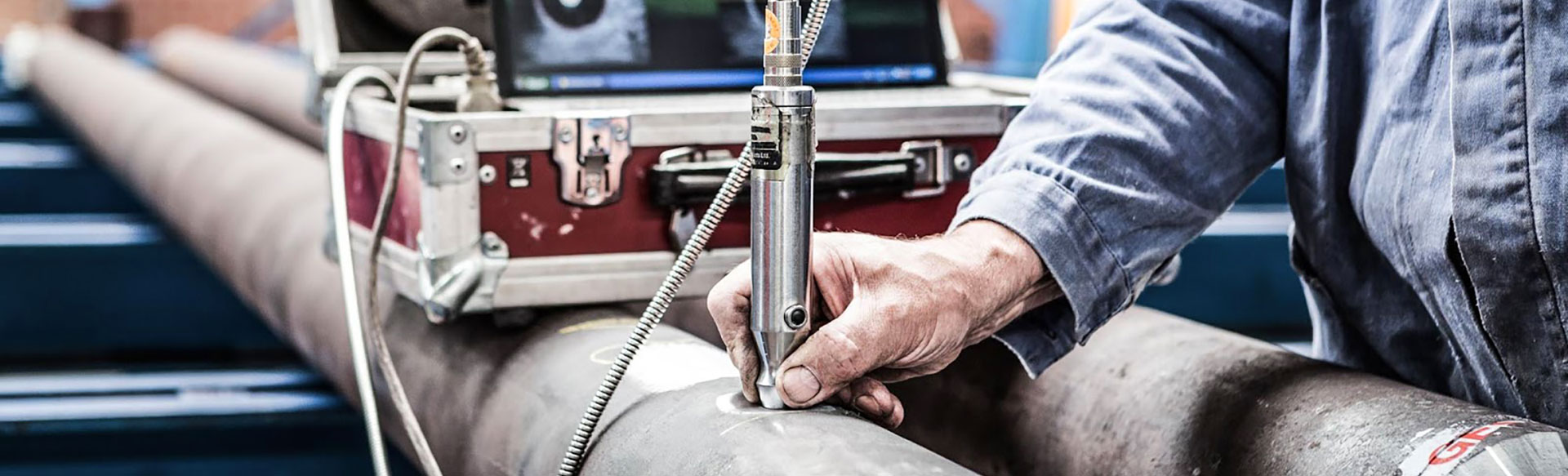
Mechanized liquid or dye penetrant testing (PT) is a non-destructive material testing method where the capillary forces of surface cracks or pores are visible.

EUROLABhas developed an innovative manipulator that can examine areas that are not possible to examine with ultrasonic testing due to high levels of attenuation, geometry or accessibility.
Common audited objects are:
Such objects may be susceptible to IGSCC (Intergranular Stress Crack Corrosion) and/or thermal fatigue, making them priority for inspection. The materials in the T-joints and valve body are generally austenitic castings, which are impossible to inspect with ultrasonic due to high attenuation. Because, EUROLAB developed this new innovative solution for its customers.
Benefits you get from the Liquid Penetrant Test of the materials
About Liquid Penetrant Test of Materials
Liquid or dye penetrant testing (PT) is based on penetration of liquid penetrant into open surface discontinuities. Penetrant test is not applied to highly porous materials. The dye penetrant method is used to identify surface defects, including surface cracks, pores, lack of fusion, and intergranular corrosion. Common materials for T-joints and valve stems are SS2333 or SA403, these materials can be subjected to thermal stress (eg a leaking valve). The octopus system can reach these areas in pipe diameters of DN 100 - DN 450. The following systems in the nuclear power plant are affected by this type of erosion.
The octopus system has already been used successfully in two Boiling Water Reactors (BWR). The octopus is equipped with several levers to adjust itself inside the tube, the system has several cameras next to the PT nozzle for better orientation. The system can also be steered in a modular way that enables the scanner to reach even the most difficult geometries. After pre-cleaning, the penetrant is applied to the surface area of the test piece. This penetrates fine cracks or pores through capillary action. After carefully removing the rest of the test media from the surface, a developer is applied to remove the dye penetrant from the pores and cracks and can then be evaluated.
Dye penetrant testing is usually done with red dye penetrant, which can be done in daylight. The fluorescent dye penetrant test uses a fluorescent test substance that can be more easily evaluated in the dark or under UV light. The octopus inspection system is suitable for internal surface refraction defects with dimensions: 3,5 mm x 0,5 mm x 4 µm (Length x Depth x Width).
EUROLAB's penetrant testing experts are ISO 9712, ENIQ certified and we meet the following testing standards: ISO 3452-1:2013, PNAE G-7-018-89, GOST 18442-80.
EUROLAB, with its highly expert team and internationally accredited laboratories, Liquid Penetrant Test of Materials It performs all test, analysis, measurement, evaluation and report generation services completely and reliably.
To get an appointment, to get more detailed information or to request an evaluation, you can ask us to fill in our form and reach you.

