
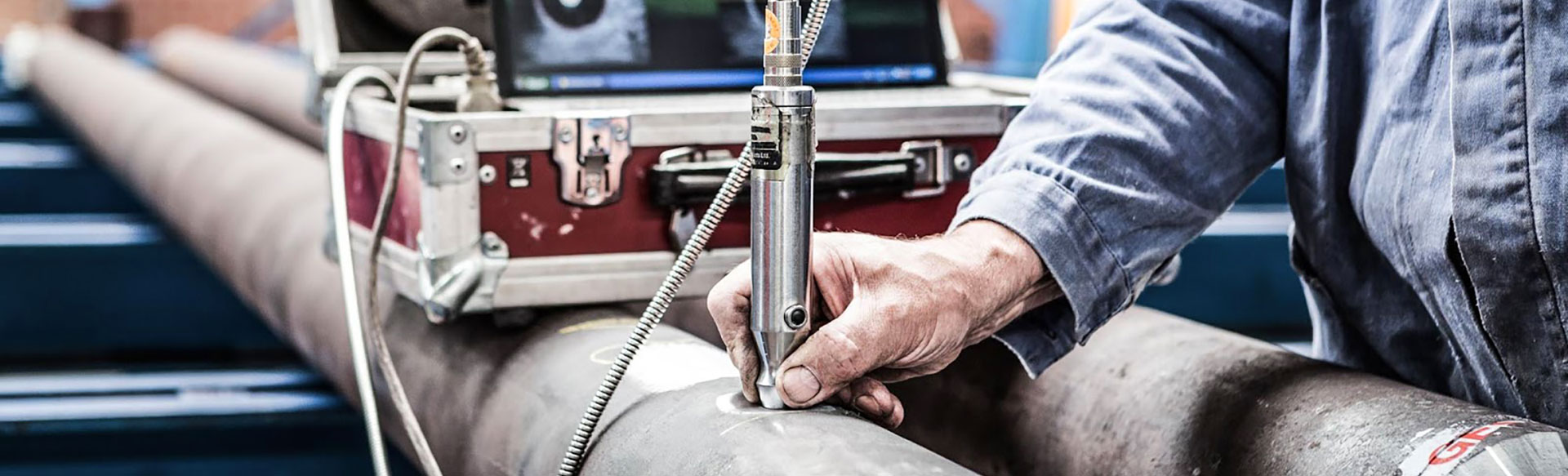
Liquid or dye penetrant testing (PT) is a non-destructive material testing method that uses capillary forces to locate surface cracks or pores and make them visible. It can detect surface breaker defects such as cracks, laps, porosity.
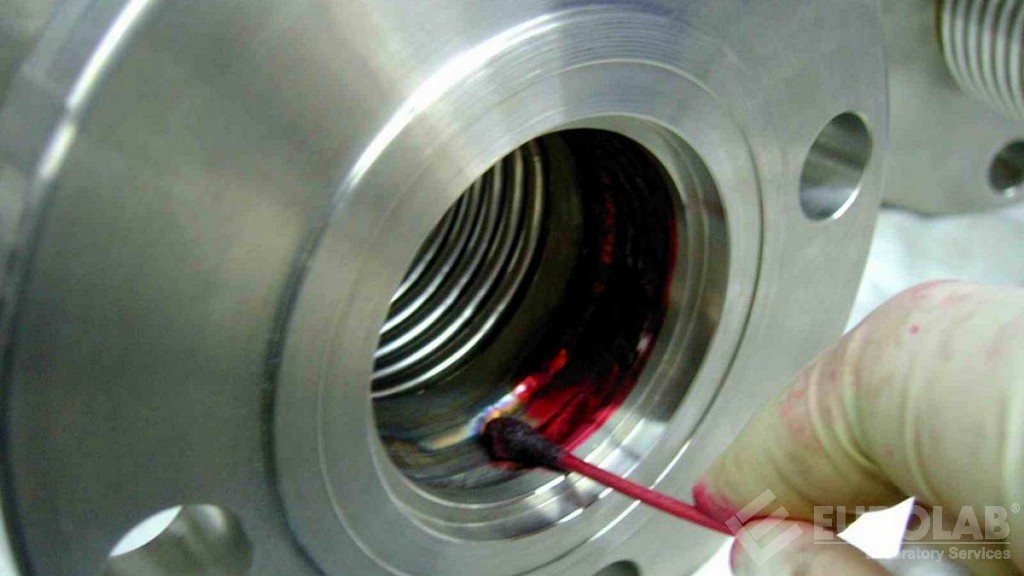
Benefits of Liquid Penetrant Testing of Materials
About Liquid Penetrant Test
Liquid or dye penetrant testing (PT) is based on penetration of liquid penetrant into open surface discontinuities. Penetrant test does not apply to highly porous materials. The dye penetrant method is used to identify surface defects, including surface cracks, pores, lack of fusion, and intergranular corrosion. Dye penetrant testing is done on welds and base material
A distinction should be made between dye penetrant testing and fluorescent penetrant testing, and only the area of a test piece near the surface is examined. After pre-cleaning, the penetrant is applied to the surface area of the test piece. This penetrates fine cracks or pores through capillary action. After carefully removing the rest of the test media from the surface, a developer is applied to remove the dye penetrant from the pores and cracks, and indications are created that can be evaluated later.
Dye penetrant testing is usually done with red dye penetrant, which can be done in daylight. The fluorescent dye penetrant test uses a fluorescent test substance that can be more easily evaluated in the dark or under UV light.
The liquid penetrant test can be applied to metallic or non-metallic non-porous clean materials, but is not suitable for dirty or very rough surfaces. Surface cleaning is a vital part of the penetrant testing technique. The method can be manual, semi-automatic or fully automatic. Penetration inspections are common in continuous-run production lines where samples are cleaned, dipped, washed and dried in one time cycle.
Liquid Penetrant Testing - a six-step process:
1. Surface cleaning (degreasing, etc.)
2.Applying a penetrating liquid (dip, spray, brush)
3. Removing excessive penetrant (solvent, water)
4. Developer application
5. Examination of the test surface (visual, television camera)
6. Post inspection cleaning (anti-corrosion solutions).
Automated processes
EUROLABoffers solutions to fully automate the visual inspection phase of the process. Inspection can be performed by robotic use of the sample in a programmed procedure with inspection camera imaging and pattern recognition to identify and recognize defects. This method is increasingly used in advanced mechanized applications.
EUROLAB's penetrant testing experts are certified according to ISO 9712 and we meet the following testing standards: ISO 3452-1:2013, PNAE G-7-018-89, GOST 18442-80.
EUROLAB, with its highly expert team and internationally accredited laboratories, Liquid Penetrant Test It performs all test, analysis, measurement, evaluation and report generation services completely and reliably.
To get an appointment, to get more detailed information or to request an evaluation, you can ask us to fill in our form and reach you.

