
The ISO 5669 standard, published by the International Organization for Standardization (ISO), describes the main interchangeability dimensions for the compensator and articulated hydraulic cylinders that actuate the mechanically controlled brakes fixed to the axles of agricultural trailers and towed equipment.
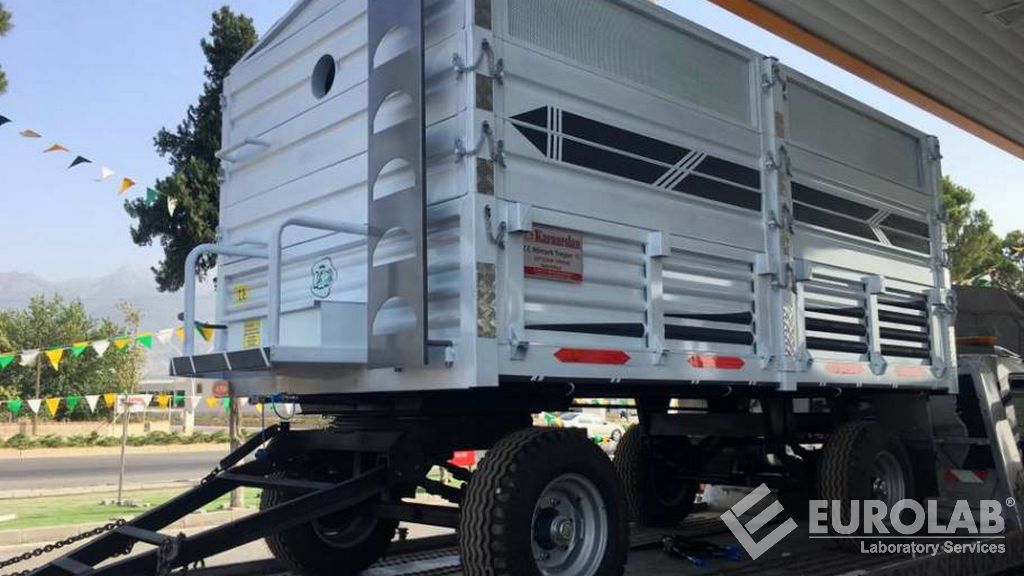
All farmers hope to travel faster with larger loads because these transfers are seen as wasted time and it is desirable to move faster in the field. Agricultural trailers and trailed equipment need to evolve, especially in terms of more precise maneuvers such as braking.
Trailer brakes can operate using mechanical, hydraulic, or pneumatic systems. For high-load capacity models, hydraulic or pneumatic systems are almost mandatory in terms of efficiency. In any case, what is needed is the best coordination between the vehicle's braking and the towed equipment, especially taking into account the weight transfer caused by changes in the alignment of the two components.
Mechanical brakes are generally used to equip farm trailers with low load capacities. In practice, the brake components are shoes manually operated by a special lever located on the side of the driver's seat. The most important feature of this system is that the control lever, which must be operated manually, is used in combination with the pedals on the base of the tractor. This can cause stability issues if the two braking processes do not work together due to defective synchronization.
Today, models with air and hydraulic brake systems equipped with ABS are being developed. Axle tipper trailers are produced with vehicles working with mixed automatic hydraulic and air brake systems. Although the hydraulic and air cylinders operate independently of each other, they operate via the same pedal that moves the brake components. On the other hand, when the pressure in the system drops to zero, a solid spring in the rear axle of the cylinders engages the parking brake.
Mechanically controlled brakes work by means of force transmitted to a body in rotating or linear motion, such as an axle, shaft or wheel, to slow or stop motion. Mechanical brakes generally include an assembly with a mechanical clutch to engage and disengage the shafts.
Among the numerous test, measurement, analysis and evaluation studies it provides for businesses in various sectors, our organization also provides testing services for agricultural trailers and trailed equipment brake cylinders within the scope of ISO 5669 standard, with its trained and expert staff and advanced technological equipment.
To get an appointment, to get more detailed information or to request an evaluation, you can ask us to fill in our form and reach you.

