

EN 13230-1 Railway Applications - Rails - Concrete Sleepers and Bearings - Part 1: General Requirements
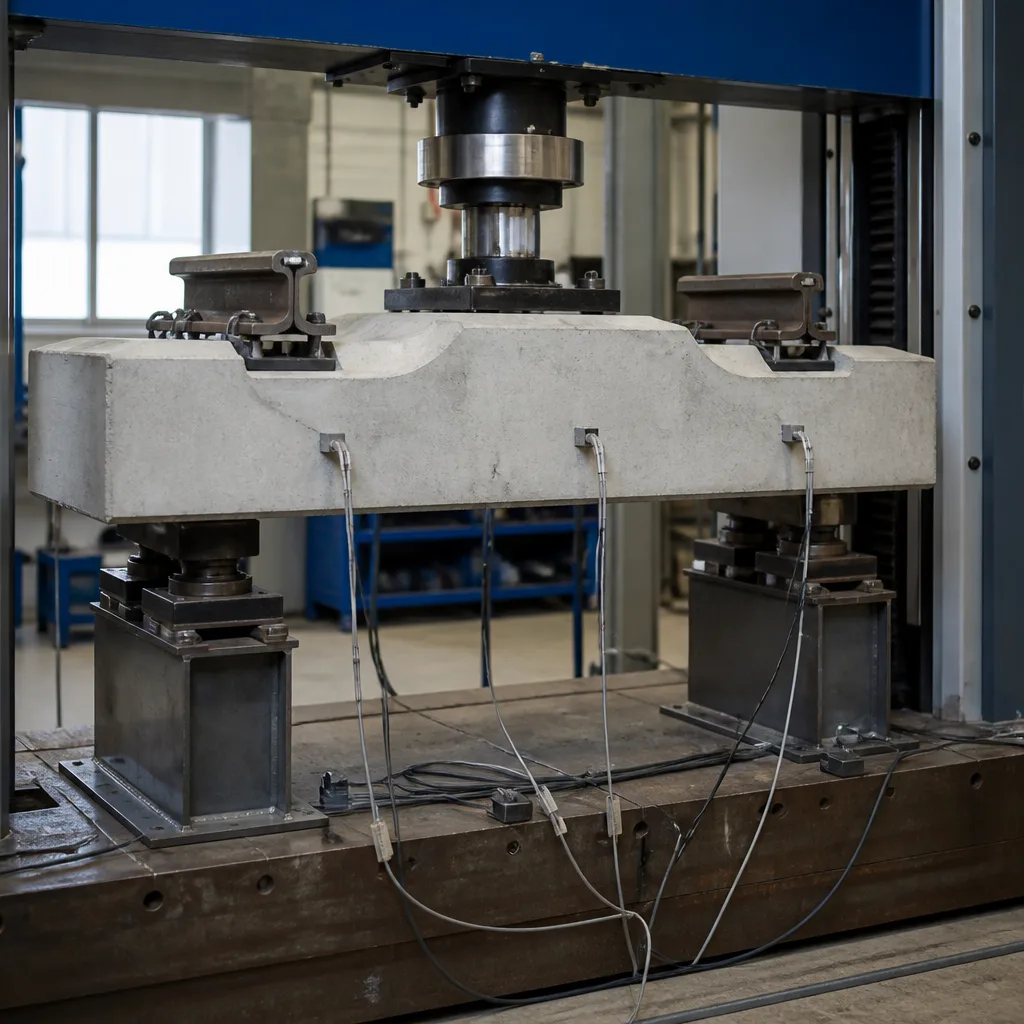
The European standard “EN 13230-1 Railway applications - Rails - Concrete sleepers and carriers - Part 1: General requirements” describes the technical criteria and inspection procedures that must be met by component materials and finished concrete sleepers and carriers, such as prefabricated concrete sleepers, double-block reinforced sleepers, carriers for switches and crossings, and special elements for railway lines.
The primary requirement for concrete sleepers and supports is the transmission of vertical, lateral, and longitudinal loads from the rails to the ballast or other support. During use, they are also exposed to frost damage and moisture, which can cause harmful chemical reactions within the sleeper.
This standard defines mechanical tests that ensure the ability of sleepers or carriers to withstand repeated loading and provide adequate durability. In addition, controls are applied to manufacturing processes and testing to ensure the concrete will not deteriorate during service through chemical reactions and frost damage.
The EN 13230-1 standard forms the basis of the EN 13230 series, which regulates the design, manufacture, testing, and quality assurance of prestressed concrete sleepers and bearings for conventional, high-speed, freight, and urban railway networks. Railway sleepers are critical structural components that perform the following functions:
The EN 13230-1 standard specifies the minimum technical requirements that ensure these concrete components operate safely under challenging environmental and operating conditions throughout their intended service life. This standard applies to:
This standard specifies the requirements for:
Instead of defining the detailed design of each sleeper type, the EN 13230-1 standard provides a common technical framework used in conjunction with the rest of the EN 13230 standard series.
The main technical requirements described in this standard are as follows:
These materials must consistently produce concrete that provides the necessary mechanical strength and long-term durability.
Mechanical tests show that the sleepers can withstand repeated traffic without excessive cracking or structural failure.
These requirements help ensure a long service life with minimum maintenance.
Precise dimensions are essential for safe train operation, especially on high-speed lines.
These checks help ensure consistent product quality from batch to batch.
Although detailed procedures are described in later parts of the EN 13230 series, the EN 13230-1 standard provides the framework for the following tests:
Manufacturers are expected to maintain documented quality systems, including the following:
Because concrete sleepers are considered safety-critical railway components, agreements between buyers and suppliers typically include robust quality management arrangements.
The EN 13230-1 standard is widely applied in the following areas:
Compliance with the EN 13230-1 standard primarily offers the following advantages:
The EN 13230-1 standard is often used in conjunction with other standards covering the following topics:
Together, these standards form a comprehensive framework for safe and reliable railway track construction.
The EN 13230-1 standard is commonly used by:
Consequently, the EN 13230-1 standard is the fundamental standard in Europe for concrete railway sleepers and carriers. By defining general requirements for materials, manufacturing, testing, durability, and quality control, it ensures that these safety-critical components can reliably withstand decades of mechanical loading and environmental impacts. When used in conjunction with other parts of the series, this standard provides a coherent framework supporting a safe, durable, and interoperable railway infrastructure.
For many years, our organization, with its competent and experienced staff, has been understanding the needs of its clients, providing the advanced testing services they require, and assisting them in the establishment, implementation, and improvement of management systems. Within this framework, we also provide testing services in accordance with the EN 13230-1 standard.
To get an appointment, to get more detailed information or to request an evaluation, you can ask us to fill in our form and reach you.

