

The ASTM D4935 Standard Test Method for Measuring Electromagnetic Shielding Effectiveness of Planar Materials, developed by the American Society for Testing and Materials (ASTM), describes a test method for measuring the electromagnetic shielding effectiveness of a planar material for planar, far-field electromagnetic waves. From the measured data, near-field shielding effectiveness (SE) values for magnetic (H) sources can be calculated for electrically thin samples. Electric field SE values can also be calculated from the same far-field data, but their validity and applicability have not yet been determined.
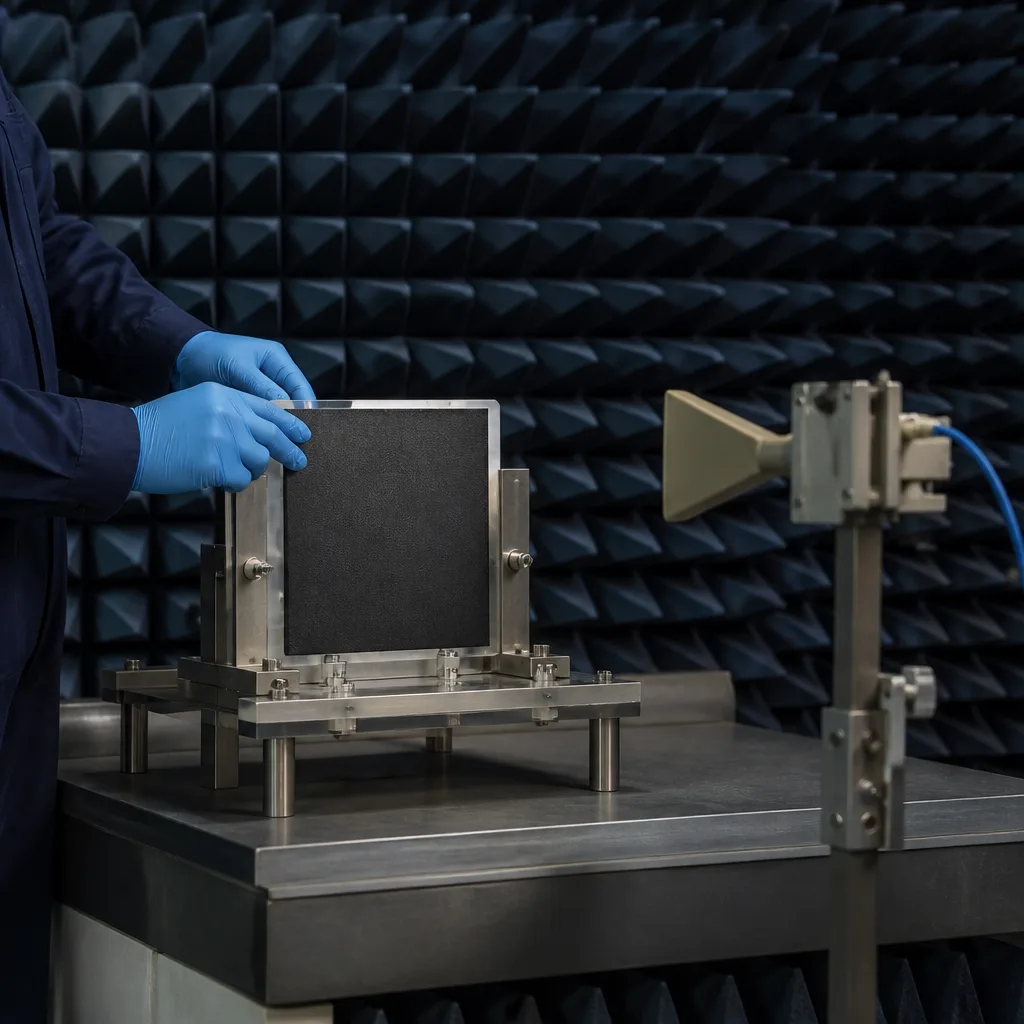
The measurement method is valid in the frequency range of 30 MHz to 1,5 GHz. These limits are not exact, but are based on the reduced displacement current due to decreasing capacitive coupling at lower frequencies and overmodulation (excitation of modes other than the transverse electromagnetic mode) at higher frequencies for the size of the sample holder described in this test method. Any number of discrete frequencies can be selected within this range. For electrically thin, isotropic materials with frequency-independent electrical properties such as conductivity, dielectric constant, and magnetic permeability, measurements will likely only need to be performed at a few frequencies, as the far-field SE values will be frequency-independent. If the material is not electrically thin, or if any of the parameters vary with frequency, measurements are performed at a few frequencies within the relevant band.
This test method is not applicable to cables or connectors.
The ASTM D4935 standard is a test method used to determine the electromagnetic shielding effectiveness (SE) of planar materials. It is particularly useful in evaluating materials designed to reduce the transmission of electromagnetic energy through a material, such as conductive polymers, metal foils, coated fabrics, composites, and other shielding materials.
The described method determines how effectively a flat or planar material attenuates an electromagnetic wave under normal angle of incidence, far-field, plane wave conditions. The measurement essentially represents the combined shielding effect resulting from reflection and absorption.
Electronic systems generate and receive electromagnetic energy. If electromagnetic radiation is not adequately controlled, it can cause the following:
A material with good electromagnetic shielding can reduce the amount of electromagnetic energy passing through it. This is particularly important in applications such as automotive electronics, telecommunications, consumer electronics, aerospace equipment, electrical enclosures, medical equipment, and electronic packaging.
Shielding effectiveness, often abbreviated as SE, refers to the reduction of electromagnetic energy generated by a shielding material. It is usually expressed in decibels (dB). In general,
For example, a material with a 40 dB SE value provides significantly greater attenuation than a material with a 10 dB SE value. The measured shielding performance is influenced by properties such as the material's electrical conductivity, permeability, dielectric constant, thickness, structure, and frequency-dependent behavior.
The ASTM D4935 standard uses a coaxial transmission path arrangement to evaluate a planar sample. The sample is placed in a specially designed holder that forms part of the transmission path. An electromagnetic signal is applied, and the amount of energy transmitted through the sample is measured. The difference between the reference transmission and the transmission through the material is used to determine the shielding effectiveness. This method measures the net shielding effectiveness resulting from reflection and absorption. The standard also describes the measurement of reflected and absorbed power using a calibrated bidirectional coupler.
One of the key features of the ASTM D4935 standard is the specified frequency range. The method is approximately applicable within this range: 30 MHz to 1,5 GHz. The limits depend on the characteristics of the test setup and the electromagnetic transmission conditions. For materials whose electrical properties vary with frequency, measurements at multiple frequencies may be necessary to adequately characterize their shielding performance.
The ASTM D4935 standard is designed for planar materials. Examples may include:
This method is not designed for cables or connectors.
Several factors can influence the measured protection effectiveness:
Measurement uncertainty can be affected by material properties, transmission line inconsistencies, the dynamic range of the measurement system, and the accuracy of auxiliary equipment. Deviations from the specified procedure can increase uncertainty.
Generally, this process follows these steps:
Sample preparation, fixture configuration, calibration, measurement sequence, and reporting requirements must comply with this standard.
Electromagnetic shielding, in terms of reflection and absorption, generally involves several mechanisms. Reflection occurs when electromagnetic energy encounters a material with suitable electrical properties, particularly high conductivity. Absorption occurs when electromagnetic energy dissipates within the material. In practical shielding applications, the overall shielding performance can therefore be affected by both mechanisms. Instead of treating shielding solely as a measure of material conductivity, the ASTM D4935 standard specifies the net shielding effectiveness associated with reflection and absorption.
ASTM D4935 may be applicable to automotive materials where electromagnetic shielding is important. Potential applications include:
As vehicles increasingly incorporate radar, wireless communications, sensors, cameras, high-voltage systems, and electronic control units, electromagnetic compatibility is becoming increasingly important. Therefore, the ASTM D4935 standard can serve as a useful material-level characterization method during material selection and development.
For many years, our organization, with its competent and experienced team, has been understanding the needs of its clients, providing the advanced testing services they require, and assisting them in the establishment, implementation, and improvement of management systems. Within this framework, we also provide testing services in accordance with the ASTM D4935 standard.
To get an appointment, to get more detailed information or to request an evaluation, you can ask us to fill in our form and reach you.

