IEEE 1309 Calibration of Electromagnetic Field Sensors and Probes (Excluding Antennas) for the Frequency Range from 9 kHz to 40 GHz
The IEEE 1309 Calibration of Electromagnetic Field Sensors and Probes (Excluding Antennas) for the Frequency Range 9 kHz to 40 GHz, published by the Institute of Electrical and Electronics Engineers (IEEE), describes calibration methods for electromagnetic field sensors and probes, excluding antennas, in the frequency range 9 kHz to 40 GHz. This standard defines the characteristics, operation, and measurement uncertainties of electromagnetic field sensors and field probes. The areas covered are:
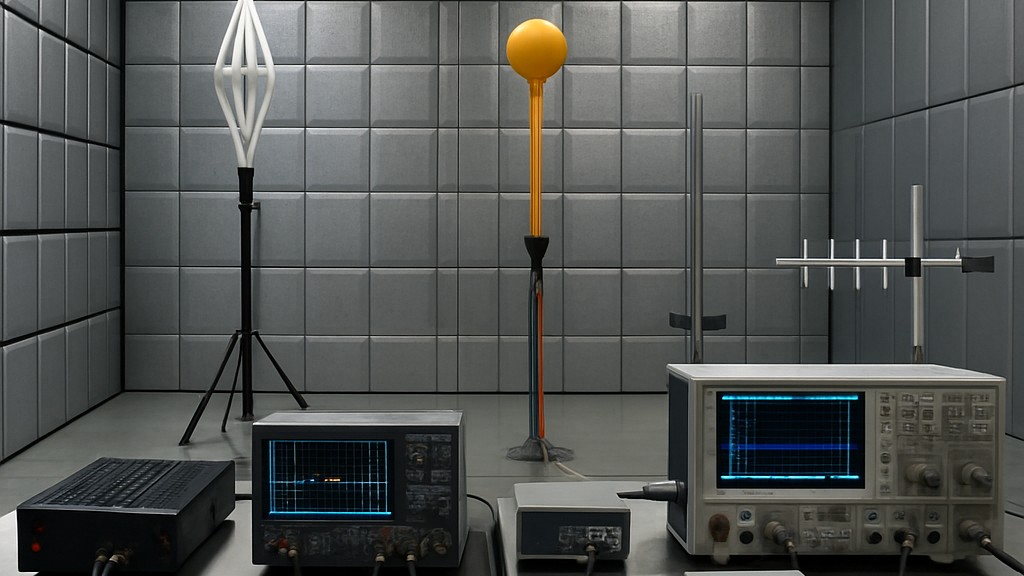
- Anisotropy effects
- Temperature effects
- Probe linearity effects
- Modulation effects
- Source and conductor proximity (near field) effects
- Response in multi-frequency fields, partial or complete immersion of probes/meters, impurity and harmonic field effects caused by amplifiers
Additionally, this standard provides specific instructions for properly calibrating probes for different applications.
This standard provides consensus calibration methods for electromagnetic field sensors and probes. Calibration organizations and other users require uniform calibration methods to obtain consistent results. The calibration methods in this standard produce results that are easily traceable to a national measurement institute. This standard specifies data recording and reporting requirements and methods for estimating measurement uncertainty.
Electromagnetic field sensors and probes are essential because they enable the detection, measurement, and analysis of critical electromagnetic fields in a wide variety of scientific, industrial, medical, and military applications. Their importance stems from the following:
- Electromagnetic radiation measurement: Electromagnetic fields are invisible, and their effects can only be understood through precise measurements. Sensors and probes provide quantitative data (e.g., field strength, frequency, power density), which is crucial for:
- RF and microwave engineering
- Wireless communication
- Antenna characterization
- Safety and compliance: Human exposure to high levels of electromagnetic fields can be harmful. These tools help ensure compliance with health and safety regulations (e.g., IEEE, FCC guidelines). They are typically used in:
- Hospitals (MRI scanners, diathermy)
- Industrial facilities (RF heating)
- Public areas near cell towers or power lines
- System diagnostics and troubleshooting: Electromagnetic field probes help identify electromagnetic interference (EMI) and electromagnetic compatibility (EMC) issues. Key areas include:
- Circuit board design
- Shielding effectiveness tests
- EMI troubleshooting in complex systems (e.g., avionics, automotive electronics)
- Research and development support: Fundamental to research and development in electromagnetics, enabling validation of theoretical models and simulations. Used in experimental physics, materials testing, and biomedical research.
- Critical for advanced applications: Electromagnetic field sensors are indispensable in:
- Radar and satellite systems
- Remote sensing
- Medical imaging and diagnostics (e.g., electric field imaging, TMS, microwave imaging)
- Security systems (e.g. surveillance, border control using electromagnetic field wave sensors)
- Real-time monitoring: Many applications require continuous monitoring of electromagnetic fields. For example,
- Electrical grid monitoring
- Wireless network optimization
- Environmental electromagnetic field mapping
In short, electromagnetic field sensors and probes are indispensable tools for modern technology, security, and scientific progress. Without them, managing the increasing complexity and prevalence of electromagnetic-based systems would be nearly impossible.
The IEEE 1309 standard covers the frequency range from 9 kHz to 40 GHz (some sources up to 60 GHz). It establishes uniform calibration procedures with comprehensive reporting and uncertainty estimation. It ensures consistent measurements across laboratories by separating sensor/probe calibration from antenna performance.
IEEE1309-2013 describes various calibration environments and setups in detail:
- GTEM cell and TEM cell: For broad-spectrum controls and uncertainty analysis
- Parallel plate and tapered transmission lines: Well-defined field regions using conformal matching and termination schemes
- Anechoic chamber installations:
- Pyramidal horn antennas (450MHz–40GHz): Includes field VSWR tests, field uniformity, gain calculations, and an uncertainty budget.
- Open-ended waveguides (200MHz-450MHz): Explains near-field/far-field transitions, extrapolation calibration techniques.
This standard includes detailed uncertainty budgeting (such as for repeatability, cable losses, reflections, alignment) and combined expanded uncertainties of approximately plus/minus 0,96 dB.
The IEEE 1309 standard is currently deactivated. Therefore, users who need up-to-date calibration protocols can refer to the relevant IEEE standards (e.g., “IEC 61000-4-3 Electromagnetic compatibility (EMC) - Part 4-3: Testing and measurement techniques - Radiated radio-frequency electromagnetic field immunity test”).
The IEEE 1309 standard is considered important because it provides a consistent, reliable, and traceable method for calibrating electromagnetic field sensors and probes (excluding antennas), which are critical instruments in electromagnetic measurement systems. The primary reasons for this standard's importance are:
- Standardized calibration procedures: This standard defines uniform methods for the calibration of electric and magnetic field probes between 9 kHz and 40 GHz. Without such standardization, different laboratories may produce inconsistent or inaccurate results, leading to errors in measurement and data interpretation.
- Improved measurement accuracy: Proper calibration ensures that sensors accurately measure electromagnetic fields across a wide frequency range. This helps minimize uncertainties arising from:
- Field irregularity
- Sensor positioning errors
- Instrumentation shift
- Ensures repeatability and comparability: This standard enables meaningful comparison of electromagnetic field measurements taken by different organizations, laboratories, or devices. Essential for collaborative research, product testing, and compliance assessments.
- Supports traceability and regulatory compliance: Calibration under this standard is traceable to national standards and is typically required for:
- Medical device approvals
- Military and aerospace system validation
- FCC and CE compliance testing
- Vital for electromagnetic compatibility (EMC) and safety testing: They ensure that products do not emit harmful levels of electromagnetic radiation and are not susceptible to external electromagnetic fields. Applications include:
- EMC testing laboratories
- Wireless device certification
- MRI and medical EM safety assessments
- Industry acceptance and versatility: Applicable in telecommunications, aerospace, automotive, healthcare, defense, and electronics manufacturing. Bridges the gap between theoretical models and real-world measurements.
- Builds trust and credibility: Products and test results backed by IEEE 1309-based calibration carry greater technical credibility. This standard is particularly important in legal, regulatory, or high-risk engineering environments.
As a result, the IEEE 1309 standard provides the basis for accurate, repeatable, and standardized electromagnetic field measurements, ensuring the quality and safety of a wide range of technologies on which we are increasingly dependent.
Our organization, which has been supporting businesses across all sectors for years through a wide range of testing, measurement, analysis, and evaluation activities, has a strong team of employees who closely follow global developments in science and technology and are constantly improving themselves. In this context, we also provide testing services in accordance with the IEEE 1309 standard for the calibration of electromagnetic field sensors and probes (excluding antennas) between 9 kHz and 40 GHz.



