

The standard "EN IEC 50147-1 Anechoic chambers - Part 1: Shield attenuation measurement," based on a European standard and subsequently published by the International Electrotechnical Commission (IEC), describes a procedure for measuring shielding attenuation in shielded enclosures (rooms) in the frequency range 9 kHz to 40 GHz. The purpose of this standard is to establish a common measurement procedure for verifying the shielding effectiveness of a shielded enclosure.
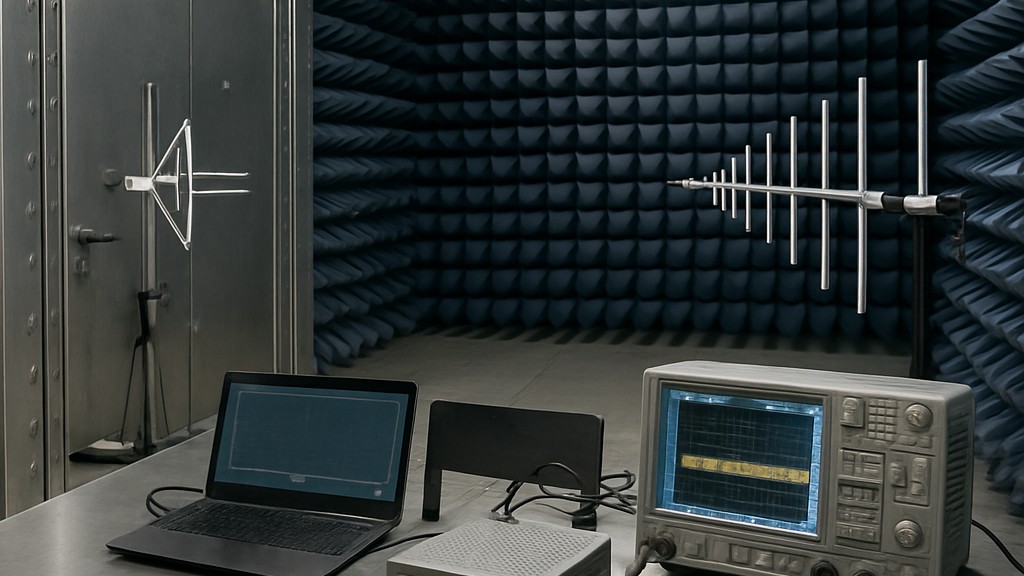
The measurement is typically performed with all shielding components in place and, in the case of filters, all wires and cables connected. This procedure is derived from the National Security Agency's specification "NSA 65-6 RF-shielded enclosures for communications equipment."
When performing this shield attenuation test, the following types of equipment will be used, depending on the frequency range specified in the enclosure specifications. The measuring equipment must have sufficient dynamic range to perform the test:
During acceptance tests, measurements should be taken at various points around the enclosure as specified in the enclosure's specifications. These measurements are typically taken before absorber installation. If the ambient noise level is sufficiently low, all tests should be conducted with the receiver outside the enclosure and the transmitter inside the enclosure.
Before acceptance testing, leak tests should be performed throughout the door frame, accessible connections, around filters, and throughout the air ducts. Additionally, the magnitude and location of the maximum signal level emitted from the enclosure should be determined by moving the antennas to at least four locations, preferably on different walls.
Electric and magnetic field attenuation tests (reference measurements) should be made with the antennas placed directly opposite each other and separated by a specified distance plus the wall thickness.
Magnetic fields should be measured with the loops parallel to a wall panel directly opposite each other. Recommended test frequencies for magnetic fields are 10 kHz, 100 kHz, 1 MHz, 10 MHz, and 30 MHz, and for electric fields are 10 MHz and 30 MHz.
Plane wave measurements should be made at least at frequencies of 100 MHz, 400 MHz, 1 GHz, 10 GHz, and 40 GHz, depending on the frequency range specified in the enclosure specification.
Shield attenuation can only be calculated under ideal conditions. The most important factor is that the shielded enclosure be homogeneous and made of materials with defined properties in all respects. In practice, deviations from these conditions can be so significant that the calculation yields only approximate values.
EN IEC 50147-1 is a European standard that specifies general requirements for shielded enclosures and anechoic chambers used in electromagnetic compatibility (EMC) testing. This standard plays a critical role in ensuring the reliability, accuracy, and repeatability of EMC tests, which are crucial for assessing whether electronic equipment complies with electromagnetic interference (EMI) limits.
The primary purpose of this standard is to define the general construction and performance requirements for shielded enclosures, particularly those used for radiation emission and radiation immunity testing. These enclosures are required to create controlled environments that isolate the equipment under test from external electromagnetic fields and reflections.
The basic requirements of this standard are:
The EN IEC 50147-1 standard applies to:
This standard is important because it ensures the accuracy, reliability, and repeatability of electromagnetic compatibility (EMC) tests, which are critical to the development and certification of electronic devices. The key reasons for this standard's importance include:
This standard helps prevent these safety-critical failures by enabling accurate EMC testing.
Consequently, the EN IEC 50147-1 standard is of fundamental importance to anyone involved in electromagnetic compatibility testing in Europe. It ensures that anechoic and shielded test environments provide accurate, repeatable, and interference-free conditions, ensuring products meet stringent EMC requirements. As electromagnetic pollution becomes a growing concern in a digitally connected world, compliance with EN IEC 50147-1 and similar standards is more critical than ever.
Our organization, which has been supporting businesses across all sectors for years with a wide range of testing, measurement, analysis, and evaluation activities, has a strong team of employees who closely follow global developments in science and technology and are constantly improving themselves. In this context, we also provide testing services in accordance with the "EN IEC 50147-1 Anechoic chambers - Part 1: Shield attenuation measurement" standard.
To get an appointment, to get more detailed information or to request an evaluation, you can ask us to fill in our form and reach you.

