14 CFR 25.853 Cabin Interiors
Published under the Federal Regulations Act (CFR), Title 14 of the CFR contains federal aviation regulations governing civil aviation operations in the United States. Section 25 sets standards for airworthiness for passenger aircraft (including large commercial jets). Specifically, Section 14 CFR 25.853, “Cabin Interiors,” is a critical federal aviation regulation (FAR). This section addresses the fire safety and flammability of materials used in cabin interiors, particularly those occupied by crew or passengers.
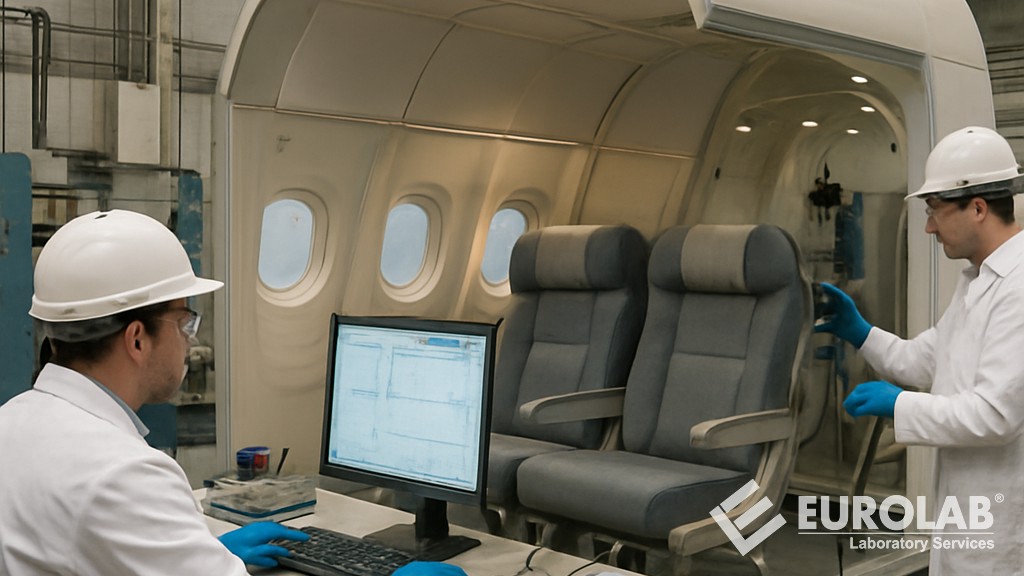
The primary goal of this regulation is to minimize cabin fire hazards by ensuring interior materials are flame-resistant, limit flame spread, reduce heat release, restrict smoke production, and rapidly self-extinguish when exposed to flame. This helps protect passengers in in-flight incidents or post-accident fire scenarios.
According to section 14 CFR 25.853 Cabin Interiors, the following applies to each compartment used by crew or passengers:
- Materials (including coatings or decorative surfaces applied to materials) must meet the applicable test criteria specified in the appendix to this section or other approved equivalent methods, regardless of the aircraft's passenger capacity (Appendix F, Part I). This test method is the vertical Bunsen burner test (commonly referred to as the vertical burn test). Typically, the basic passing criteria are: self-extinguishing behavior, limited burn length (e.g., average approx. 16 cm), flame duration after ejection of no more than 15 seconds, and dripping flame duration of no more than 3–5 seconds.
- (Keeped confidential)
- In addition to meeting the requirements in paragraph (a) above, seat cushions, excluding those in flight crew seats, must meet the test requirements or other equivalent methods specified in this Annex (Annex F Part II), regardless of the aircraft's passenger capacity. Accordingly, passenger seat cushions (excluding flight crew seats) must also pass the more rigorous oil burner test (typically the seat cushion flammability test or fire prevention requirement). This simulates exposure to a larger fire source.
- Except as specified in paragraph (e) of this section, the following interior components of aircraft with a capacity of 20 or more passengers shall meet the test requirements or other approved equivalent methods specified in the annex to this section (Annex F Parts IV and V), in addition to the flammability requirements specified in paragraph (a) above:
- Interior ceiling and wall panels, excluding lighting lenses and windows.
- Compartments, excluding transparent panels necessary to enhance cabin security.
- The kitchen structure includes exposed surfaces of stacked carts and standard containers, and exposed cavity walls where such carts or containers are not fully transported.
- Besides under-seat storage compartments for small items like magazines and maps, there are large cabinets and cupboard storage compartments.
This paragraph states that, for aircraft with 20 or more passengers, in addition to clause (a), they must also meet heat emission and smoke emission tests. These include:
- Interior ceiling and wall panels (excluding lights/windows)
- Partitions (excluding transparent security panels)
- Kitchen structures and exposed surfaces of cars/containers
- Large closets and cabinet storage compartments (excluding small under-seat items)
- The interiors of compartments such as pilot cabins, galleys, toilets, crew restrooms, lockers and storage compartments do not have to meet the standards in paragraph (d) above, but the interiors of these compartments must be isolated from the main passenger cabin by doors or equivalent means that would normally be closed in the event of an emergency landing.
- Smoking is not permitted in restrooms. If smoking is permitted in any area occupied by crew or passengers, a sufficient number of self-contained, removable ashtrays must be provided in designated smoking areas for all seated passengers.
- Regardless of whether smoking is permitted in other areas of the aircraft, restrooms must have self-contained, removable ashtrays prominently displayed on or near the entrance of each restroom door; however, one ashtray may serve more than one restroom door if the ashtray is easily visible from each cabin.
- Every container used for the disposal of combustible waste materials must be completely sealed, made of at least fire-resistant materials, and contain any fires that may occur during normal use. The container's ability to contain these fires under all possible wear, misalignment, and ventilation conditions expected during service must be demonstrated by testing.
The tests in 14 CFR 25.853 Appendix F include:
- Part I: Flammability (basic ignition resistance) of vertical/horizontal Bunsen burners.
- Part II: Oil burner (intense flame burst) for seat cushions.
- Sections IV and V: Ohio State University calorimeter for heat release rate and smoke density.
Many manufacturers also refer to the European CS-25.853 regulation or original equipment manufacturer specifications.
This regulation affects materials such as plastics, fabrics, composites, foams, leathers, carpets, panels, and insulation. It is common for materials such as flame-retardant thermoplastics or fire-resistant seats to be compliant.
This regulation is required for aircraft certification, interior modifications, and supplier material approvals. Non-compliance may prevent type certification or additional type certifications for cabin upgrades.
Aircraft cabin fires, although rare, can spread extremely rapidly in the enclosed, high-altitude environment of a commercial aircraft, and the flames, intense heat, dense toxic smoke, and inadequate evacuation measures can lead to catastrophic loss of life. In this respect, 14 CFR 25.853 is considered very important.
Aircraft cabins utilize a large amount of lightweight, flammable materials (e.g., polyurethane foam in seats, plastics, fabrics, insulation, and composites in panels). These provide comfort and low weight, but when ignited, they generate a significant fuel load.
This regulation mandates the use of materials that are flame-resistant, limit flame spread, reduce heat release rates, minimize smoke production, and rapidly self-extinguish; this provides critical time for the evacuation of passengers and crew or for firefighting efforts.
For many years, our organization, with its competent and experienced staff, has been understanding the needs of its clients, providing the advanced testing services they require, and assisting in the establishment, implementation, and improvement of management systems. Within this framework, we also provide testing services compliant with the "14 CFR 25.853 Cabin Interiors" regulation.