

A national aviation standard, “NASM 1312-9 Fastener test methods - Method 9 Stress corrosion,” describes a test method for determining the relative susceptibility of threaded fasteners to stress corrosion cracking.
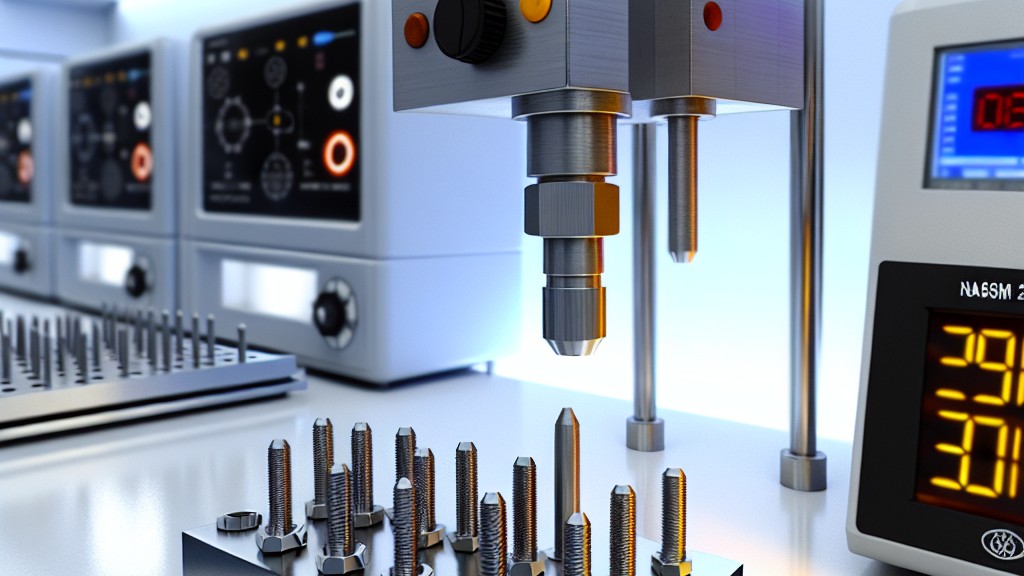
This method is an accelerated method in which the test specimen is subjected to uniaxial tensile stress and is subjected to an alternating cycle of immersion in 3-1/2 percent sodium chloride solution. This test is potentially hazardous because the fastener is subjected to high sustained loads. It is recommended that the test area be completely enclosed to prevent injury to personnel working in the vicinity of the test area. It is also recommended that safety masks be worn while loading and examining the specimen.
Apparatus used in stress corrosion testing includes:
Test units include:
The length measuring device must be able to directly read length changes of 0,00254 mm. Its accuracy must be such that the display error is within 0,00254 mm.
The test chamber and all its accessories shall be constructed of materials such as hard rubber, plastic or suitably coated materials which will not interfere with the test conditions. The test chamber shall be suitably ventilated and shall have a volume in which the bulk of the equipment under test will not interfere with the operating conditions described in this standard. An alternative immersion device shall be provided and constructed to produce an alternative immersion cycle. In addition, the test chamber shall be equipped with devices such as fans or blowers to produce a circulating air system. The chamber and its accessories shall be constructed and arranged in such a way that:
The salt solution shall be substantially free of nickel and copper and shall contain not more than 0,01 percent sodium iodide and not more than 0,3 percent total impurities on a dry basis. A 3-1/2 percent sodium chloride solution shall be prepared by dissolving 3-1/2 parts by weight of salt in 96-1/2 parts by weight of distilled water or deionized water having total chlorides of less than 200 ppm.
The salt solution should be maintained at a pH of 24 to 3 at a solution temperature of 6,5 degrees plus/minus 7,5 degrees. The pH of the solution should be checked every 24 hours and measured electrochemically using a glass electrode with a saturated potassium chloride bridge or colorimetrically using bromothinol blue as an indicator. Only diluted analytical reagent grade hydrochloric acid or sodium hydroxide (as appropriate) should be used to adjust the pH of the solution.
Only one type of alloy fastener system should be tested at a time in the same solution chamber. Fresh salt solution should be used for each test. The interval between solution changes should not exceed 7 days. The 3-1/2 percent salt solution should be maintained by adding distilled or deionized water and the concentration should be checked with a hydrometer tested in accordance with ASTM E126.
When preparing test specimens, the ends of the externally threaded test specimen should be prepared in such a way that accurate and repeatable length measurements can be obtained. The ends of the coated specimen should be sealed after loading to eliminate corrosion. Unless otherwise specified, uncoated and metallic coated test specimens and test units should be completely free of dirt, oil and grease. Specimens should be cleaned with detergent and rinsed with deionized water to obtain a water-tight surface, then rinsed with isopropyl alcohol and air or blow-dried. No halogenated solvents or abrasives of any kind are permitted.
Our organization, which has been trying to support businesses from every sector with its testing, measurement, analysis and evaluation studies carried out in a wide range for years, has a strong staff that closely follows the developments in the world in the field of science and technology and constantly improves itself. In this context, testing services in accordance with the "NASM 1312-9 Fastener Test Methods - Method 9 Stress Corrosion" standard are also provided to businesses.
To get an appointment, to get more detailed information or to request an evaluation, you can ask us to fill in our form and reach you.

