
The standard "ASTM D4585 Standard Practice for Testing Water Resistance of Coatings Using Controlled Condensation," developed by the American Society for Testing and Materials (ASTM), describes the basic principles and operating procedures for testing the water resistance of coatings using controlled condensation. Condensation is produced by exposing one surface of a coated sample to a heated, saturated mixture of air and water vapor, while the reverse side of the sample is exposed to the cooling effect of room-temperature air. This practice is based on research conducted by the Cleveland Association for Coating Technology.
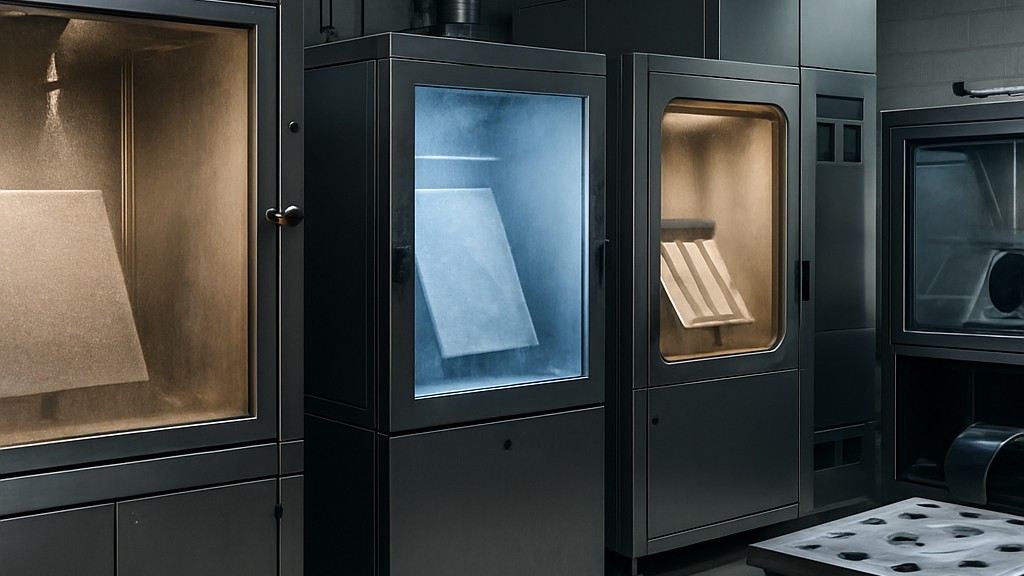
This application is limited to methods for obtaining, measuring, and controlling the conditions and procedures for controlled condensation tests. It does not specify sample preparation, specific test conditions, or evaluation of results.
Alternative practices for testing the water resistance of coatings include ASTM D870, ASTM D1735, and ASTM D2247 standards.
ASTM D4585 is not intended to address all safety issues, if any, associated with its use. It is the responsibility of the user of this standard to determine appropriate safety and health practices and to determine the applicability of regulatory limitations before use.
The practice described in this standard describes the preparation and testing of panel assemblies to evaluate the resistance of external cladding to accelerated weathering. This standard provides a procedure for exposing clad panels to environmental conditions intended to simulate the effects of natural weathering, such as exposure to sunlight, humidity, and temperature fluctuations.
The ASTM D4585 standard is important because it provides a standardized and reliable method for evaluating the durability and performance of exterior coatings such as epoxies, urethanes, and fluoropolymers when exposed to various environmental conditions. This practice helps coating manufacturers and users understand the expected performance of a coating product in real-world applications and compare the performance of different coating products against accelerated weathering. It also helps determine, during the development phase of coatings, which raw materials perform best for long-term UV exposure, salt fog exposure, and similar exposures. Coating engineers can make necessary changes during development to produce the best coating for long-term exposure.
This standard is widely used in industries such as construction, automotive and aerospace, where coatings play a critical role in protecting and enhancing the appearance of products and structures.
Water causes coating deterioration, so understanding how a coating is waterproofed helps predict its service life. Condensation test failures can be caused by a variety of factors, including defects in the coating itself, substrate contamination, or inadequate surface treatment. Therefore, the test can be used to evaluate individual coatings or entire coating systems.
Condensation testing of coatings is used for specification acceptance, quality control, and research and development of coating and substrate processes. These tests typically determine pass or fail, but can also measure the extent of failure. If there is no evidence of water-related failure after a specified time interval, the coating system is considered pass.
Until the quantitative significance of the coating or coating system is determined, results obtained using condensation tests according to this practice should not be expressed as equivalent to a period of natural water exposure.
Testing is typically performed on metal, plastic, or wood samples with the coating facing the interior of the room. However, the foam resistance of house coatings on wood samples can be tested by mounting an uncoated wood surface facing the interior of the room.
This practice can be used for corrosion testing, especially if the sample is regularly dried. Although corrosion products are discharged into the water bath, they are not carried over into the vapor condensing on the sample.
In short, the purpose of ASTM D4585 is to evaluate the ability of a coating to resist water-induced degradation using a condensation test. This test essentially involves exposing a sample to a controlled-temperature environment with saturated steam, resulting in a pass or fail determination. Furthermore, this test can evaluate the coating or the entire coating system, as damage observed in this test can be caused by a variety of factors. For example, failures can be caused by substrate contamination, inadequate surface preparation, or the coating itself. To measure the water resistance of a sample, this test relies on the evaluation of aesthetic characteristics such as color change, blistering, loss of adhesion, and softening, which are detailed in other standards. Finally, by evaluating the coating's water resistance, it is possible to predict its performance in the field.
The main factors to be considered when performing this test are exposure time, temperature and periodic drying of the sample.
The required number of samples for the tests is two, and it is recommended that a material with known performance be tested alongside the second sample to serve as a control. The minimum sample size is 76 mm wide by 152 mm high, with a maximum thickness of 8 mm. The test temperature typically ranges from 38°C to 82°C. The steam temperature is 38, 49, or 60°C.
The ASTM D4585 standard is deemed necessary for the following reasons:
Our organization, which has been supporting businesses across all sectors for years through a wide range of testing, measurement, analysis, and evaluation activities, has a strong team of employees who closely follow global developments in science and technology and are constantly improving themselves. In this context, we also provide testing services in accordance with ASTM D4585 Standard Practice for Testing the Water Resistance of Coatings Using Controlled Condensation.
To get an appointment, to get more detailed information or to request an evaluation, you can ask us to fill in our form and reach you.

