
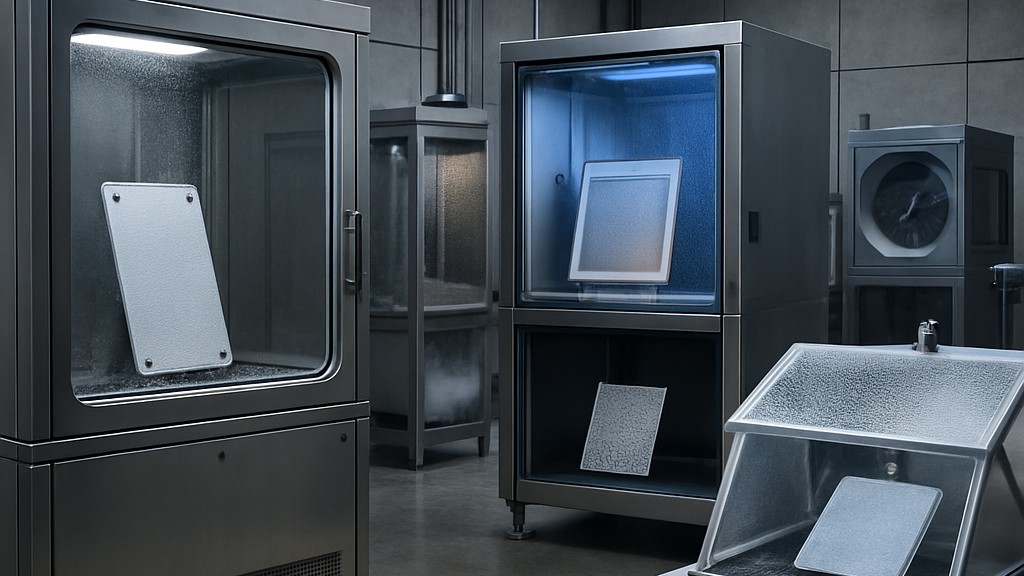
The ASTM G151 standard, “Standard Practice for Exposure of Nonmetallic Materials in Accelerated Testing Apparatus Using Laboratory Light Sources,” developed by the American Society for Testing and Materials (ASTM), describes general procedures to be used when exposing nonmetallic materials in accelerated testing apparatus using laboratory light sources. Detailed information regarding procedures to be used for specific apparatus is found in the standards that define the particular apparatus used. For example, detailed information covering exposures in apparatus using carbon arc, xenon arc, and fluorescent UV light sources is found in ASTM G152, ASTM G153, and ASTM G154 standards, respectively.
Carbon arc, xenon arc, and fluorescent UV exposures are also addressed in ASTM G23, ASTM G26, and ASTM G53, which define very specific equipment designs. These ASTM standards are performance-based.
This application also describes general performance requirements for devices used to expose nonmetallic materials to laboratory light sources. This information is primarily intended for manufacturers of laboratory accelerated exposure devices.
This application provides information on the use and interpretation of data obtained from accelerated exposure tests. Specific information on methods for determining the properties of a nonmetallic material before and after exposure is found in standards that describe the method used to measure each property. Information on reporting results from exposure tests on plastic materials is included in ASTM D5870.
ASTM G141 provides information for addressing variability in exposure tests of nonmetallic materials. The ASTM Committee is developing a standard guide for applying statistics to exposure test results.
This standard is technically equivalent to “ISO 4892-1 Plastics - Methods of exposure to laboratory light sources - Part 1: General guidance and requirements”.
When performing exposures on devices using laboratory light sources, it is important to consider how well validated test conditions will reproduce the property changes and failure modes associated with end-use environments for the devices under test. Additionally, it is essential to consider the effects of variability in both accelerated and outdoor exposures when setting up exposure tests and interpreting results from accelerated exposure tests.
No laboratory exposure test can be purported to be a complete simulation of actual use conditions in outdoor environments. The results from these laboratory accelerated exposures can be considered representative of actual use exposures only when the degree of rank correlation is established for the specific materials tested and the type of degradation is the same. The relative durability of materials under actual use conditions can vary significantly at different locations due to variations in UV radiation, exposure time, relative humidity, temperature, contaminants, and other factors. Therefore, even if the results from a particular exposure test conducted according to this practice are found to be useful for comparing the relative durability of materials exposed in a specific outdoor environment, they cannot be assumed to be useful for determining the relative durability of the same materials in a different environment.
Although very hot, it is not recommended to calculate an acceleration factor for radiant exposure relative to external exposure in a laboratory accelerated test. These acceleration factors are not valid for several reasons.
In short, ASTM G151 is a fundamental standard that provides a general framework for conducting accelerated light exposure testing of non-metallic materials. It plays a critical role in evaluating how materials such as plastics, coatings, textiles, and composites degrade when exposed to light, heat, and humidity (factors that mimic outdoor or indoor environments). This application is not a standalone test method, but rather a guide for conducting controlled exposure tests using laboratory light sources.
The primary purpose of this standard is to define general procedures and requirements for exposing materials in test chambers simulating environmental aging conditions. For example:
This standard is intended to supplement more specific test methods such as ASTM G154 and ASTM G155 by providing general guidelines applicable to different types of laboratory light exposure devices.
The ASTM G151 standard is widely used across industries to simulate the effects of environmental exposure over time, helping to:
This standard is applicable to a variety of non-metallic materials such as:
Some of the key issues addressed in the ASTM G151 standard include:
Our organization, which has been supporting businesses across all sectors for years with a wide range of testing, measurement, analysis, and evaluation activities, has a strong team of employees who closely follow global developments in science and technology and are constantly improving themselves. In this context, we also provide testing services in accordance with ASTM G151 Standard Practice for the Detection of Non-Metallic Materials in Accelerated Testing Devices Using Laboratory Light Sources.
To get an appointment, to get more detailed information or to request an evaluation, you can ask us to fill in our form and reach you.

