Radiation Tightness Test
Radiation is the propagation and transfer of energy through space or matter, usually in the form of waves or particles. There are two main types of radiation, ionizing and non-ionizing, depending on the amount of energy it carries:
- Ionizing radiation: This type has enough energy to strip electrons from atoms or molecules, creating ions. It can damage living tissue and is carefully controlled in medicine and industry. Examples:
- Alpha particles: Heavy, positively charged particles (from radioactive decay).
- Beta particles: High-energy electrons or positrons.
- Gamma rays: High-energy electromagnetic waves.
- X-rays: Produced by electron transitions or X-ray tubes.
- Neutrons: Uncharged particles resulting from nuclear reactions.
The uses of ionizing radiation are as follows:
- Medical imaging (X-rays, CT scans)
- Cancer treatment (radiotherapy)
- Industrial inspection (radiography)
- Sterilization and material testing
Non-ionizing radiation: This type has lower energy and cannot ionize atoms, but can still cause heating or excitation of molecules. Examples:
- Ultraviolet (UV) (partially ionizing at high frequencies)
- Visible light
- Infrared (IR)
- Microwaves
- Radio waves
The areas of non-ionizing radiation are:
- Communications (radio, Wi-Fi, mobile phones)
- Heating (microwave ovens)
- Remote controls and sensors
- Sunlight and artificial lighting
Radiation seal testing refers to the process of assessing the integrity of systems, components, or enclosures to determine their ability to contain or protect against radiation, as well as to prevent leaks or exposure. This testing method is critical in industries where radiation (e.g., ionizing radiation such as alpha, beta, gamma, or neutron radiation) poses significant safety, environmental, or operational risks, such as nuclear energy, medical radiology, aerospace, and defense.
Radiation seal testing ensures safety and regulatory compliance by verifying that materials, seals or structures can effectively contain radioactive substances or prevent radiation from escaping or penetrating.
The primary purpose of the radiation tightness test is to ensure:
- Appropriate shielding of radiation sources (such as X-ray tubes, gamma sources or radioactive isotopes).
- The amount of radiation escaping from the system is within legally acceptable exposure limits for personnel and the environment.
- Equipment complies with regulatory standards.
Radiation proof testing is typically performed on the following devices:
- Medical imaging equipment: X-ray devices, IT scanners, fluoroscopy units.
- Industrial devices: Radiography units, irradiation rooms, nuclear measuring devices.
- Laboratory enclosures: Hot cells, glove boxes, lead containers.
- Transport barrels: Used to transport radioactive materials.
The main radiation sealing methods are:
- Leak test:
- Pressure testing: The system is tested under high or low pressure. For example, pressurized gas (such as helium) is introduced into a container and leak detectors are used to search for leaks.
- Helium leak testing: Helium gas is used to detect small leaks because helium has very small molecules and indicates leaks sensitively.
- Tracer gas testing: Leaks are detected using non-radioactive tracer gases.
- Vacuum test: The system is placed under vacuum and leaks are measured.
- Shielding effectiveness:
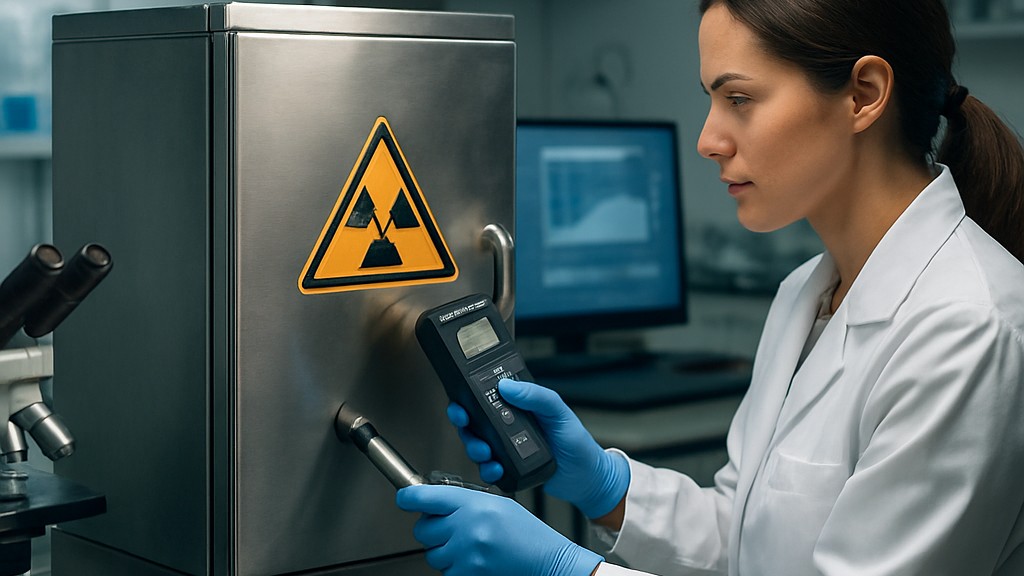
- Radiation detectors (e.g., Geiger counters or dosimeters) are used to measure the extent to which shielding materials (e.g., lead, concrete) block radiation. The test uses a specific radiation source (e.g., gamma rays) to check radiation levels beyond the shield.
- Non-destructive testing (NDT):
- Radiographic testing: Using X-rays or gamma rays, structural defects (e.g. cracks or weld defects) are searched for.
- Ultrasonic testing: Defects within the material are detected using sound waves.
- Magnetic particle testing: Used to find microcracks on metal surfaces.
Radiation tightness testing is widely used in the following areas:
- Nuclear facilities: To ensure that reactor components, waste storage areas or transport containers prevent radioactive leaks.
- Medical equipment: To verify shielding on devices such as X-ray machines or radiotherapy equipment to protect patients and staff.
- Aerospace and defense industries: To test spacecraft or military equipment exposed to cosmic or weapons-generated radiation.
- Research laboratories: To ensure the safe handling of radioactive isotopes.
Radiation tightness testing is deemed necessary for the following reasons:
- Safety: By ensuring that radioactive materials or radiation are kept under control, it prevents exposure of workers, the public and the environment to harmful radiation and reduces the risks of radiation sickness, cancer or ecological damage.
- Regulatory compliance: Meets rigorous standards set by organizations such as the International Atomic Energy Agency, the Nuclear Regulatory Commission, or local health and safety authorities.
- Operational reliability: Ensures equipment operates correctly in the event of radiation exposure, which is critical for nuclear reactors or space missions.
- Operational integrity: Verifies that systems (e.g., nuclear reactors, medical devices, or spacecraft) operate reliably in the event of radiation exposure and prevents failures.
- Environmental protection: Protects ecosystems by preventing radioactive contamination of air, water or soil.
- Public trust: Demonstrates commitment to safety and responsibility in industries working with radioactive materials and maintains trust.
Consequently, radiation leakage testing is crucial to ensuring that containment and shielding systems operate reliably and meet regulatory requirements while protecting human health, the environment, and operational integrity. This is a crucial safety test performed to verify that radiation-generated devices, systems, or containers do not leak radiation into the environment. This testing plays a critical role in protecting both human health and the environment.
Our organization, with its competent and experienced team, has been understanding our customers' needs for years, providing them with the advanced testing services they need, and assisting them in establishing, implementing, and improving management systems. In this context, we also provide radiation leakage testing services to businesses.