
The IEC 60068-2-27 standard published by the International Electrotechnical Commission (IEC) defines a standard test method for determining the ability of a sample to withstand specified intensities of non-repetitive or repetitive shocks. The purpose of this test is to reveal mechanical weakness or deterioration in specified performances or accumulated damage or deterioration caused by shocks. In conjunction with that standard, this test method is sometimes used to determine the structural integrity of samples or as a quality control tool.
If a product is to be tested unpackaged, it is defined as a test sample. However, if the product is packaged, the product and its packaging together are defined as the test sample. When the IEC 60068-2-27 standard is used together with the IEC 60068-2-47 standard, this standard can be used to test packaged products.
The IEC 60068-2-27 standard is written in terms of predicted impact shapes. Conditions for the selection and application of these pulses are in the annex to the standard (Annex A). The characteristics of the different impact shapes are given in Appendix B.
Where possible, the shape and test intensity of the shock applied to the specimen should be such as to reproduce the effects of the actual transport or operating environment to which the specimen will be exposed, or to meet the design requirements if the purpose of the test is to assess structural integrity.
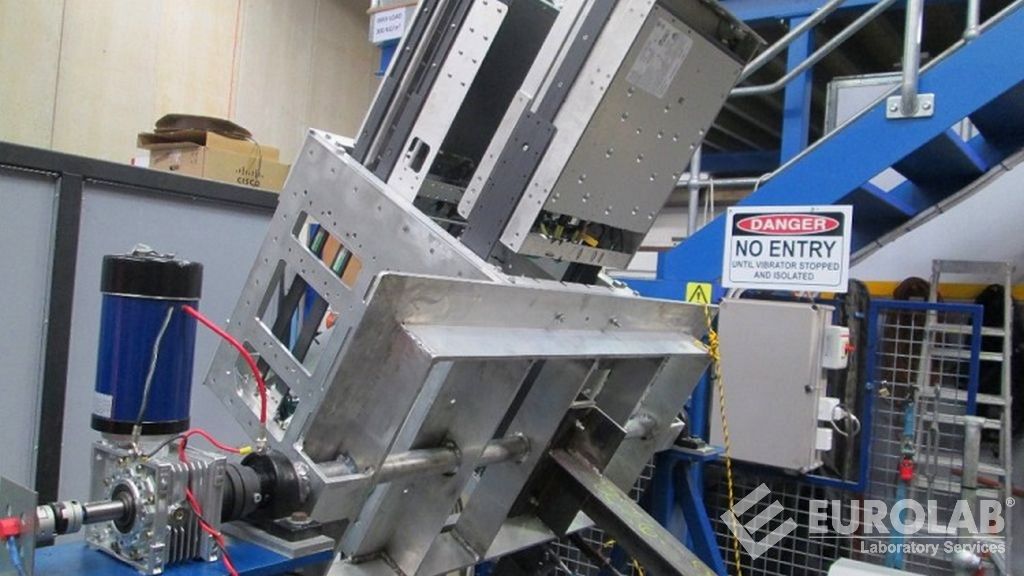
For the purposes of this test method, the specimen is always mounted on the fixture or table of the shock testing machine during testing.
For the purposes of this document, the term control point refers to a point on the fixture, on the table surface of the shock testing machine, or on the specimen, as close as possible to and securely attached to the fixation point. Fixation point refers to the part of the sample that is in contact with the fixture or table of the shock testing machine at a point where the sample is normally fixed in service, the repetition rate refers to the number of shocks per second, the shock intensity is the combination of peak acceleration, nominal impact time and number of shocks.
Among the numerous tests, measurements, analyses, and evaluations our organization provides for businesses in various sectors, we also offer environmental testing services under the IEC 60068-2-27 standard, including Ea: shock testing, with our trained and expert staff and advanced technological equipment.
To get an appointment, to get more detailed information or to request an evaluation, you can ask us to fill in our form and reach you.

