

Chemical safety assessment, including extractable and leak testing and assessment, is no different from other scientific endeavors as it has relevant generalizations, ground rules and urban myths. In the early days of E&L, one of the most widespread and potentially influential myths, it was the concept of direct solution contact and is explained as follows: “If a container closure system component does not come into direct contact with the drug product during manufacture, after storage and distribution and clinical use, substances that can be removed from the component can be Since there is at least one barrier between the drug product, the drug cannot leak the product. "
While this is true for some materials (e.g. glass, metallic, specially structured polymeric barrier films), most of the most widely used plastic-based primary packaging systems have limited barrier properties, especially when considering some quenching conditions of clinical use (e.g. long shelf life, high temperature exposure (terminal sterilization, pasteurization), large surface area to volume ratios].
While discussing this particular urban myth has implications for all items other than the primary packaging of a pharmaceutical product (for example, secondary packaging such as excessive bags, tertiary packaging such as shipping cartons, and environmental resources such as wooden shipping pallets), perhaps the deepest impact impacts printing and labels with significant potential. to recognize them as sources of leakage.
Although container closure systems have numerous functional requirements, an often not appreciated product is the requirement that they convey valuable and critical information about the product, its proper clinical use, and its packaging. This requirement for information communication has led to the proliferation of printing and the expanded use of labels on primary, secondary and tertiary packaging.
Leaks from print and labels are a concern for global regulatory agencies, at least in part due to the admission that this issue has not been adequately addressed in the past. In a regulatory file, a product description that specifies print and label usage "Did the sponsor properly assess print and label-related leaks?" It is almost certain that it will cause the question. An unacceptable answer to this question is, of course, a direct route to complications in order to secure legal approval.
The issue of leaks from prints and labels has many complex factors. First, there is the combination of printing inks and labels because the components drive the removable. Then there is the primary packaging itself. While the barrier properties of the primary packaging are of primary concern, some compositional properties are also important. Take the example of plasticized PVC, for example. Although plasticized PVC has some barrier properties, the conditions of use of plasticized PVC packaging (eg IV bags) are extremely challenging in terms of barrier-violating extractables (eg high temperature terminal sterilization, long shelf life).
Given only the passage, plasticized PVC bags are at risk of removable passage related to label or print throughout the shelf life. Still, the build-up of leaks from these sources is somewhat rare for pharmaceutical products in plasticized PVC bags. This is because of the plasticizer itself. Unlike polyolefin bags containing additives in quantities of tenths of a weight percent, the primary additive (plasticizer) in plasticized PVC is present in amounts of 20% or more by weight.
In addition, plasticizers have a high affinity for organic molecules, acting mainly as sponges to absorb such substances. For this reason, plasticized PVC bags cannot be used with some pharmaceutical products as the drug product effectiveness decreases due to drug substance binding. Therefore, while they can be removed from printing and labels theoretically they can pass through plasticized PVC, they do so in limited quantities because they migrate.
Then there are the terms of contact. A label placed on the outside of the primary package has two interfaces, label-package interface and label-air interface. Thus, the extractables flow in two directions from the label, from the packaging (towards the drug product) and into the air (away from the drug product). Depending on the extractables and contact conditions, the relative movement of extractables from or away from the package can be quite variable.
The purpose of this discussion is to identify that proper accounting for leaks from labels and printing can be a complex proposition that affects the design of both extractable and leaky studies and the interpretation of study results.
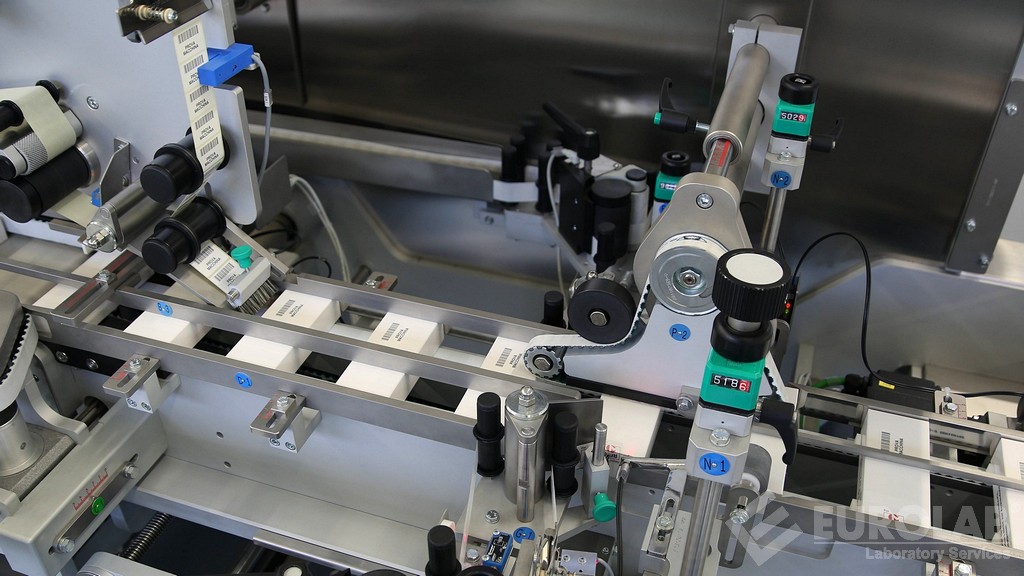
EUROLABhas extensive experience in designing, implementing, interpreting and reporting label migration studies for a wide variety of applications (ophthalmic containers, IV bags, containers used for inhalation administration, polymer vials, prefilled syringes, etc.). supporting this activity EUROLABcan leverage advanced, state-of-the-art analytics capabilities, including Headspace GC/MS, PTV-GC, as well as a comprehensive library of in-house protocols and procedures for tag migration research.
EUROLAB, with its highly expert team and internationally accredited laboratories, Label Migration Tests It performs all test, analysis, measurement, evaluation and report generation services completely and reliably.
To get an appointment, to get more detailed information or to request an evaluation, you can ask us to fill in our form and reach you.

