
The “AATCC EP2 Gray Scale for Dyeing” evaluation procedure, published by the American Association of Textile Chemists and Colorists (AATCC), describes the use of the gray scale to assess staining of undyed textiles resulting from color fastness tests.
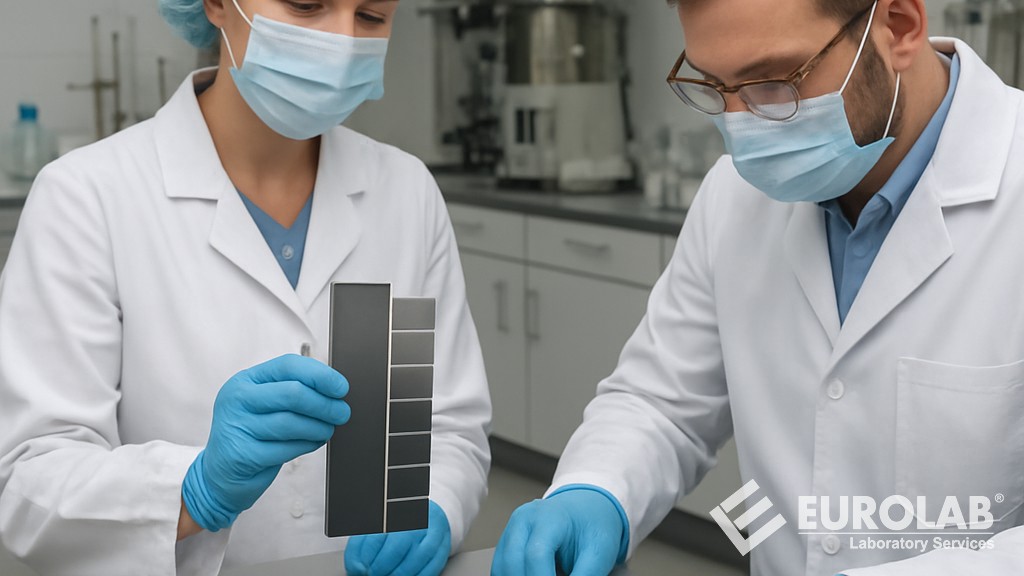
In principle, the staining result obtained from a color fastness test is graded by visually comparing the color difference or contrast between dyed and undyed samples, with differences represented by a scale. The color fastness grade is equivalent to the gray scale step that is considered to have the same color or contrast difference.
For the purposes of this procedure, the following terms apply:
Along with the scale, a mask with three rectangular holes is provided. One is labeled for evaluating stained multi-fibers, the second for evaluating pottery squares, and the third for evaluating general stains. The cleanliness and physical condition of the grey scale are extremely important for obtaining consistent results.
How to use the scale and mask depends on the nature of the stained materials. The following sections deal with creating a combination between stained and unstained materials when necessary:
To achieve visual opacity, unpainted material of the same type is placed behind painted and unpainted materials. Their surfaces are illuminated with a daylight simulator with an illumination level ranging from 1080-1340 lx at the sample plane. The light should strike the surfaces at approximately a 45-degree angle, with the viewing direction approximately perpendicular to the surface plane. The visual difference between the original unpainted and painted parts is compared using differences represented by a grayscale. The sample's rating is the grayscale number that most closely corresponds to the contrast between the original and the tested parts. A score of 5 is given only when there is no difference in color or contrast between the original unpainted material and the tested part.
The equivalent of this assessment procedure is the “ISO 105-A03 Textiles - Color fastness tests - Part A03: Grey scale for stain assessment” standard published by the International Organization for Standardization (ISO). The AATCC EP2 procedure is technically the same scope as the ISO 105-A03 standard, but the procedures may differ in detail.
In short, color fastness refers to a textile's resistance to fading or color bleeding under various conditions such as washing, light exposure, perspiration, friction (abrasion), or heat. Poor color fastness can lead to dyes leaching into other fabrics, skin, or surfaces, making it a critical issue for clothing, upholstery, car seat covers, and other products. AATCC EP2 focuses specifically on assessing staining (how much color leaches into a control or adjacent fabric) and complements AATCC EP1, which assesses color change in the original sample.
This evaluation procedure is widely used in quality control laboratories worldwide.
A grayscale is a card consisting of nine pairs of color chips. One chip in each pair is pure white (representing no staining). The chip in the response progresses from white to progressively darker shades of gray. These pairs correspond to a rating scale from 5 (no staining) to 1 (severe staining), with intermediate steps (e.g., 4-5, 3-4) for more precise evaluations.
Higher scores (closer to 5) indicate better performance and help manufacturers ensure that products like jeans don't bleed color onto white shirts or that car seats remain stain-free.
During testing, the stained adjacent fabric (usually from a multi-fiber test cloth) is visually compared to a scale under controlled lighting. The degree that matches the closest contrast determines the degree of staining.
AATCC EP2 is used as a reference in many color fastness testing methods, including:
The latest updates include more robust designs (e.g., plastic soles for better durability) and improved numbers for rating.
For many years, our organization, with its competent and experienced staff, has been understanding the needs of its clients, providing the advanced testing services they require, and assisting in the establishment, implementation, and improvement of management systems. Within this framework, we also provide testing services to businesses in accordance with the "AATCC EP2 Gray Scale for Painting" evaluation procedure.
To get an appointment, to get more detailed information or to request an evaluation, you can ask us to fill in our form and reach you.

