Lipolytic Bacteria Analysis
Lipolytic bacteria are microorganisms that can hydrolyze lipids to free fatty acids and glycerol through the secretion of lipase enzymes. These bacteria play an important role in a variety of ecological, industrial, and biotechnological processes, including wastewater treatment, soil bioremediation, and biodiesel and detergent production.
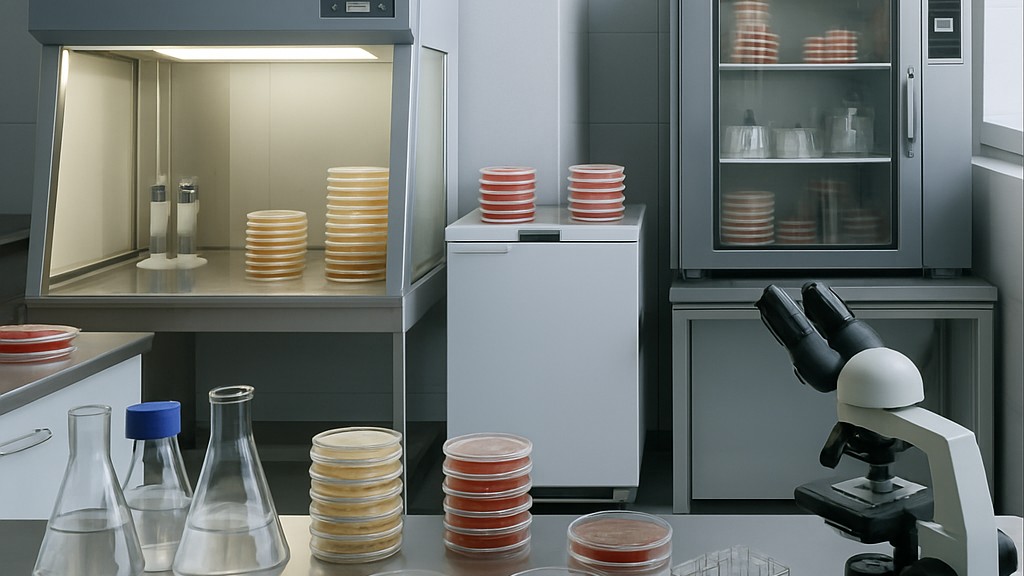
Lipolytic bacteria are widespread in nature, particularly in lipid-rich environments such as oil-contaminated soils, dairy products, and animal fats. The enzymes they produce, known as lipases, catalyze the hydrolysis of triglycerides into glycerol and free fatty acids. Studying these bacteria is important due to their industrial potential and ecological importance.
Lipolytic bacteria can be isolated from various environments:
- Natural habitats: Soil, compost, hot springs and marine environments.
- Industrial waste: Dairy waste, slaughterhouse waste and oil mill residues.
- Food products: Cheese, butter and fermented products.
- Animal microbiota: Intestinal flora of ruminants and other animals.
Common genera include Pseudomonas, Bacillus, Staphylococcus, Acinetobacter, and Burkholderia.
Isolation and screening techniques include:
- Sample collection and pretreatment: Lipolytic bacteria are often isolated from lipid-rich media such as:
- Soil contaminated with oil or grease
- Milk waste
- Compost, animal intestines or industrial waste
Pretreatment of samples may include:
- Dilution in sterile saline or buffer
- Enrichment in lipid-containing media to support the growth of lipolytic microbes
Enrichment: This process increases the population of lipolytic bacteria. The media used are typically:
- Nutrient broth or minimal media supplemented with olive oil, tween-80, tributyrin, or animal fats
- Incubated under aerobic or anaerobic conditions depending on the target bacteria
Primary screening: Detection of lipolytic activity.
- Agar plate methods (qualitative screening) are widely used:
- Tributyrin agar: Contains tributyrin oil as a lipid substrate. Colonies that produce lipase due to lipid hydrolysis produce clear halos.
- Rhodamine B-olive oil agar: Contains olive oil and Rhodamine B dye. Lipase activity causes fluorescent orange halos under UV light.
- Spirit blue agar: Contains lipid emulsion and dye. Lipolytic activity causes halo zones or color change. Creates distinct halos around colonies (tributyrin agar).
Secondary screening (quantitative assays): These confirm and quantify lipase production. Quantitative assays measure lipase activity using titrimetric, spectrophotometric, or fluorometric methods.
- Titrimetric analysis: Lipase activity is assessed by titrating the free fatty acids released from lipid hydrolysis. Common substrates are olive oil and triolein. This method measures the release of free fatty acids after enzymatic hydrolysis using titration with sodium hydroxide.
- Spectrophotometric analysis: Lipase activity is measured by absorbance at specific wavelengths. Chromogenic substrates such as p-nitrophenyl palmitate are used. Lipase cleaves p-nitrophenyl palmitate, releasing p-nitrophenol, measured at 405 nm.
- Turbidimetric and fluorometric analyses: Used for high-throughput screening. Useful for high-throughput screening in industrial applications. Measures changes in turbidity or fluorescence due to substrate degradation.
Molecular techniques:
- 16S rRNA gene sequencing: Molecular identification involves extracting bacterial DNA followed by amplification of 16S rRNA genes for sequencing. Sequencing and comparison with databases identify bacterial species.
- PCR with lipase gene primers: Specific lipase genes are targeted to confirm lipase coding ability.
- Whole-genome sequencing: Provides comprehensive information on lipase genes and other metabolic pathways. It is useful for identifying new enzymes and understanding their regulation. Next-generation sequencing helps uncover new lipase genes and uncharacterized microbial diversity in complex samples.
- Metagenomics (for unculturable bacteria): Direct DNA extraction from environmental samples. Bypasses culturing and is useful for discovering lipase genes in microbial communities. This method has also helped uncover new lipase genes and uncharacterized microbial diversity in complex samples.
Industrial and environmental applications of lipolytic bacterial analysis include:
- Bioremediation: Provides the degradation of oils and greases in contaminated areas.
- Detergent industry: Lipases increase stain removal at low temperatures.
- Food industry: Used in the ripening of cheese and to enhance its flavor.
- Biodiesel production: Lipases catalyze the transesterification of fats into biodiesel.
- Leather and pulp industries: Assists in degreasing and tar removal.
Despite their potential, lipolytic bacteria and their enzymes face challenges such as:
- Low yield or stability of lipases under industrial conditions.
- Difficulty in large-scale enzyme purification.
- Limited understanding of structure-function relationships of novel lipases.
Future research may focus on protein engineering, metagenomics discovery, and synthetic biology approaches to improve lipase production and performance.
Briefly, analytical techniques for lipase activity are:
- Titrimetric analysis: A quantitative analysis method. It measures the amount of free fatty acids released by lipase during lipid hydrolysis. It is a reliable method for crude extracts. It is not suitable for small-scale analysis.
- Spectrophotometric analysis: A quantitative analysis method. It uses chromogenic substrates that release a measurable product upon hydrolysis. It is suitable for high throughput and requires well-controlled reaction conditions.
- Fluorometric analysis: A quantitative analysis method. It uses fluorescent substrates that release a fluorophore when cleaved by lipase. It is suitable for low enzyme concentrations. It is useful for real-time analysis.
- Turbidimetric analysis: It is a semi-quantitative analysis method.Measures turbidity reduction as lipase breaks down emulsified lipids. Useful for crude samples. Non-lipase is affected by turbidity changes.
- Plate assays (agar-based): This is a qualitative/semi-quantitative analysis method. It measures the clearing zone or color change around microbial colonies on lipid-containing agar. It is a visual and easy-to-interpret method. It depends on diffusion and plate conditions.
- Colorimetric analysis: A quantitative analysis method. It measures the color change resulting from lipase activity on lipid-linked dyes. It is useful for end-point analysis. It is less accurate than titration or spectrophotometry.
- Gas chromatography (GC)/HPLC: A highly quantitative method (analytical chemistry). It measures the concentration of glycerol, FFA, or esters formed by lipase. It is highly accurate and sensitive.
Consequently, lipolytic bacteria represent a promising resource for both environmental sustainability and industrial innovation. Advances in microbiology, molecular biology, and biotechnology continue to increase the efficiency of lipase-based processes and reveal new applications.
Our organization, which has been supporting businesses across all sectors for years with a wide range of testing, measurement, analysis, and evaluation activities, has a strong team of employees who closely follow global developments in science and technology and are constantly improving themselves. In this context, we also provide lipolytic bacteria analysis services to businesses.