
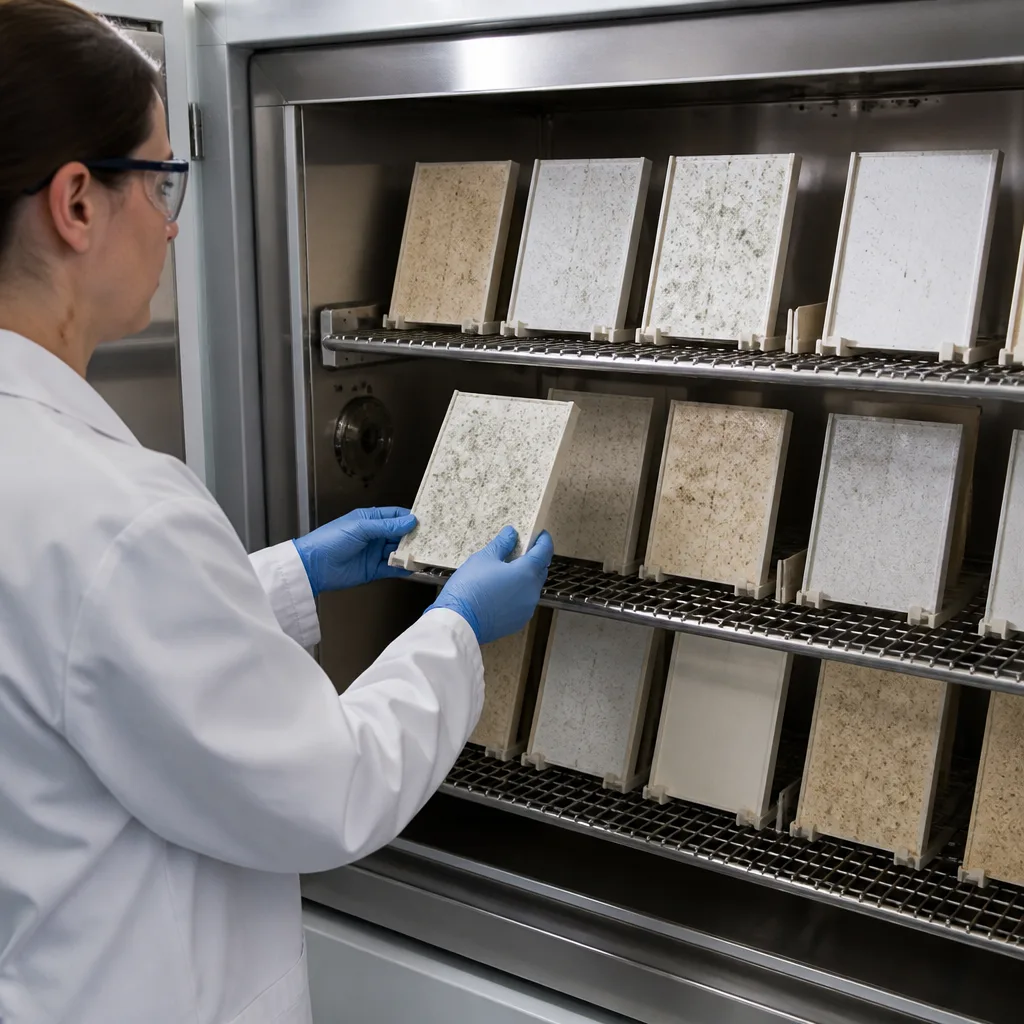
The test method described in the “ASTM D3273 Standard test method for testing resistance to mold growth on the surface of interior coatings in an environmental chamber” standard, developed by the American Society for Testing and Materials (ASTM), defines a small environmental chamber and operating conditions to evaluate the relative resistance of paint films to mold and mildew growth in an indoor environment in a repeatable manner over a 4-week period. The device is designed to be easily constructed or supplied by any interested party and replicates the results obtained in a large environmental chamber.
This testing method can be used to evaluate the comparative resistance of interior coatings to accelerated mold growth. Performance at a given rating does not necessarily imply a specific timeframe for a mold-free coating. However, a higher-rated coating almost always performs better in actual end-use.
This test method is designed to accelerate the assessment of the resistance of interior coatings to fungal-induced degradation. Its use to evaluate the performance of exterior coatings has not been validated, and no limitations have been established for such use.
For the chamber to function reproducibly throughout the short test period, temperature and humidity must be effectively controlled within the specified relatively narrow limits. The severity and speed of mold growth on a film depend on the moisture content of both the film and the substrate. For rapid development of the test panels and to maintain sufficient moisture levels to support mold growth, a temperature of 32,5 degrees plus/minus 1 degree and 95 percent plus/minus 3 percent relative humidity are required.
An accelerated test to determine the resistance of interior coatings to mold growth is useful in predicting the performance of coatings designed for use in indoor environments that promote mold growth, and in evaluating compounds that may inhibit such growth and the overall levels associated with their use.
ASTM D3273 is a widely used test standard for evaluating the resistance of interior coatings (such as paints and varnishes) to mold growth under controlled laboratory conditions.
The primary purpose of this standard is to determine how well a coating can resist mold (mildew) growth when exposed to a high-humidity, mold-promoting environment. This is particularly important for coatings used in the following locations:
The ASTM D3273 test method simulates a humid, mold-prone environment to observe how coatings perform over time. This method generally follows these steps:
This rating helps manufacturers and engineers compare coating performance.
The ASTM D3273 standard is particularly important in industries where hygiene, durability, and indoor air quality are critical:
The ASTM D3274 standard is generally used in conjunction with "ASTM D3273 Standard test method for testing the resistance of interior coatings to mold growth in an environmental room." It focuses on visual surface damage caused by mold rather than resistance.
The necessity of the ASTM D3273 standard stems from health, durability, and quality assurance in humid environments. Without a standardized method for evaluating mold resistance, coatings can fail unpredictably under real-world conditions. The main reasons why this standard is considered important are as follows:
This standard helps create safer indoor environments, especially in homes, hospitals, and workplaces, by testing coatings for their ability to prevent mold growth.
This standard provides a consistent benchmark for manufacturers to demonstrate that their products perform reliably.
Without this method, results would vary between laboratories and be difficult to rely on.
ASTM D3273 is essential because it ensures coatings can withstand mold growth before being used in real-world environments. It protects people, improves product performance, and provides the industry with a reliable, standardized way to measure and compare mold resistance.
In conclusion, the ASTM D3273 standard is a critical standard for evaluating the mold resistance of interior coatings. By simulating real-world humid conditions, it helps coatings provide health protection, durability, and aesthetic stability in moisture-prone environments.
For many years, our organization, with its competent and experienced team, has been understanding the needs of its clients, providing the advanced testing services they require, and assisting them in the establishment, implementation, and improvement of management systems. Within this framework, we also provide testing services in accordance with the ASTM D3273 standard.
To get an appointment, to get more detailed information or to request an evaluation, you can ask us to fill in our form and reach you.

