ASTM D5127-13 Standard Guide for Ultrapure Water for Use in the Electronics and Semiconductor Industries
The "ASTM D5127-13 Standard guide for ultrapure water used in the electronics and semiconductor industries" standard published by the American Society for Testing and Materials (ASTM) describes recommendations for water quality related to electronics and semiconductor industry production.
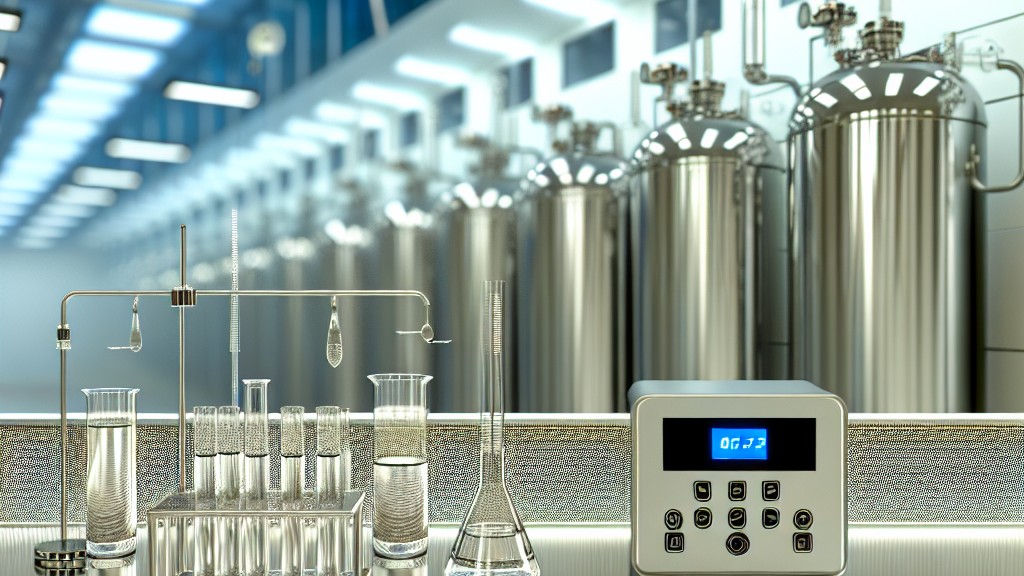
This standard includes seven water classifications, including water for line widths as low as 0,032 microns. In all cases, the recommendations are for water at the point of distribution.
Water is used for washing and rinsing semiconductor components during fabrication. Water is also used for cleaning and etching processes, generating vapors for oxidation of silicon surfaces, preparing photomasks, and depositing luminescent materials. Other applications include the development and manufacture of solid-state devices, thin-film devices, communication lasers, light-emitting diodes, photodetectors, printed circuits, memory devices, vacuum tube devices, or electrolytic devices.
Users requiring water qualities different from those described herein should refer to other water standards such as ASTM D1193-06 Standard Specification for Reagent Water and ASTM D5196-06 Standard Guide for Bioapplication Grade Water.
For the purposes of this standard, in addition to the terms and definitions given in the "ASTM D1129-13 Standard Terminology for Water" standard, the following definitions apply:
- Total bacterial count is the total number of culturable microorganisms present in the specified sample, determined in accordance with ASTM F1094 standard test methods, excluding obligate anaerobic organisms.
- Total organic carbon (TOC) refers to the carbon measured after the inorganic carbon response has been eliminated by one of the prescribed ASTM test methods.
This standard recommends the required water quality for the electronics and microelectronics industries. High purity water is required to prevent contamination of products during production, as contamination is unacceptable and can lead to poor electronic device efficiency. The water purity range is defined as appropriate for the manufacturing process. Ultrapure water types are defined by device line width. In all cases, water quality recommendations apply at the point of distribution. Contamination limits are based on current contamination specifications and available analytical methods (performed in a suitable clean laboratory or with on-line instrumentation). On-line and off-line methods are used in accordance with current industry practice. Concentration of the sample may be required to measure contaminants at levels specified in the table entitled “Water requirements at the point of distribution in the electronics and semiconductor industries” given in the standard.
This standard describes seven types of electronic grade water. In all cases, water quality recommendations apply at the point of distribution. The classification is as follows:
- Type E-1: This water is classified as microelectronic water for use in the production of devices with line widths between 0,5 and 1,0 µm.
- Type E-1.1: This water is classified as microelectronic water for use in the production of devices with line widths between 0,25 and 0,35 µm.
- Type E-1.2: This water is classified as microelectronic water for use in the production of devices with line widths between 0,09 and 0,18 µm.
- Type E-1.3: This water is classified as microelectronic water for use in the production of devices with line widths between 0,065 and 0,032 µm. This type is water of final practical purity produced in large volumes and is intended for the most critical microelectronic uses.
- Type E-2: This water is classified as microelectronic water for use in the production of devices with dimensions between 1 and 5 µm.
- Type E-3: This water class is classified as macroelectronic water to be used in the production of devices with dimensions greater than 5 µm. This class can be used to produce larger components and some small components that are not affected by trace impurities.
- Type E-4: This class may be classified as water used in the preparation of plating solutions and other applications where the water used may be of lower quality.
The components of the water system used to produce electronics grade water should be grouped into five general process sections to simplify the organization of the systems components. These processes are as follows:
- Pretreatment: Treatments in this group include the addition of various types of coagulants, flocculants, clarifiers, sedimentation tanks, and particulate filtration systems (including sand filters, disposable filter elements, ultrafiltration membranes, and other particulate removal systems). Adsorbent or trap beds may include green sand, activated carbon, and various synthetic materials specific for particular organic and inorganic impurities.
- Desalination: This process is fundamental to the production of all grades of ultrapure water and may include ion exchange, reverse osmosis, electrodialysis, continuous electrode ionization, or multiple processes of all of the above. The size of the system determines the combination of desalination processes selected. A variety of configurations of different processes should be considered, including dual-bed and mixed-bed demineralization, multistage reverse osmosis using various membrane types, electrode ionization, and electrodialysis.
- Organic and biological removal systems: Removal of biological and organic contaminants is an important addition to any system used to prepare ultrapure water. Dissolved organic compounds, in addition to being present in the original water, can accumulate in the system during processing. Methods to minimize biological contamination include the addition of hydrogen peroxide and ozone. To obtain maximum effect from irradiation, variables such as water flow and turbidity, degree of specific contaminants such as iron, humic and fluvic acid must be taken into account. Total organic carbon is reduced by the removal of organics.
- Particle removal: In ultrapure water production, particle removal is different from pretreatment, which removes large suspended matter. All types of particles (biological, organic or inorganic) significantly affect the production of electronic components. Processes used to remove particulate matter generally consist of the use of a flat, cylindrical or pleated microporous membrane structure.
- Storage and distribution system: Storage of electronics grade water is critical during production, as impurities are added to the water in proportion to the solubility of the impurities, the contact area, and the contact time between water, air, holding materials, or combinations thereof. Since it is important to minimize contact of water with the storage container, storage volume should also be minimized. High purity nitrogen should be used to blanket the atmosphere above the stored water.
Our organization, which has been trying to support businesses from every sector with its testing, measurement, analysis and evaluation studies carried out in a wide range for years, has a strong staff that closely follows the developments in the world in the field of science and technology and constantly improves itself. In this context, testing services in accordance with the "ASTM D5127-13 Standard guide for ultrapure water used in the electronics and semiconductor industries" standard are also provided to businesses.



