

The standard “ASTM D2463 Standard Test Method for Drop Impact Resistance of Blow-Molded Thermoplastic Containers,” developed by the American Society for Testing and Materials (ASTM), describes a test method for evaluating the drop impact resistance of water-filled blow-molded thermoplastic containers, which is a combination of the effects of the material, manufacturing conditions, container design, and possibly other factors.
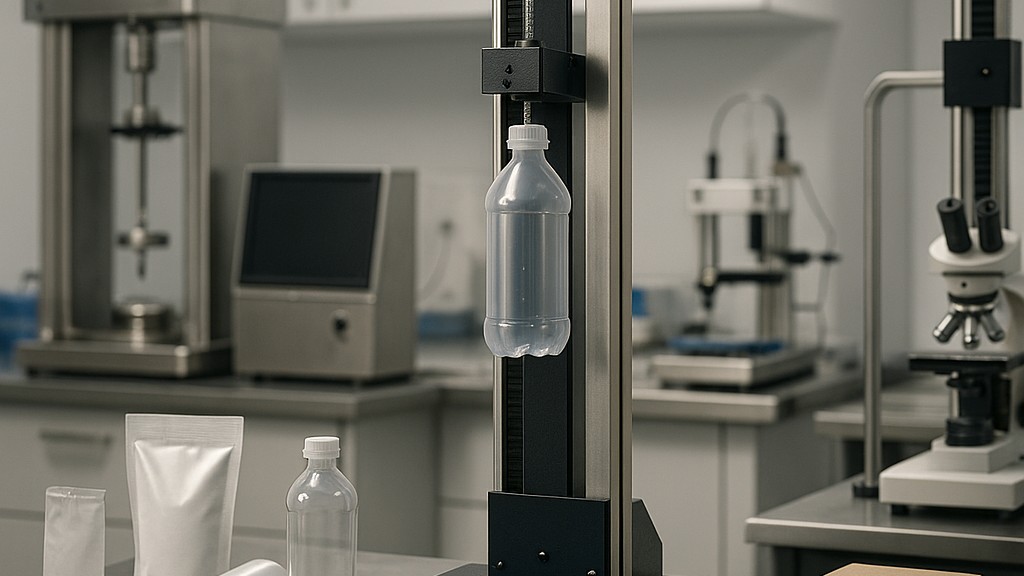
This standard defines the following procedures for these tests:
For the purposes of this standard, the terms and definitions given in ASTM D883 and ASTM E456 apply unless otherwise noted. In addition, any rupture visible to the naked eye and an observer with ordinary vision is considered a failure. This term includes any evidence of liquid on the exterior of the container through any opening other than the molded opening.
Drop impact resistance is determined by dropping conditioned blow-molded water-filled containers from a platform onto a designated surface. Data developed with a water-filled container are not necessarily representative of what would be expected with a carbonated liquid, an aerosol package, a high specific gravity product, or a low bulk density powder.
Procedure A consists of dropping at least 20 containers from a fixed height and reporting the percentage failures. Procedure B consists of dropping at least 20 test containers from varying heights above and below the set's average failure height. A mean failure height and standard deviation are then calculated from the data.
These procedures provide a means of evaluating the drop impact resistance of a group or batch of blown vessels from which test specimens are selected. These procedures are acceptable for routine inspection purposes. These procedures evaluate the combined effects of construction, materials, and processing conditions on the impact resistance of blown vessels.
Before proceeding with this test method, the specification for the material being tested must be consulted. Any test specimen preparation, conditioning, dimensions, or test parameters, or combinations thereof, included in the material specification take precedence over those specified in this test method. If no material specification is available, the default conditions apply.
The drop test machine used in these tests has the following features:
The first procedure, the "Static drop height method," is rapid and particularly useful for quality control purposes. When preparing a sample, a representative sample of blow-molded thermoplastic containers is selected from a group or batch. The containers are filled with water as specified in the material or product specifications. Test specimens are conditioned according to the material specifications (e.g., temperature, humidity). If no specifications are provided, the default conditions specified in the standard are used. A fixed drop height is selected based on the material specifications or test requirements (e.g., a standard height of 1,5 m).
When performing a drop test, each container is dropped from a specified height onto a flat, hard surface (e.g., concrete or steel). The container is typically oriented to drop onto its base or other specified area. It is recorded whether the container exhibits defects (e.g., cracks, leaks, or tears) or survives the drop. The percentage of containers that survive the drop is evaluated to determine the impact resistance of the batch. This method is qualitative and focuses on pass/fail criteria from a fixed height. It is ideal for rapid testing in production environments to ensure consistent quality.
The second procedure, the "Bruceton staircase method," is more analytical and is used to determine the mean failure height and the standard deviation of the failure height distribution. In sample preparation, similar to Procedure A, containers are selected and filled with water, ensuring they meet the material specification requirements. The samples are conditioned according to the material specification or assumed conditions. An initial drop height estimated to be close to the mean failure height is selected (based on prior knowledge or preliminary testing).
When performing a drop test (ladder method), a container is dropped from the initial height. If the container fails (for example, if there are cracks or leaks), the drop height is reduced by a constant increment (e.g., 0,1 m). If the container remains intact, the drop height is increased by the same increment. This process is repeated, adjusting the height based on the results of each drop, using a new container for each test. This process continues until a sufficient number of tests (typically 20-50 tests) have been completed to establish a reliable failure height distribution. The mean failure height (the average height at which 50 percent of the containers fail) is calculated. The standard deviation of the failure height distribution is determined to assess variability. This procedure is considered appropriate for detailed analyses, such as research, development, or certification, where precise failure characteristics are required.
This standard is necessary because it provides a standardized method for evaluating the drop impact resistance of blow-molded thermoplastic containers commonly used in the packaging of chemicals, food, pharmaceuticals, and consumer goods.
Our organization, which has been supporting businesses across all sectors for years through a wide range of testing, measurement, analysis, and evaluation activities, boasts a strong team of employees who closely follow global developments in science and technology and are constantly improving themselves. In this context, we also provide testing services in accordance with ASTM D2463 Standard Test Method for Drop Impact Resistance of Blow-Molded Thermoplastic Containers.
To get an appointment, to get more detailed information or to request an evaluation, you can ask us to fill in our form and reach you.