

The ASTM F1249 Standard Test Method for Water Vapor Transmission Rate Through Plastic Films and Sheets Using Modulated Infrared Sensors , developed by the American Society for Testing and Materials (ASTM) , describes a test method for determining the water vapor transmission rate through flexible barrier materials. This method is applicable to sheets and films up to 3 mm thick, made of single or multi-layer synthetic or natural polymers and foils, including coated materials. This standard allows for the determination of the water vapor transmission rate, the water vapor permeability of the film, and the water vapor permeability coefficient for homogeneous materials. Water vapor permeability and water vapor permeability coefficient values should be used with caution. The inverse relationship between water vapor transmission rate and thickness, and the direct relationship between water vapor transmission rate and the partial pressure difference of water vapor, may not always hold true.
For the purposes of this standard, the following terms and definitions apply:
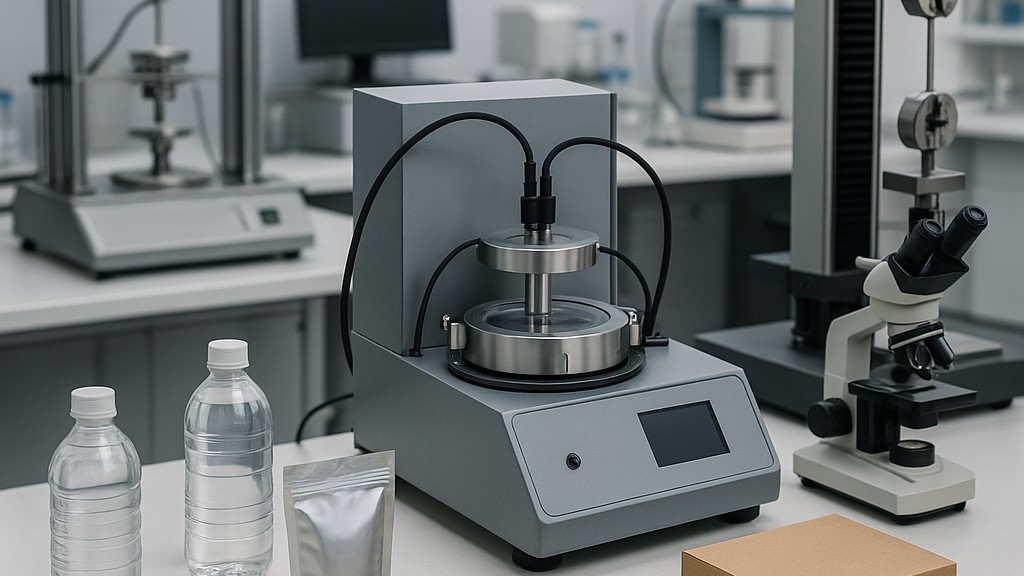
During the test, a dry chamber is separated from a wet chamber of known temperature and humidity by the barrier material to be tested. The dry chamber and wet chamber form a diffusion cell, enclosed by the test film. Water vapor emitted from the film mixes with the gas in the dry chamber and is carried to a pressure-modulated infrared sensor. This sensor measures the fraction of infrared energy absorbed by the water vapor and generates an electrical signal whose amplitude is proportional to the water vapor concentration. The amplitude of the electrical signal generated by the test film is then compared to a signal generated by measuring a calibration film with a known water vapor transmission rate. This information is then used to calculate the rate at which moisture is transmitted through the test material.
The purpose of this test method is to obtain reliable values for the water vapor transmission rate of plastic film and sheet. Water vapor transmission rate is an important property of packaging materials and can often be directly related to the shelf life and stability of the packaged product.
Data obtained from this test method are suitable for use as a referee testing method if the buyer and seller agree on sampling procedures, standardization procedures, test conditions and acceptance criteria.
The ASTM F1249 standard is essential because it provides a reliable and standardized method for measuring the water vapor transmission rate of plastic films and sheets, which is critical in many industries (especially packaging). Here are a few reasons why it is considered so important:
In short, the ASTM F1249 standard provides consistency, reliability, and performance benchmarking for moisture barrier properties in materials where water vapor permeability is a critical factor.
Our organization, which has been supporting businesses across all sectors for years through a wide range of testing, measurement, analysis, and evaluation activities, has a strong team of employees who closely follow global developments in science and technology and are constantly improving themselves. In this context, we also provide testing services in accordance with the "ASTM F1249 Standard Test Method for Water Vapor Transmission Rate through Plastic Films and Sheets Using a Modulated Infrared Sensor."
To get an appointment, to get more detailed information or to request an evaluation, you can ask us to fill in our form and reach you.