ASTM D4169 Transport Containers and Systems Performance Test
Developed by the American Society for Testing and Materials (ASTM), ASTM D4169, Standard Practice for Performance Testing of Shipping Containers and Systems, provides a basis for evaluating the ability of shipping units to withstand the distribution environment in a laboratory. This is accomplished by implementing a test plan consisting of a series of anticipated hazards encountered during various distribution cycles. However, this practice is not intended to replace material properties or existing pre-shipment testing procedures.
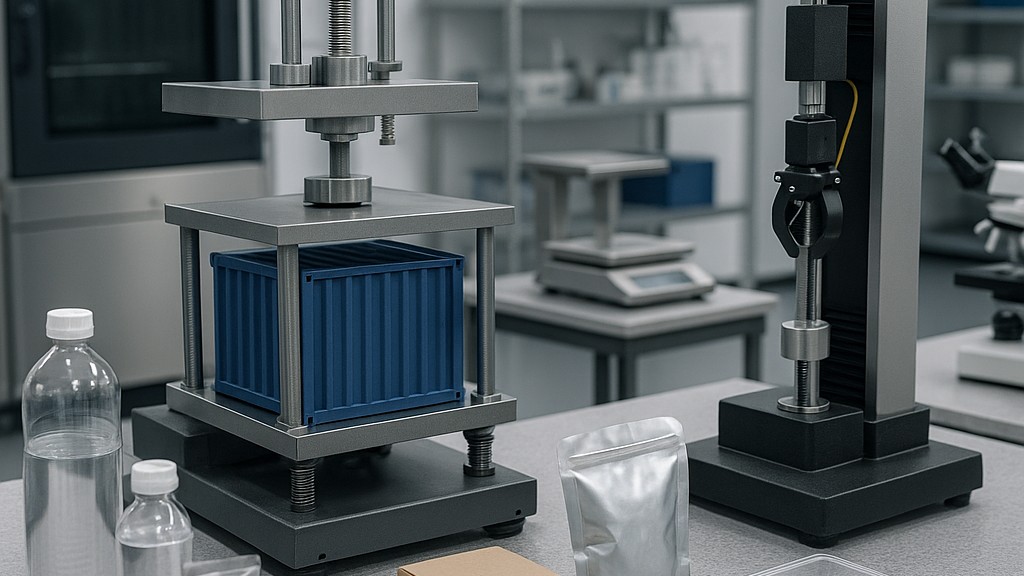
ASTM D7386 is recommended for testing packages for single-parcel shipments. However, its suitability for use with hazardous materials has not been established.
For the purposes of this standard, the following definitions apply in addition to the terms and definitions given in ASTM D996:
- Acceptance criteria refer to the acceptable quality level that must be met after the transport unit has been subjected to the test plan.
- The assurance level represents the level of test intensity based on the probability of occurrence in a typical deployment cycle. Level I is a high test intensity level with a low probability of occurrence. Level III is a low test intensity level but with a correspondingly high probability of occurrence. Level II lies between these extremes. For deployment cycle 18, MIL-STD-2073–1 applies to military protection level definitions.
- The coefficient of restitution expresses the ratio of the rebound velocity to the impact velocity.
- A distribution cycle is a sequential list of test schedules used to simulate the hazard elements expected to occur for a specific route of a transport unit from production to consumption.
- A feeder aircraft refers to a small, potentially unpressurized aircraft used to transport express packages.
- A hazard element is a specific event occurring in a distribution cycle that could pose a hazard to a transport unit. The element is typically simulated with a single test schedule.
- A shipping unit refers to the smallest complete unit that will be placed in a distribution medium, such as a shipping container and its contents. A small shipping unit is defined as a unit that has no side dimension or diameter greater than 1,52 m and a gross weight of 45 kg or less. A large shipping unit is defined as a unit that has at least one side dimension or diameter greater than 1,52 m or a gross weight greater than 45 kg or a gross weight greater than 45 kg and is secured to a base or the bottom of a shipping unit.
- A test plan is a specific list of the sequence of tests to be followed to simulate anticipated hazards during a shipping unit's deployment cycle. This includes the test intensity and the number of sequential tests to be conducted.
- The test program includes a reference to the specific procedure to be used, the three assurance level intensities, and the test methodology underlying the program. The program's purpose is to simulate the forces generated during each hazard element of the deployment cycle.
- The total velocity change is the sum of the impact and rebound velocities.
Test samples consist of representative samples of complete shipping units, including the actual contents. Products with defects or minor defects may be used if the defective component will not be examined by testing and the defect will be documented in the report. Dummy test loads are acceptable if testing the actual product would be hazardous. If a dummy load is used, instrumentation must be used to determine whether the actual product's fragility level is exceeded.
If test packages are sent to the testing site, care should be taken to ensure there is no damage to the product or packaging. If there is any doubt about the condition of the package, the product should be repackaged in new packaging material before testing.
The number of retests depends on the desired testing objectives and the availability of spare products and shipping containers. Retesting is recommended to increase the reliability of test results.
If the distribution cycle includes climatic conditions that affect the performance characteristics of the product, shipping container, or components such as cushioning, one of the following procedures is used:
- Testing is conducted under standard conditions, compensating for any climatic conditions. Shipping units are conditioned in a standard atmosphere of 23 degrees Celsius plus/minus 1 degree Celsius and 50 percent relative humidity plus/minus 2 percent. The same atmospheric condition must be used for any given level of assurance. A conditioning period of 72 hours, or sufficient time for all components of the packaging and product to reach equilibrium, is recommended.
- In some cases, it may be necessary to perform some or all tests under specific climatic conditions, such as those listed in ASTM D4332 or ASTM D951, or others (salt, spray, water immersion, humidity, or temperature). The same climatic conditions should be used for any given level of assurance. A conditioning period should be provided to allow sufficient time for all components of the package and product to reach equilibrium.
In short, this standard provides a structured method for testing the ability of packaging systems to withstand distribution hazards. It is typically used for packages shipped by various means, such as truck, air, or rail. The general steps involved in applying this standard are:
- Determination of the transport medium (distribution cycle): e.g. motor freight, air and motor freight, international shipments or export shipments with sea containers).
- Select the assurance level: Level I is the most severe, Level II is moderate (most commonly used), and Level III is the least severe.
- Determining the package type and contents: Package configuration, product type and fragility, and package weight and dimensions.
- Developing the test plan (hazard sequence): Creating a test sequence based on the selected deployment cycle and assurance level. For example, handling (drop tests, rotational impact), compression (static and dynamic compression), vibration (random or repetitive vibration), shock (inclined impact or horizontal impact), and environmental (atmospheric conditioning).
- Conditioning the package: The package is preconditioned according to environmental guidelines (e.g. temperature and humidity), if applicable.
- Performing tests: Tests are performed in the specified order. Typical tests may include:
- Drop tests at specified heights and directions
- Compression test for stacking strength
- Vibration test simulating transportation
- Shock tests, such as impacts from sudden stops
- Evaluating the results: After the test, the package and product are inspected. Product damage is checked, the package integrity is assessed, and the package still meets the performance criteria.
Our organization, which has been supporting businesses across all sectors for years through a wide range of testing, measurement, analysis, and evaluation activities, has a strong team of employees who closely follow global developments in science and technology and are constantly improving themselves. In this context, we also provide testing services in accordance with ASTM D4169 Standard Practice for Performance Testing of Shipping Containers and Systems.