

The standard “ASTM F2054/F2054M Standard test method for burst testing of flexible package gaskets using internal air pressurization within restraint plates” developed by the American Society for Testing and Materials (ASTM) describes a test method for determining the minimum burst strength of a gasket placed around the perimeter of a flexible package and internally pressurized and sealed within restraint plates.
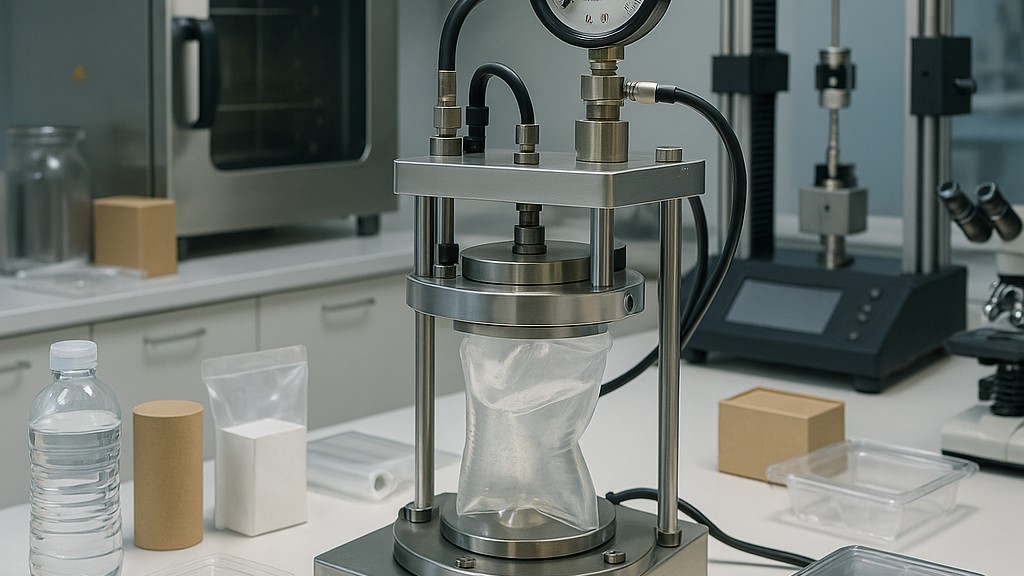
Bursting testing of flexible package seals is essential to ensure the integrity, reliability, and safety of packaging used for products, particularly in the medical, pharmaceutical, and food industries. This test measures the maximum internal pressure a sealed package can withstand before rupturing. This helps verify that the seals are strong enough to protect the contents during shipping, storage, and handling.
Furthermore, for medical devices or sterile products, a weak seal can lead to contamination, compromise of sterility, and patient risk. Regulatory agencies, most notably the Food and Drug Administration (FDA), often require evidence from burst testing to verify packaging performance. These tests help manufacturers identify weak seals, seal defects, or variations in production. They aid in the verification of packaging processes and ensure consistent seal quality across batches. Unlike visual inspections, burst testing provides measurable results (e.g., pressure at the point of failure). This makes it easier to establish acceptance criteria, compare materials, and troubleshoot problems.
The test methods described in ASTM F2054/F2054M are functionally similar to ASTM F1140, except for the use of limiting plates. ASTM F1140 describes burst test methods that do not include limiting plates and are suitable for determining a package's overall ability to withstand compressive stresses. Under ASTM F1140, stresses are not distributed evenly across the entire sealing area of the package. Under unconfined conditions, the stress on the package is greatest at the center of the pouch, where the package expands to its maximum diameter. Therefore, the test methods described in ASTM F1140 do not reliably identify the weakest area of the seal.
A burst test pressurizes the package internally and progressively until an area of the package seal around the package perimeter bursts in response to the pressure. By enclosing the package within restrictor plates during pressurization, the dimensional stability of the package is maintained, resulting in more uniformly applied stresses along the package perimeter where the seals would normally be located. This allows the test to more likely identify the weakest area of the seal and provide a measure of the pressure required to burst the package open.
This test method is only applicable to flexible packages with seals placed around the perimeter of the flexible package. It is specifically intended to be applicable to packages with peelable seals (seals that are peeled by the end user to remove the package contents). Insufficient volume flow may be the cause of porous barrier materials failing to achieve sufficient pressure to burst the package seals.
This test method provides a rapid means of assessing the tendency for package seal failure when the package is subjected to a pressure differential. Pressure differentials can occur during processes such as sterilization and transportation. This test method provides an indication of the bursting strength of a package where bursting would normally occur in one or more areas of the seal. An indication of the minimum bursting strength can be important to the package manufacturer and the end user in ensuring adequate package integrity. This test method cannot provide a measure of package seal uniformity. This test method also cannot provide an assessment of overall package integrity or the bursting strength of the areas of the package that come into contact with the surface of the used limiting plates. This test method should be combined with other methods of assessing overall package integrity, package seal uniformity, or opening functionality, if necessary.
This test method is frequently used to quickly assess the strength of the package seal during the manufacturing process and at various stages of the package life cycle.
If correlations are to be made between pieces of test equipment, it is important that all test parameters are equivalent. Typical parameters may include, but are not limited to:
The ASTM F2054/F2054M standard is important because it provides a consistent and validated method for evaluating the performance of surgical sealants and adhesives used in medical procedures. This standard is considered important for the following reasons:
Ultimately, the ASTM F2054/F2054M standard is important because it provides a standard method for burst pressure testing, ensuring the safety, reliability, and effectiveness of medical sealants. This supports both regulatory compliance and product innovation in the medical device industry.
Our organization, which has been supporting businesses across all sectors for years through a wide range of testing, measurement, analysis, and evaluation activities, boasts a strong team of employees who closely follow global developments in science and technology and are constantly improving themselves. In this context, we also provide testing services in accordance with the "ASTM F2054/F2054M Standard Test Method for Bursting Test of Flexible Package Seals Using Internal Air Pressurization within Restriction Plates" standard.
To get an appointment, to get more detailed information or to request an evaluation, you can ask us to fill in our form and reach you.