

The standard "ASTM F1306 Standard Test Method for Slow-Rate Penetration Resistance of Flexible Barrier Films and Laminates," developed by the American Society for Testing and Materials (ASTM), allows flexible barrier films and laminates to be characterized for their slow-rate penetration resistance against a driven probe. The test is conducted at room temperature by applying biaxial tension to the material at a single test speed until puncture occurs. The force, energy, and probe penetration to failure are determined.
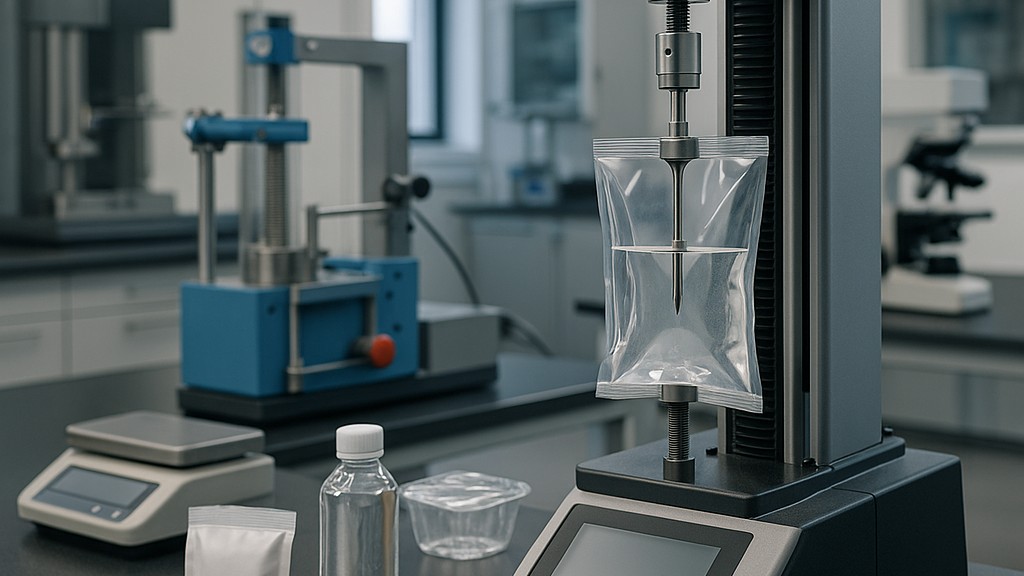
Penetration resistance is a critical end-use performance characteristic of thin, flexible materials where sharp-edged products can compromise the integrity of the barrier wrap. This allows gases, odors, and undesirable contaminants to enter or exit the package, potentially damaging the product and reducing shelf life. A material's response to penetration varies depending on numerous factors, including film thickness, elastic modulus, penetration rate, temperature, shape, and probe type. Consequently, this method allows material responses from puncture to tension to be observed and measured. While numerous combinations of experimental factors can be designed and used to simulate specific end-use applications, the recommended conditions in this method should be followed for standard material comparisons.
Slow-rate penetration resistance of flexible barrier films and laminates is a mechanical test method used to evaluate how well flexible packaging materials (such as plastic films and laminates) resist puncture by a sharp object under slow, controlled loading conditions. More simply, it measures how difficult it is to slowly puncture packaging films with a sharp probe. This simulates conditions such as a product inside a package pushing against it over time.
Flexible barrier films and laminates are materials commonly used in food, medical, or industrial packaging. They are designed to be lightweight, flexible, and resistant to moisture, oxygen, and punctures.
Penetration resistance is a measure of how much force a material can withstand before being punctured.
During testing, a probe (usually round or conical) is pushed into the film at a slow, steady rate, simulating gradual pressure (as during stacking, storage, or transportation), as opposed to sudden impacts. Standard tests are generally performed as described in ASTM F1306.
Manufacturers require this testing method to ensure that packaging can:
For companies evaluating or designing flexible packaging (e.g., vacuum bags, medical device packaging), this test method helps compare materials or check whether they meet required performance criteria.
The main equipment used in the tests are:
Samples are conditioned at the start of testing . Unless otherwise specified, film samples are conditioned for at least 40 hours at a temperature of 23 degrees plus/minus 2 degrees and a relative humidity of 50 percent plus/minus 5 percent.
Samples are generally cut into squares or circles measuring at least 76 mm x 76 mm. Samples should be flat, wrinkle-free, and free from visible defects.
The film is placed in the sample holder and compressed tightly to create tension. The test area should be flat and centered on the probe. The appropriate probe size is selected (e.g., a 3 mm diameter hemisphere). The crosshead speed is set to 250 mm/min (unless otherwise specified). The load cell is calibrated, and the displacement and force readings are zeroed. The test is then initiated. The probe moves downward at a constant speed to penetrate the film. The machine records the force versus distance until the film tears or the maximum penetration depth is reached. The peak force at fracture (maximum load) is measured and reported.
Optionally report: fracture energy (area under the curve), distance at fracture, and post-failure behavior (if required).
A force-displacement curve is generated as the test output. The peak force is used as a measure of penetration resistance. This helps compare the mechanical strength of different films or lamination structures.
For statistical reliability, the test is repeated at least five times. Tests are also performed under different conditions (e.g., after aging, exposure to heat or cold, or in wet conditions).
Our organization, which has been supporting businesses across all sectors for years through a wide range of testing, measurement, analysis, and evaluation activities, has a strong team of employees who closely follow global developments in science and technology and are constantly improving themselves. In this context, we also provide testing services in accordance with ASTM F1306 Standard Test Method for Slow-Speed Penetration Resistance of Flexible Barrier Films and Laminates.
To get an appointment, to get more detailed information or to request an evaluation, you can ask us to fill in our form and reach you.