

The “TAPPI T 511 Paper Fold Strength (MIT Tester)” standard, developed jointly by the Pulp, Paper and Converting Industries Technical Association (TAPPI) and the American National Standards Institute (ANSI), describes the method of using an MIT-type device to determine the fold strength of paper. An exhaust fan arrangement keeps the folding head at room temperature.
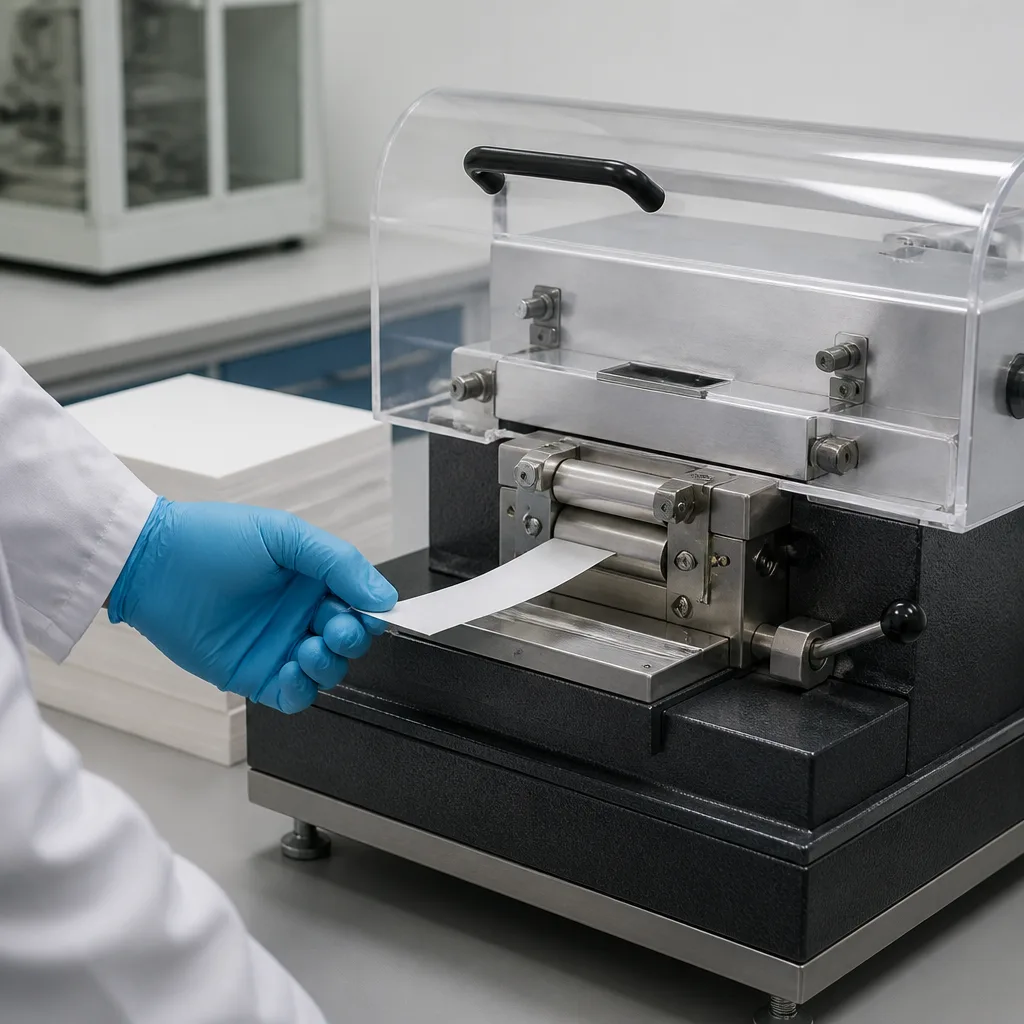
The MIT testing device is suitable for papers of all thicknesses; however, if the outer fibrous layers of paper thicker than approximately 0,25 mm tear during the first few folds, the test becomes irrelevant. The procedure for the Schopper-type device is given in the “TAPPI T 423 Paper folding strength (Schopper-type testing device)” standard.
The TAPPI T 511 standard defines a widely accepted standard testing method. This standard measures the fold strength of paper using an MIT-type fold strength tester. This method determines how many times a sample of paper can be repeatedly folded under controlled tension before breaking. This property is critical for evaluating the durability and longevity of paper in applications involving repeated bending, folding, or creasing.
Folding strength is an important indicator of a paper's ability to withstand mechanical stress over time. The test is particularly valuable in the following situations:
Higher fold strength values generally indicate stronger fiber bonding and better resistance to fatigue. This testing method is useful for quality control, product development, and predicting real-world performance.
The MIT testing device works as follows:
In the standard setup, an exhaust fan system is used to keep the folding head at room temperature and prevent heat buildup. The method is suitable for papers of various thicknesses, but with very thick papers (at least 0,25 mm), tearing of the outer layer may occur prematurely, which can reduce the significance of the test.
The main characteristics of this method are as follows:
The industrial applications of this standard are as follows:
In short, the TAPPI T 511 standard remains a fundamental test for evaluating mechanical strength in the paper industry. By measuring a paper's resistance to repeated folding, it provides manufacturers, converters, and end-users with critical data for material selection and performance prediction.
For laboratories and manufacturers, investing in a calibrated MIT fold strength testing machine provides reliable and standardized results that align with global industry expectations.
Paper products such as maps, banknotes, packaging inserts, books, labels, and specialized technical papers are frequently subjected to repeated bending and folding during use. The TAPPI T 511 standard provides a repeatable way to assess a paper's resistance to bending fatigue. Essentially, it shows how well it withstands repeated folding stress. Without a standard method, comparing durability between different paper grades or manufacturers would not be reliable.
The method described uses an MIT folding strength tester that repeatedly folds a narrow strip of paper under a specific load until it breaks. The process works as follows:
The results are generally expressed as follows:
The TAPPI T 511 standard checks various variables to ensure consistency:
Because paper properties are versatile, testing in both directions is generally recommended.
The main equipment used in the tests is as follows:
The MIT test device is specifically designed to apply repeated sharp folds while maintaining controlled tension.
The TAPPI T 511 standard is widely used in the following areas:
The TAPPI T 511 standard is important because folding is one of the most common mechanical stresses on paper. It helps manufacturers with the following:
For example, highly fine fibers can increase tensile strength but reduce ply strength. Long fibers generally increase ply resistance. Therefore, this standard helps to balance strength, flexibility, and usability.
For many years, our organization, with its competent and experienced team, has been understanding the needs of its clients, providing the advanced testing services they require, and assisting them in the establishment, implementation, and improvement of management systems. Within this framework, we also provide testing services compliant with the TAPPI T 511 standard.
To get an appointment, to get more detailed information or to request an evaluation, you can ask us to fill in our form and reach you.

