
The standard “ASTM E595-15 Standard Test Method for Total Mass Loss from Outgassing in a Vacuum and Collected Volatile Condensables” published by the American Society for Testing and Materials (ASTM) describes a screening technique for determining the volatile content of materials when exposed to a vacuum environment. Two parameters are measured in this test method: total mass loss and collected volatile condensables. An additional parameter, the amount of water vapor recovered, can also be obtained after completion of the required exposures and measurements for total mass loss and collected volatile condensables.
This test method describes the test apparatus and associated operating procedures for evaluating the mass loss of materials exposed to 125 degrees Celsius at a pressure lower than 7 x 10⁻¹ Pa for 24 hours . Overall mass loss can be classified as non-condensable and condensable. The latter are characterized here as having the ability to condense on a collector at a temperature of 25 degrees Celsius.
Unless otherwise stated, the tolerance at 25 and 125 degrees is plus/minus 1 degree and the tolerance at 23 degrees is plus/minus 2 degrees. The relative humidity tolerance is plus/minus 5 percent.
Many types of organic, polymeric, and inorganic materials can be tested. These include polymer filler compounds, foams, elastomers, films, tapes, insulations, shrink tubing, adhesives, coatings, fabrics, ties, and lubricants. Materials can be tested as received or prepared for testing according to various cure properties.
This test method is primarily a screening technique for materials and may not be valid for calculating actual contamination on a system or component due to differences in configuration, temperatures, and material processing.
The criteria used for acceptance and rejection of materials must be determined by the user and are based on specific component and system requirements. Historically, 1,00 percent total mass loss and 0,10 percent collected volatile condensable materials have been used as screening levels for rejection of spacecraft materials.
The use of materials deemed acceptable in accordance with this test method does not guarantee that the system or component will remain uncontaminated. Therefore, subsequent functional, developmental and qualification tests should be used as necessary to ensure that the performance of the material is satisfactory.
This standard is not intended to address all safety concerns, if any, associated with its use. It is the responsibility of the user of this standard to establish appropriate safety, health, and environmental practices and to determine the applicability of regulatory limitations prior to use.
For the purposes of this standard, the following terms and definitions apply:
This microvolatile condensate system was developed from an earlier system for the determination of macrovolatile condensates, which required much larger samples and a longer test period.
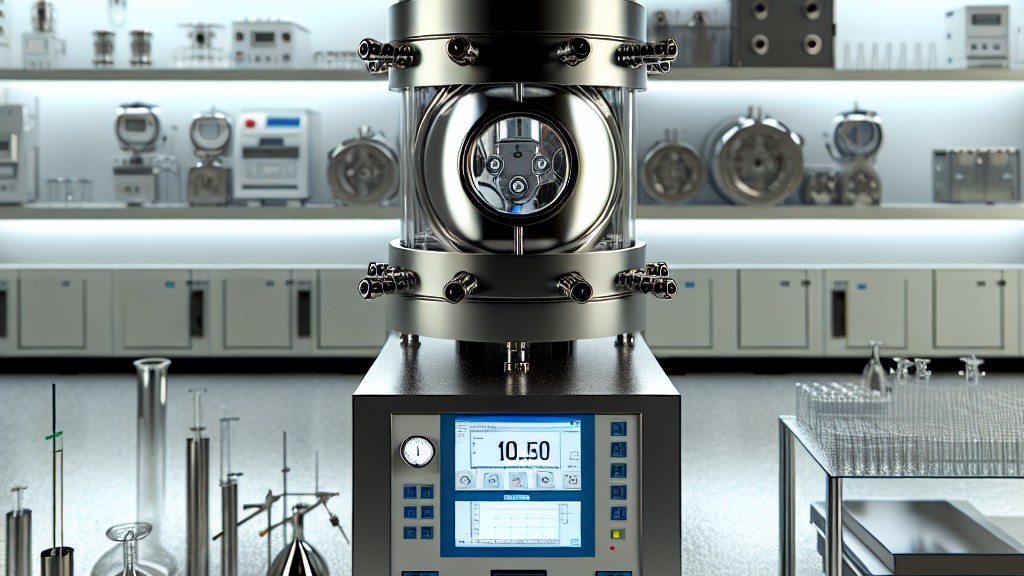
The test sample is weighed and exposed for 24 hours to a temperature of 23 degrees and 50 percent relative humidity in a pre-formed, degreased container. After this exposure, the vessel and sample are weighed and placed in one of the sample chambers in the copper heating rod, which is the pan of the testing apparatus. The copper heating rod can accommodate multiple samples for testing simultaneously. The vacuum chamber in which the heating rod and other parts of the testing apparatus are placed is then sealed and evacuated to a vacuum of at least 7 x 10⁻³ Pa . The heating rod is used to raise the sample chamber temperature to 125 degrees. This causes vapor from the heated sample to flow through a hole in the sample chamber. Some of the vapor passes into a collector chamber where some vapor condenses on a chrome-plated collector plate that has been previously weighed and is independently temperature-controlled, maintained at 25 degrees. Each sample chamber has a corresponding collector chamber isolated from the others by a partitioned separator plate to prevent cross-contamination. After 24 hours, the test apparatus is cooled and the vacuum chamber is repressurized with a dry, inert gas. The sample and collector plates are weighed. From these results and the sample mass determined before vacuum exposure, the percentage of total mass loss and the percentage of volatile condensable material collected are obtained. Normally, the reported values are the average of the percentages obtained from three samples of the same material.
After the sample is weighed to determine the total mass loss, the water vapor recovered may be determined, if desired, as follows: the sample is stored at 23 degrees Celsius and 50 percent relative humidity for 24 hours to allow the water vapor to be absorbed. The mass of the sample is determined after this exposure. From these results and the mass of the sample determined after vacuum exposure, the percentage of water vapor recovered is obtained.
Our organization, which has been trying to support businesses from every sector with its testing, measurement, analysis and evaluation studies carried out in a wide range for years, has a strong staff that closely follows the developments in the world in the field of science and technology and constantly improves itself. In this context, testing services are also provided to businesses in accordance with the standard "ASTM E595-15 Standard test method for total mass loss from gas exit in a vacuum environment and collected volatile condensable materials".
To get an appointment, to get more detailed information or to request an evaluation, you can ask us to fill in our form and reach you.