
The European standard "EN 3844-1 Aerospace series - Flammability of non-metallic materials - Part 1: Small burner test, vertical - Determination of vertical flame spread" describes a test method for determining the vertical flame spread and after-flame time of some or all non-metallic materials. This test method is also used to test non-metallic materials that must meet the test criteria for the vertical Bunsen burner test:
It is used to evaluate non-metallic materials or structures used in aerospace interiors, but may also be used in other applications specified in applicable procurement and regulatory documents. This standard should be used to measure and describe the properties of non-metallic materials, products, or assemblies in response to heat and flame under controlled laboratory conditions and should not be used to define or evaluate the fire hazard or fire risk of materials, products, or assemblies under actual fire conditions. However, the results of this test may be used as elements of a fire risk assessment that considers all relevant factors in assessing the fire hazard of a particular end use.
For the purposes of this standard, the following terms and definitions apply:
This test method is performed on a vertically held specimen. A burner flame with defined parameters is applied to the specimen for a specified period. The afterflame time and burn length are measured. The formation of droplets and the afterflame time are measured.
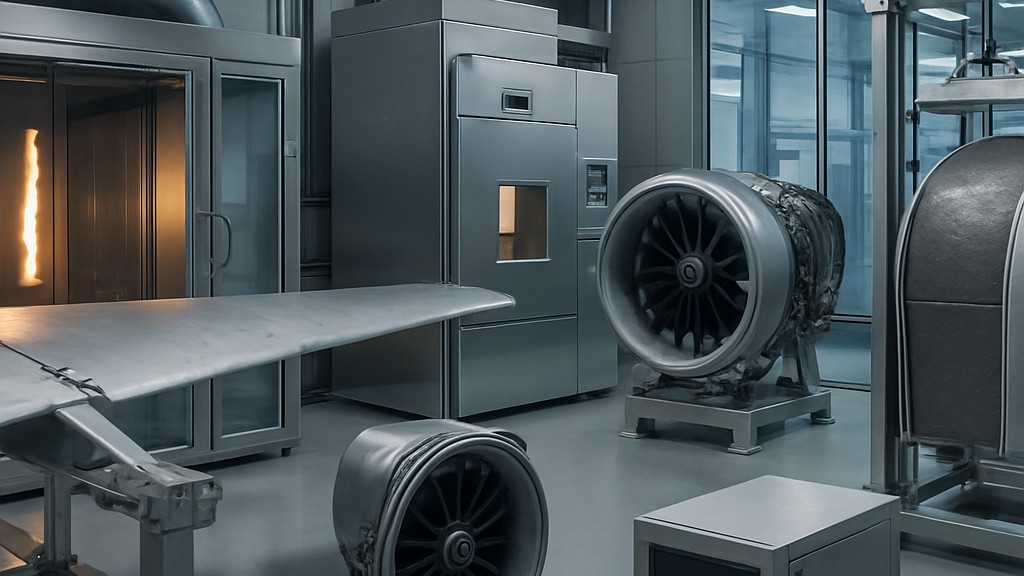
Tests should be conducted in a draft-free cabinet or other equivalent enclosure as shown in the figure provided in the standard. Details and dimensions of a suitable test cabinet are given in the figure. Larger sizes of cabinets may be used if similar results are demonstrated. 1 mm thick sheet metal should be used for the cabinet bottom surface. It is recommended that the entire interior rear wall of the cabinet be painted matte black to facilitate viewing of the test specimen. A mirror can be placed on the interior rear surface to facilitate observation of the hidden surface. It is recommended that the cabinet be located inside an exhaust hood to facilitate cleaning of smoke and soot after each test.
A sample holder must be provided with a minimum sample open area of 50 mm x 305 mm. The sample holder must be constructed of corrosion-resistant metal. A comb can be used for testing small parts that cannot be mounted on the sample holder.
The burner should be of the Bunsen or Tirrill type, have a 9,5 mm inside diameter barrel, and be equipped with a needle valve to regulate the gas flow rate and thus the flame height. No direct or aspirated air should be supplied to the burner. A Bunsen burner as defined in ASTM-D 5025 has been deemed acceptable. Methane gas should be used as the burner fuel. Natural gas is acceptable if it contains more than 90 percent methane.
The required gas connections and applicable installation are shown in the figure. A control valve system with a delivery rate designed to supply gas to the burner under a pressure of 17 plus/minus 2 kPa at the burner inlet must be installed between the gas supply and the burner.
A flame indicator should be used. The indicator should have two height indicators, for example, points marked at 22 mm and 38 mm above the top of the burner. When the flame is properly adjusted, the flame tip is at the 38 mm tip, and for pure methane, the tip of the inner cone of the flame is at the 22 mm tip. The flame height indicator may be removable.
Once the height is set, the flame temperature is measured using a calibrated thermometer and a dedicated thermocouple. The tip of the thermocouple should be completely submerged in the flame. The flame temperature should be at least 843°C.
At least three samples should be prepared and tested. For materials that may have anisotropic flammability properties, samples should be tested in both orientations.
Samples must be at least a 75 mm x 305 mm rectangle, unless the actual size used on the aircraft is smaller. If the part structure uses multiple thicknesses, the minimum thickness is tested. Foam parts thicker than 13 mm, such as seat cushions, are tested at 13 mm thicknesses.
Samples are conditioned for at least 24 hours at 23°C (72°F) plus/minus 2°C and 50% relative humidity (RH) plus/minus 5%. Only one sample at a time is removed from the conditioned medium immediately prior to testing.
Our organization, which has been supporting businesses across all sectors for years through a wide range of testing, measurement, analysis, and evaluation activities, boasts a strong team of employees who closely follow global developments in science and technology and are constantly improving themselves. In this context, we also provide testing services in accordance with the EN 3844-1 Aeronautical series - Flammability of non-metallic materials - Part 1: Small burner test, vertical - Determination of vertical flame spread standard.
To get an appointment, to get more detailed information or to request an evaluation, you can ask us to fill in our form and reach you.