
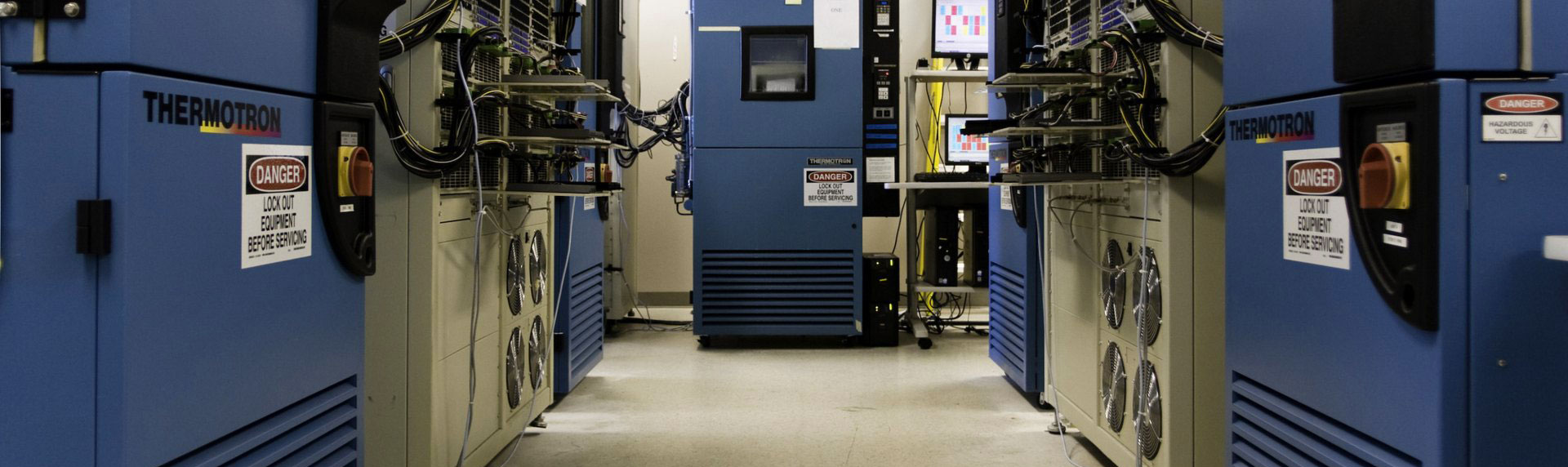
HALT (Highly Accelerated Life Test) and HASS (Highly Accelerated Stress Screen) tests are test methods that can detect process or production defects in products before they are released to the market.

You can test laboratory, IEEE 323 or other commercial/military standards (501.1, 502.1 and 507.1 MIL-STD-810 methods and MIL-STD-202D Method; 102A, RTCA/DO-160, etc.). Environmental chambers of various sizes, including large walk-in chamber chambers, help you run your testing program effectively. Except under special circumstances, it can maintain a temperature range of +200°F to -200°F and a relative humidity range of 40% to 100%.
This test provides a controlled corrosive environment and is used to provide corrosion resistance information for metals and metal coated surfaces. The test consists of spraying a salt solution in a uniform liquid phase onto the device under test. The common standard used for this test is ASTM B117, and other MIL-STD-810 and ISO-9227 tests are available.
Changes in relative humidity have environmental effects on a range of products causing problems such as corrosion, oxidation, electrical failure, material expansion, accelerated wear, brittleness or granulation. Moisture test results are an important factor in product quality assurance, as these issues affect the life or operation of components. Various ambient chambers allow for overlapping humidity characteristics with temperature, altitude, and functional testing in other applications.
Identify product vulnerabilities over a wide temperature range without thermal shock. High-temperature testing can identify weaknesses in electronic equipment, such as resistance and inductance of circuits, softening or expansion of molded parts, or accelerated aging, while low-temperature testing can reveal weaknesses such as brittleness, electrical stability, or freezing from moisture.
Tests with ramp rates in excess of 50°C/min can confirm the change in product performance in extreme temperature environments.
Lifecycle aging/product durability testing performs battery testing that simulates equipment lifecycles. This test can also accelerate the aging process of equipment through various other test systems and processes.
The effect of low pressure and low pressure at high altitudes on a product, often called a "decompression test", is determined. Because many types of shipping packaging have the potential to tear or leak during height changes, tests such as MIL-STD-810, ASTM D6653, IEC 60068-2-13, RTCA/DO-160 are performed.
HALT (Highly Accelerated Life Test) and HASS (Highly Accelerated Stress Screen) tests are test methods that can detect process or production defects in products before they are released to the market. The HALT test is configured to apply a small amount of temperature and vibration shock for the unit time and short duration of the test.
Typically, these tests are performed at every stage of the product development process. The HASS test applies high levels of temperature and vibration shocks for much longer periods than normally applied. HASS tests are usually done after HALT tests because of their extreme levels.
To get an appointment, to get more detailed information or to request an evaluation, you can ask us to fill in our form and reach you.

