
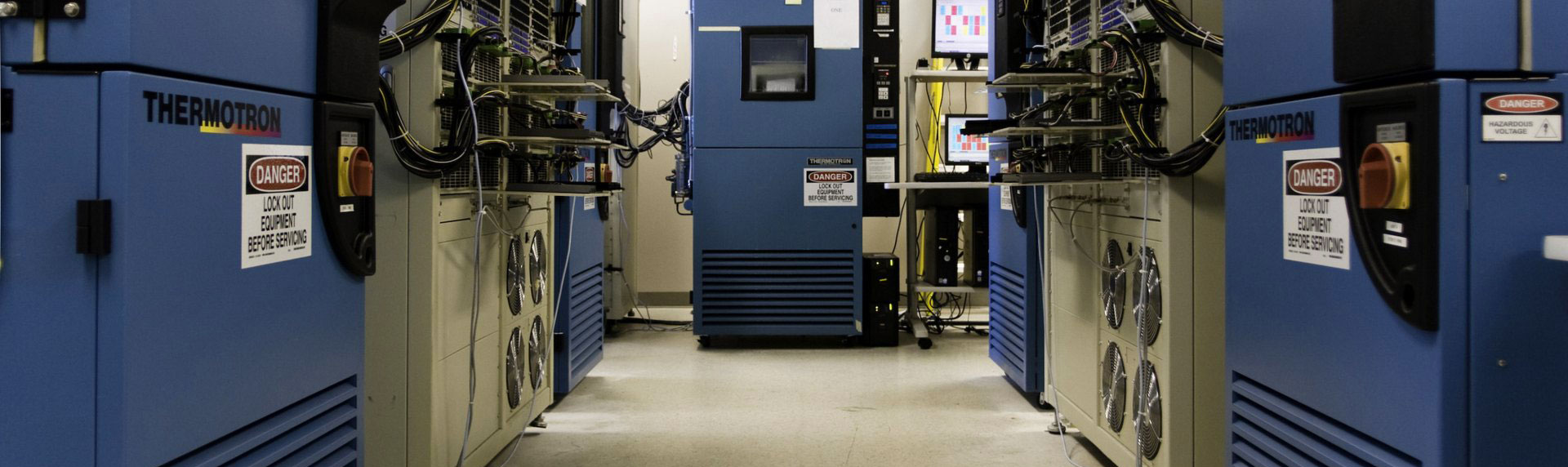
Highly Accelerated Stress Scanning (HASS) techniques are performed during the production phase to find manufacturing process defects that could cause product failures in the field. With this testing method,

HASS testing uses accelerated stresses (beyond product specifications and as determined by previous highly accelerated life test HALT tests) to detect product defects in production screens. HALT testing is important in uncovering many of the weak links that exist in the design and manufacturing processes of a new product.
The accelerated stresses of the HASS program shorten the time to failure of defective units and therefore reduce the time for corrective action and the number of units produced with similar defects. Many problems caused by process changes after HALT scanning were previously only seen as early-life failures in the field. With a proper HASS application, these defects are now detected and corrected before they are shipped to the customer.
HASS testing is generally not recommended unless extensive HALT testing is performed, because without HALT testing, fundamental design limitations and imperfections restrict the stress levels that can be applied in the HASS process. HASS testing provides significant savings in screening costs because less equipment (shakers, chambers, monitoring systems, power, and liquid nitrogen) is required due to the time compression in the screening process.
Highly accelerated stress testing (HAST) combines high temperature, high humidity, high pressure, and time to measure component reliability with or without electrical bias. In a controlled manner, HAST testing accelerates the stresses of more traditional testing. It essentially serves as a corrosion failure test. Corrosion-type failures are accelerated and reveal defects in packaging seals, materials, and joints in a shorter period of time.
Typical HAST test conditions include a temperature of 110 or 130 degrees, 85 percent relative humidity, and a test run time of 96 hours. After the highly accelerated stress test is complete, the tested samples are returned to the customer in moisture-proof bags with test time labels. HAST testing generally follows the methodology described in the “JEDEC JESD22-A110E Highly accelerated temperature and humidity stress test (HAST)” standard.
The main standards used in HAST tests are as follows:
The test method described in the standard “JEDEC JESD22-A118B Accelerated Moisture Resistance - HAST Without Bias” is performed for the purpose of evaluating the reliability of non-hermetically packaged solid-state devices in humid environments. It is a highly accelerated test in which temperature and humidity are used to accelerate the penetration of the outer shielding material (encapsulant or gasket) or the interface between the outer shielding material and the metal conductors passing through it under non-condensing conditions. Bias is not applied in this test to ensure that failure mechanisms that may be overshadowed by bias (e.g. galvanic corrosion) are revealed. This test is used to identify failure mechanisms within the package and is destructive.
The purpose of the test method described in the “JEDEC JESD22-A110E Highly Accelerated Temperature and Humidity Stress Test (HAST)” standard is to evaluate the reliability of non-hermetically packaged solid-state devices in humid environments. This method uses severe temperature, humidity and bias conditions that accelerate the penetration of moisture through the outer shielding material (encapsulant or gasket) or along the interface between the outer shielding material and the metallic conductors passing through it.
In short, HASS testing is performed on production products or components during production. It is a screening method used to uncover manufacturing defects that could cause failure in normal field environments, including transportation, storage and use.
Our organization has a strong staff that closely follows the developments in the world in the field of science and technology and constantly improves itself. Among the numerous test, measurement, analysis and evaluation studies provided for businesses in various sectors, there are also HASS, highly accelerated stress screening test services.
To get an appointment, to get more detailed information or to request an evaluation, you can ask us to fill in our form and reach you.

