

The “ANSI/AMCA Standard 500-L Laboratory Test Methods for Louvers for Rating,” published jointly by the American National Standards Institute (ANSI) and the Air Motion and Control Association (AMCA), an international standards development organization, helps manufacturers understand what tests conducted according to the specified methods prove and what they do not prove for a given project.
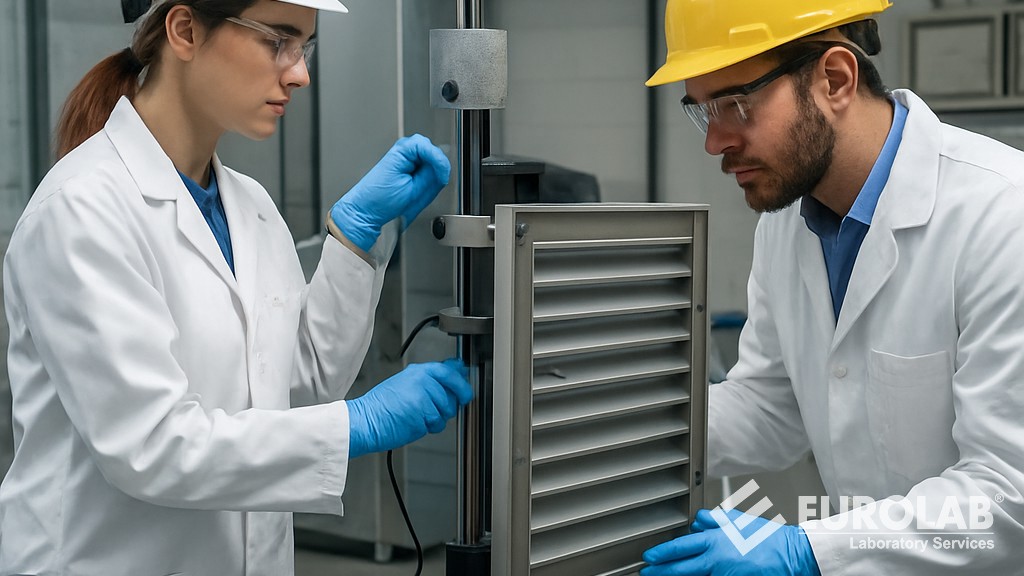
The ANSI/AMCA Standard 500-L currently includes five test protocols. These are:
All of these test protocols are performed in a laboratory accredited by AMCA.
This standard establishes uniform laboratory test methods for evaluating the performance of louvers, which are ventilation components mounted on building walls or facades that allow airflow while preventing the entry of unwanted water, debris, or particles.
This standard does not set minimum or maximum performance thresholds, such as requiring a blind to exceed a specific water permeability level. Instead, it defines consistent, repeatable testing procedures so that manufacturers can accurately measure and report performance characteristics. This allows engineers, architects, and specifiers to reliably compare blinds. The protocols of this standard form the basis for the AMCA Certified rating program, where third-party testing verifies manufacturer data and products bear the AMCA certification seal.
This standard is rooted in the “AMCA Standard 500 Temporary test methods for shutters, dampers and blinds” standard. After several revisions, this standard was divided into two parts:
The latest version of the AMCA 500-L standard improves testing for air leakage, pressure drop, water penetration, wind-borne rain resistance, and more.
ANSI/AMCA Standard 500-L covers various performance aspects, typically carried out in AMCA-accredited laboratories:
More recent revisions include additional directions, improvements in precipitation units, robust performance references, or structural considerations under wind loads.
Louvers protect building openings for HVAC inlets/outlets by balancing airflow with weather resistance. Accurate and standardized testing ensures:
Many manufacturers refer to AMCA 500-L standard compliance in their product literature. Specifiers often require AMCA certification for air performance and water permeability to ensure quality.
This standard remains the cornerstone of shutter performance evaluation and is used worldwide as a reference in building design and procurement.
ANSI/AMCA Standard 500-L defines the following five test protocols in more detail:
The test protocol involves taking five or more measurements at equal increments within the desired airflow rate range. For each measurement, a reading is taken for each of the following values:
As in the pressure drop test, five or more measurements are taken at equal pressure difference increases covering a desired range under equilibrium conditions. Testers use precisely measured weights and measure the distance with devices with 1,0 millimeter divisions. Multiple samples of the shutter are required for this test. Testers use the following criteria for the samples:
Once the test is complete, the results will include at least the following: closing method, blade direction, blade movement, airflow direction, and test type.
For this test protocol, water droplets are placed in front of the blind to simulate light, vertical rain. The simulated rain is placed in front of the blind in the following proportions:
This test requires a meter-by-meter core sample. After the shutter is placed in the test chamber, a high-powered fan is placed in front of it to simulate the following conditions:
This test sends airborne dry sand particles at varying airflow rates through the louvre being tested. The louvre is mounted and sealed inside the sand injection chamber, so that all measured sand input comes only from the louvre's blades.
The test dimensions of the shutter are 1220 mm x 1220 mm. The test is performed with dry sand evenly distributed via a sandblasting device, while recording the pressure drop.
The protocols specified in ANSI/AMCA Standard 500-L were created to establish uniform laboratory testing methods for shutters across all manufacturers, including pressure drop, air leakage, water permeability, wind-borne rain, and wind-borne sand. Shutters tested according to these protocols earn the AMCA seal, signifying third-party verification of the test data. This is a feature that specifiers should look for on the shutter specification page.
For many years, our organization, with its competent and experienced staff, has been understanding the needs of its clients, providing the advanced testing services they require, and assisting them in the establishment, implementation, and improvement of management systems. Within this framework, we also provide testing services compliant with ANSI/AMCA Standard 500-L to businesses.
To get an appointment, to get more detailed information or to request an evaluation, you can ask us to fill in our form and reach you.

