

The European standard, “EN 13755 Test methods for natural stone - Determination of water absorption at atmospheric pressure,” describes a method for determining the water absorption of natural stones.
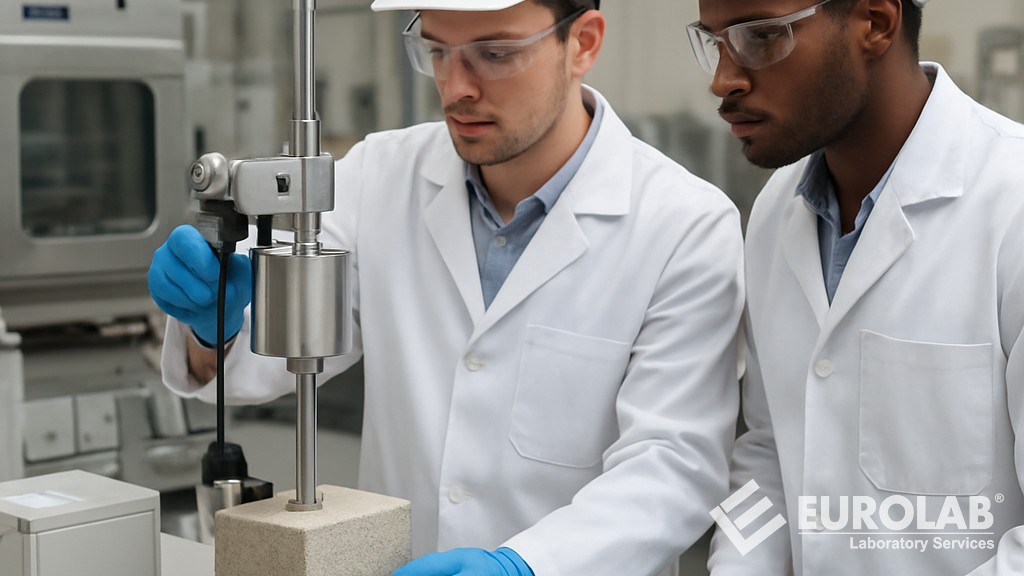
In principle, after drying to a constant mass, each sample is weighed and immersed in water at atmospheric pressure for a specified period. Water absorption at atmospheric pressure is determined by expressing it as a percentage, as the ratio of the mass of the saturated sample (obtained at constant mass) to the mass of the dry sample.
Sample collection is not the responsibility of the testing laboratory unless specifically requested. At least six samples must be selected from a homogeneous batch. Samples should be in the shape of cylinders, cubes, or prisms with dimensions of 70 mm plus/minus 5 mm or 50 mm plus/minus 5 mm, and obtained by diamond cutting or core drilling. Their apparent volume, calculated by geometric measurements, should be at least 60 ml. Furthermore, the surface area/volume ratio should be between 0,08 mm⁻¹ and 0,20 mm⁻¹. Samples prepared for determining compressive or flexural strength may be used if they meet the surface area/volume ratio.
Test samples should be dried to a constant mass at a temperature of 70 degrees plus/minus 5 degrees. A constant mass is reached when the difference between two consecutive weighings, taken at intervals of 24 hours plus/minus 2 hours, does not exceed 0,1% of the first mass. Samples should be kept in a desiccator until they reach room temperature (20 degrees plus/minus 5 degrees).
After drying, the samples are weighed with an accuracy of 0,01 g. The samples are placed in the tank on the provided supports. Each sample should be at least 15 mm away from adjacent samples. Then, tap water at 20 degrees plus/minus 10 is added up to half the height of the samples. For 60 plus/minus 5 minutes, tap water is added until the water level reaches three-quarters the height of the samples. For 120 plus/minus 5 minutes, tap water is added until the samples are fully submerged to a water depth of 25 mm plus/minus 5 mm. For 48 plus/minus 2 hours, the samples are removed from the water, quickly wiped with a damp cloth, and then weighed within 1 minute with an accuracy of 0,01 g.
The samples are re-immersed in water and the test continues. Every 24 hours plus/minus 2 hours, the samples are removed from the water, quickly wiped with a damp cloth, and then weighed within 1 minute with an accuracy of 0,01 g. The successive masses of the samples are noted.
The samples are tested until a constant mass is reached. A constant mass is reached when the difference between two consecutive weighings does not exceed 0,1 percent of the initial two masses. The result of the final weighing is the mass of the saturated sample.
The water absorption of each sample at atmospheric pressure is calculated using the equation given in the standard.
In the world of construction and architecture, natural stone has long been valued for its durability, aesthetic appeal, and versatility. From majestic marble facades to rustic granite countertops, stone materials play a significant role in both interior and exterior applications. However, choosing the right stone isn't just about looks; performance factors such as resistance to weathering, frost, and moisture are essential for long-term success. This is where standards like EN 13755 come into play. This standard provides a standardized method for measuring how much water a natural stone can absorb under normal atmospheric conditions. By ensuring consistency in testing, this standard helps architects, engineers, and manufacturers make informed decisions to prevent problems such as cracking, staining, or deterioration over time. Widely adopted across Europe, this standard remains an integral part of quality control and compliance with broader building regulations in the natural stone industry.
Water absorption is a critical property, especially for natural stones exposed to external factors. Highly porous stones like limestone or sandstone can absorb water like a sponge, which can lead to problems in cold climates if the water freezes, expands, and causes cracks. Even in milder environments, absorbed moisture can promote mold growth, efflorescence (salt deposits), or chemical reactions that erode the stone's surface.
The EN 13755 standard addresses this issue by specifying absorption as a percentage, allowing stones to be classified according to their suitability for specific uses. For example,
Without standardized tests, comparisons between suppliers or stone types are unreliable and can lead to costly errors. The industry also promotes sustainability by aligning with the EN 13755 standard. Selecting low-absorption stones conserves resources by reducing the need for frequent replacement.
This standard is often used in conjunction with other standards such as EN 12670 (natural stone terminology) and EN 12440 (assessment criteria) to provide a comprehensive framework for stone evaluation.
In conclusion, the EN 13755 standard exemplifies how targeted standardization can advance materials science and how the timeless beauty of natural stone can withstand modern demands. By offering a reliable measure of water absorption, it protects projects against hidden vulnerabilities and fosters trust throughout the supply chain. Whether a contractor supplying travertine for a villa or a researcher examining stone durability, this standard is an indispensable tool.
For many years, our organization, with its competent and experienced staff, has been understanding the needs of its clients, providing the advanced testing services they require, and assisting in the establishment, implementation, and improvement of management systems. Within this framework, we also provide testing services to businesses in accordance with the "EN 13755 Natural stone testing methods - Determination of water absorption at atmospheric pressure" standard.
To get an appointment, to get more detailed information or to request an evaluation, you can ask us to fill in our form and reach you.

