

The standard “ASTM E2412 Standard practice for condition monitoring of in-service lubricants by trend analysis using Fourier transform infrared (FT-IR) spectrometry,” published by the American Society for Testing and Materials (ASTM), describes a procedure for using FT-IR to monitor additive depletion, contaminant accumulation, and base oil degradation in lubricants, hydraulic fluids, and other fluids used in normal machine operation.
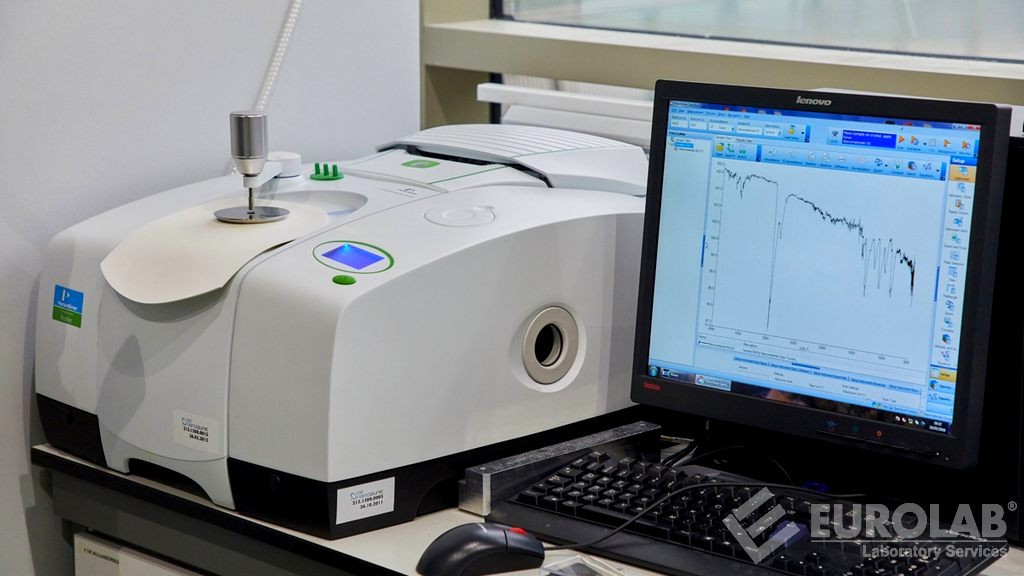
Contaminants monitored include water, soot, ethylene glycol, fuels, and faulty oil. Oxidation, nitration, and sulfonation of base oils are monitored as evidence of deterioration. The purpose of this monitoring activity is to diagnose the operating condition of the machine based on the fault conditions observed in the oil. Measurement and data interpretation parameters are presented to allow operators of different FT-IR spectrometers to compare results using the same techniques.
This practice is based on analysis of the trend and scatter response obtained from mid-infrared absorption measurements. While calibration to establish physical concentration units is possible, it is unnecessary or impractical in most cases. Warning or alarm limits (the point at which maintenance is recommended or required on a monitored machine) can be determined using statistical analysis, history of the same or similar equipment, cyclic testing, or other methods that correlate with equipment performance. These warning or alarm limits can be a fixed maximum or minimum value for comparison with a single measurement or can be based on the rate of change of the measured response. This practice accounts for scatter but does not preclude the use of rate-of-change warnings and alarms.
It is not the intent of this guide to set or recommend normal, caution, warning, or alarm limits for any machine. These limits should be determined in conjunction with the advice and guidance of the machine manufacturer and its maintenance group.
The spectra and distribution profiles presented here are for illustrative purposes only and should not be construed as representing or constituting lubricant or machinery guidelines.
This application is designed as a quick and simple spectroscopic check for condition monitoring of in-service lubricants and can be used to help determine overall machine health through measuring properties observable in the mid-infrared spectrum, such as water, oil oxidation and others as mentioned above.
The infrared data generated by this application is typically used in conjunction with other testing methods. For example, infrared spectroscopy cannot determine wear metal levels or any other type of elemental analysis. The presented application is not designed to estimate lubricant physical properties (e.g., viscosity, total base number, total acid number). This application is designed for monitoring in-service lubricants and can help determine overall machine health. It is not designed for analyzing lubricant composition, lubricant performance, or additive package formulations.
Periodic sampling and analysis of lubricants has long been used as a means of determining overall machine health. Atomic emission and atomic absorption spectroscopy are frequently used in wear metal analysis (e.g., the ASTM D5185 standard test method). A range of physical property tests complement wear metal analysis and provide information about lubricant condition (e.g., the ASTM D445, ASTM D2896, and ASTM D6304 standard test methods). Molecular analysis of lubricants and hydraulic fluids using FT-IR spectroscopy provides direct information on molecular species of interest, including additives, fluid degradation products, and external contaminants, thus complementing wear metal and other analyses used in a condition monitoring program.
ASTM E2412 is a critical tool in machinery maintenance and lubricant analysis. It provides a framework for assessing the condition of in-service lubricants, such as machine lubricants, hydraulic fluids, and other fluids used in normal machinery operation. Utilizing FT-IR spectrometry, this standard provides insight into machine health and operational efficiency by monitoring additive depletion, contaminant accumulation, and base stock degradation.
The ASTM E2412 standard focuses on monitoring key parameters, including:
The primary goal is to identify fault conditions in machinery by analyzing trends in lubricant conditions over time. This application is designed to diagnose operating problems through periodic sampling, not to analyze lubricant composition, performance, or additive package formulations.
The key features of the ASTM E2412 standard are as follows:
The ASTM E2412 standard is widely used in industries where machine reliability is critical, such as manufacturing, automotive, aerospace, and power generation. By regularly sampling and analyzing lubricants, maintenance professionals can:
However, this standard has several limitations:
As a result, ASTM E2412 is a foundational standard for condition-based maintenance, enabling industries to monitor lubricant health and diagnose machine issues using FT-IR spectrometry. By providing a structured approach to trend analysis, it supports proactive maintenance strategies, helping to extend equipment life and reduce downtime.
Our organization, which has been operating for many years and meticulously follows global developments in science and technology, conducts testing, measurement, and analysis in a wide range of areas for businesses across all sectors with a skilled team and extensive infrastructure. In this context, we also provide testing services in accordance with ASTM E2412 Standard Practice for Condition Monitoring of In-Service Lubricants by Trend Analysis Using Fourier Transform Infrared (FT-IR) Spectrometry.
To get an appointment, to get more detailed information or to request an evaluation, you can ask us to fill in our form and reach you.

