

Developed by the American National Standards Institute (ANSI), the standard "ANSI Z136.9 American National Standard for the Safe Use of Lasers in Manufacturing Environments" describes recommendations for the safe use of lasers and laser systems operating at wavelengths between 180 nm and 1 mm. Laser applications in manufacturing include, but are not limited to, materials processing, manufacturing, laser alignment, leveling, inventory, measurement, and machine vision.
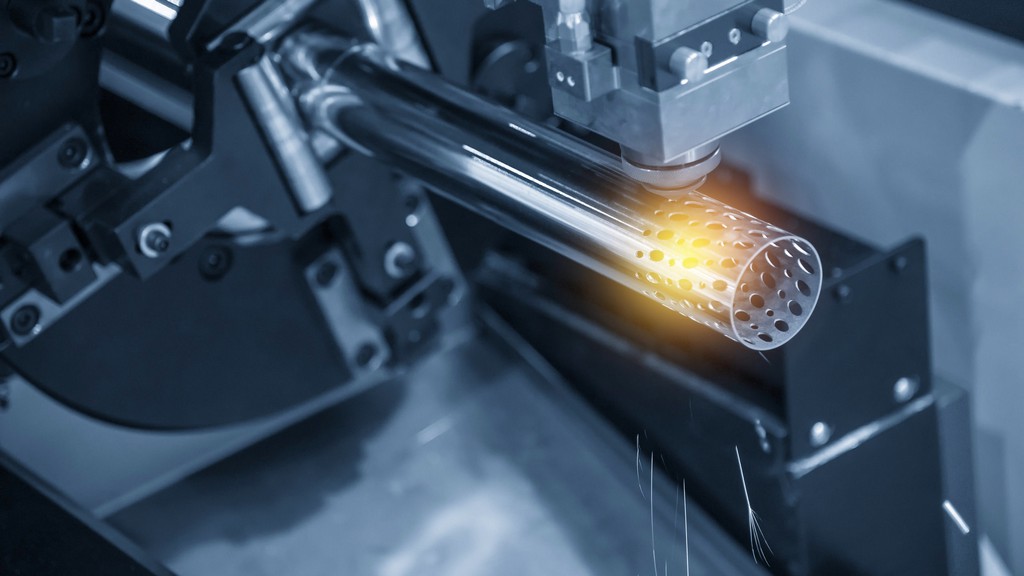
The purpose of this standard is to provide reasonable and sufficient guidance for the safe use of lasers and laser systems. A practical way to achieve this is to first classify lasers and laser systems according to their relative hazards and then specify appropriate controls for each classification. Only certified laser products should normally be used in a production environment. Certification requires meeting applicable local, state, or federal requirements. These include:
The procedures and methodologies described in the ANSI Z136.9 standard are intended to provide specific practices for ensuring laser safety in areas where lasers are used in manufacturing, including public and private sectors, product development, and test environments. Laser applications in manufacturing include, but are not limited to, materials processing, manufacturing, laser alignment, leveling, inventory, metrology, and machine vision.
Only certified laser products should normally be used in a production environment. Certification requires meeting applicable local, state, or federal requirements, such as the U.S. Food and Drug Administration (FDA), Code of Federal Regulations, 21 CFR 1040, or International Standard IEC 60825-1. However, if a certified laser product is modified by the end user, additional evaluation is required. Compliance with the Federal Laser Product Performance Standard may require those modifying a certified laser product to recertify the product.
The step-by-step procedure for using this standard is as follows:
For the purposes of this standard, only Class 4 lasers can produce hazardous diffuse reflections, except for short-range imaging of small diameter or focused Class 3B lasers. Therefore, diffuse reflection imaging calculations are normally only required for Class 4 lasers.
The laser hazard classification system is based entirely on the laser's radiation emission. Non-radiation hazards must be considered separately.
The ANSI Z136.9 standard is critical guidance for ensuring the safe use of lasers in industrial environments. This standard provides comprehensive recommendations for protecting workers, equipment, and facilities from laser-related hazards in production environments, including material handling, manufacturing, laser alignment, leveling, inventory, metrology, and machine vision. The ANSI Z136.9 standard complements ANSI Z136.1. While the Z136.1 standard provides general guidelines for laser safety in a variety of applications, the Z136.9 standard focuses on the unique challenges of industrial environments, offering simplified, industry-specific guidance to help laser safety officers implement effective safety programs. The primary purpose of this standard is to protect individuals from laser radiation hazards while ensuring compliance with regulations such as the Occupational Safety and Health Administration (OSHA).
Like ANSI Z136.1, the Z136.9 standard classifies lasers based on their potential for biological harm, from Class 1 (non-hazardous) to Class 4 (high hazard). These classifications guide the selection of appropriate control measures. For example, Class 3B and Class 4 lasers, commonly used in metal or ceramic cutting production, require strict controls due to their potential to cause eye and skin injuries. ANSI Z136.9 simplifies the hazard assessment for lower classes by emphasizing that only Class 4 lasers generally produce hazardous diffuse reflections.
This standard outlines specific control measures to reduce laser risks:
These measures are designed to be practical for manufacturing environments where lasers are often integrated into automated systems or used in dynamic processes.
The ANSI Z136.9 standard emphasizes the use of certified laser products that comply with federal regulations such as 21 CFR 1040, IEC 60825-1, and similar international standards. Any modifications to a certified laser require reassessment of the standard to ensure continued compliance. This is especially true in manufacturing processes where custom modifications to laser systems are common.
Lasers are an integral part of modern manufacturing, providing precision in applications such as cutting, welding, and metrology. However, their high-powered, focused beams pose significant risks, including burns, eye damage, and even fire or explosions if misused. The ANSI Z136.9 standard provides a framework for laser safety officers to develop robust safety programs that protect workers, visitors, and infrastructure while ensuring OSHA compliance. By addressing industry-specific hazards, the standard simplifies the implementation of safety measures, making it an indispensable tool for manufacturing facilities.
As a result, the ANSI Z136.9 standard is a vital resource for ensuring laser safety in manufacturing environments. By providing industry-specific guidance, it enables laser safety officers to mitigate risks, protect workers, and comply with regulatory requirements. While currently an outdated standard, its principles remain valid, and its upcoming revision will further enhance its applicability to modern laser technologies. Organizations using lasers in manufacturing should integrate the ANSI Z136.9 standard into their safety programs to foster a culture of safety and responsibility.
Our organization, which has been operating for many years and meticulously follows global developments in science and technology, conducts testing, measurement, and analysis in a wide range of areas for businesses across all sectors with a skilled team and extensive infrastructure. In this context, we also provide testing services in accordance with ANSI Z136.9, the American National Standard for the Safe Use of Lasers in Production Environments.
To get an appointment, to get more detailed information or to request an evaluation, you can ask us to fill in our form and reach you.

