

The "UL 555S Smoke Dampers" standard, developed by Underwriters Laboratories (UL), describes the requirements for smoke dampers designed for use in heating, ventilation, and air conditioning (HVAC) systems. Smoke dampers are used for the following purposes:
Dampers falling under these requirements are considered for use in:
Smoke dampers covered by these requirements are designed to be installed in accordance with:
Building and fire codes require fire and smoke protection features to protect building occupants from fire hazards and the dangers associated with smoke and hot toxic gases in the event of a fire. These codes ensure fire and life safety for both building occupants and firefighters and emergency responders during emergency operations.
A key aspect of this protection plan is to limit the spread of fire within a building using a compartmentalization approach that creates fire zones, along with the associated smoke and toxic gases. This requires the provision of fire-resistant devices such as fire walls, fire barriers, fire partitions, shaft enclosures, and horizontal devices to limit the spread of fire.
Building and fire codes also include requirements requiring smoke barriers and baffles, designed to limit the movement of smoke and toxic gases within a building by creating smoke compartments. This passive protection system is an integral part of the overall fire safety approach adopted by the codes.
The regulations, which contain important information on limiting the spread of fire, smoke and toxic gases by protecting duct inlets and air handling openings in fire and smoke resistant assemblies, include five types of dampers:
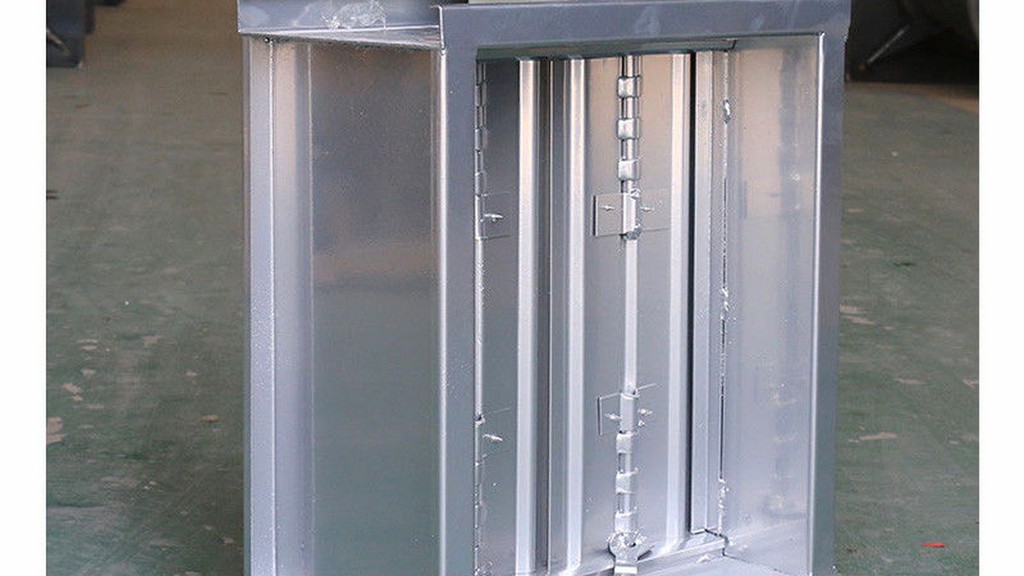
Smoke dampers are used to restrict the movement of smoke when it enters ducts and air transfer openings within devices designed to restrict the movement of smoke. These devices are installed to operate automatically, are controlled by a smoke detection system, and can be positioned from a remote command station as needed.
Smoke dampers may be required where ducts pass through smoke barriers or smoke baffles, or in other locations within an engineered smoke control system. Smoke dampers can be used in HVAC systems where fans are shut off in the event of a fire, as well as in smoke control systems designed to operate during a fire. Smoke dampers are designed to operate against air velocity and fan pressure.
UL-listed smoke dampers have a leakage class rating that indicates the level of air leakage measured through the damper under test conditions. Leakage ratings are defined as Class I, Class II, and Class III. Leakage ratings for smoke dampers are determined at a minimum differential pressure of 4 inches (10,16 cm) of water gauge across the closed damper. Leakage rates can also be determined at higher differential pressures in 2-inch (5,08 cm) water gauge increments. Model codes require a smoke damper with a Class I or II rating.
Smoke dampers are also provided with an airflow rating, maximum velocity (damper open) and static pressure (damper closed).
Smoke dampers are tested and listed as part of vertical or horizontal installations in accordance with UL 555S. Smoke dampers are investigated for use in specific vertical or horizontal installations as specified in the installation instructions provided with the product. Each listing is specific with respect to the construction details of the installation in which the damper is installed, the air leakage rate, the damper mounting location (i.e., vertical or horizontal), the minimum and maximum dimensions of a single section, and the maximum dimensions of multiple damper sections.
The UL 555S standard is a critical criterion for evaluating smoke dampers used in heating, ventilation, and air conditioning (HVAC) systems. Smoke dampers play a vital role in fire and life safety by restricting the spread of smoke through HVAC systems during a fire, enabling safer evacuation and reducing property damage.
According to the UL 555S standard, smoke dampers serve two primary purposes:
The UL 555S standard specifies rigorous testing protocols to ensure smoke dampers perform effectively under fire conditions. Key requirements include:
Smoke dampers are typically installed in HVAC ducts or corridor ceiling openings that penetrate smoke barriers such as walls or partitions. Their design incorporates seals at the edges of the blades and along the damper's jambs to prevent smoke leakage when closed. These dampers are integrated with smoke detection systems or fire alarms to enable rapid response in emergencies. For example, in a multi-story building, smoke dampers prevent smoke from spreading through the HVAC ducts to unaffected floors, giving occupants more time to evacuate and firefighters better access to the fire source.
Ultimately, the UL 555S standard is the cornerstone of fire and life safety in HVAC systems, ensuring reliable operation of smoke dampers under challenging conditions. By establishing stringent requirements for leakage, temperature, airflow, and durability, UL 555S helps protect life and property. Construction professionals must ensure compliance with this standard and related regulations to create safer environments.
Our organization, which has been operating for many years and meticulously follows global developments in science and technology, employs a skilled team and extensive infrastructure to conduct testing, measurement, and analysis in a wide range of areas for businesses across all sectors. In this context, we also provide testing services in accordance with the UL 555S Smoke Damper Standard.
To get an appointment, to get more detailed information or to request an evaluation, you can ask us to fill in our form and reach you.

