

The standard "ANSI Z136.6 Safe Use of Lasers Outdoor", developed by the American National Standards Institute (ANSI), provides guidance on the safe use of potentially hazardous lasers and laser systems (180 nm to 1 mm) in outdoor environments. It also provides guidance on controlling disabling glare caused by exposure to harmless levels of visible laser light that could affect sensitive or mission-critical tasks. Lasers used in fixed, terrestrial point-to-point free-space optical telecommunications are not addressed in this standard.
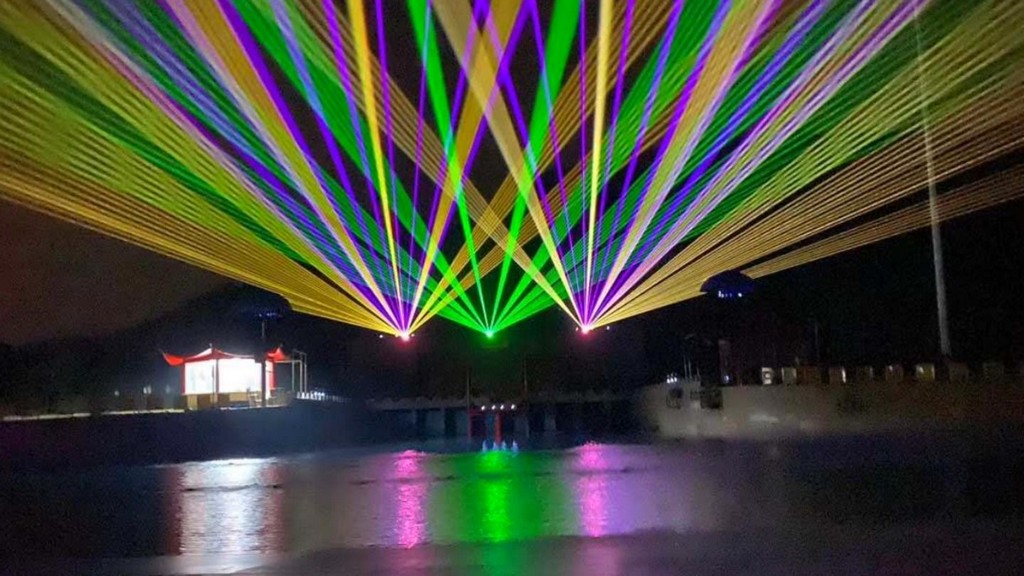
Visible laser beams used for imaging and other purposes outdoors, particularly at night, may require additional control measures to protect individuals potentially exposed to the hazards associated with bright light. These hazards include temporary visual and psychological effects of laser beams, such as afterimages, glare, and startle. These effects can pose indirect safety hazards when people are performing critical visual tasks.
Examples of critical tasks include, but are not limited to: operating heavy equipment or motor vehicles, piloting aircraft, or facilitating control tower activities.
For the purposes of this standard, visible radiation effects are assumed to occur in the spectral region between 380 nm and 780 nm. The precise distinctions between visible and invisible radiation depend on an individual's spectral sensitivity and other considerations. Spectral ranges such as 400 nm to 700 nm or 380 nm to 780 nm are defined for convenience and should not be considered absolute boundaries between the visible and the invisible.
This standard addresses biological effects on both visual impairment and the actual potential for injury from optical radiation. The 380 nm to 780 nm spectrum is used for evaluation of transient visual effects.
This standard provides guidance on the safe use of lasers in outdoor environments, for example, in construction, laser light shows, scientific and astronomical research, and military applications.
In short, the ANSI Z136.6 standard provides comprehensive guidance for the safe operation of lasers outdoors. This standard is part of the ANSI Z136 series, which addresses laser safety in a variety of applications. This standard focuses specifically on ensuring safety in environments such as construction, laser light shows, scientific and astronomical research, and military applications.
The primary objective of this standard is to protect individuals from the hazards associated with laser radiation, which can pose significant risks to eyes and skin due to the high intensity and directionality of laser beams. This standard provides practical recommendations for implementing safety measures in scenarios where lasers are used outside controlled indoor environments. For example,
Unlike indoor environments, outdoor environments present unique challenges, including longer beam paths, atmospheric effects, and potential exposure to the public or aircraft. The ANSI Z136.6 standard addresses these challenges by outlining control measures, hazard assessments, and operational protocols.
The ANSI Z136.6 standard is designed to provide clear and applicable guidance for laser safety officers, operators, and organizations. Its key components are:
This standard also introduces the concept of a nominal hazard zone, where laser radiation exceeds the maximum permissible exposure limits and requires special care to prevent accidental exposure.
This standard provides sample forms, such as suspect exposure surveys and letters to information processing programs, to facilitate compliance with regulatory requirements.
This standard emphasizes flexibility, allowing laser safety officers and management to tailor safety measures to specific applications while adhering to essential requirements.
As a result, the ANSI Z136.6 standard is an essential resource for ensuring the safe use of lasers in outdoor environments. By providing detailed guidance on hazard classification, control measures, maximum permissible exposure limits, and outdoor-specific considerations, it helps protect individuals and the public from the risks associated with laser operations. Whether for construction, recreational, research, or military applications, compliance with the ANSI Z136.6 standard is critical to maintaining a safe work environment and maintaining regulatory compliance.
Our organization, which has been serving businesses for many years and meticulously following global developments in science and technology, employs a team of experienced professionals and a broad infrastructure to conduct testing, measurement, and analysis in a wide range of areas for businesses across all sectors. In this context, we also provide testing services in accordance with the ANSI Z136.6 standard for the safe use of lasers outdoors.
To get an appointment, to get more detailed information or to request an evaluation, you can ask us to fill in our form and reach you.

