

The “CEN/TR 16512 Child care and handling products - Safety principles for child carriers” standard, a technical specification developed by the European Committee for Standardization (CEN), describes the principles for a product designed for carrying a child solely on the caregiver's body, without integrated openings for the child's limbs, and allowing the caregiver to keep their hands free while standing or walking.
An integrated leg opening is an opening for the child's legs when the product is attached to the caregiver's torso. The leg opening created when the caregiver puts on the product is not an integrated opening. Furthermore, child carrier slings are not covered under EN 13209-1 and EN 13209-2 standards.
The CEN/TR 16512 standard identifies common risks associated with infant carriers and offers recommendations for mitigating them:
Swallowing small objects that pass into a child's stomach can cause internal blockages. It is preferable to avoid using small objects attached to a hanger whenever possible. However, if small objects must be used, they should be securely attached to the product and should not be likely to detach or break into small pieces.
The CEN/TR 16512 standard describes the requirements for all these hazards and provides test methods.
The CEN/TR 16512 standard provides non-mandatory guidance to help manufacturers, regulators and testers assess and improve the safety of infant carriers (soft fabric carriers designed to keep infants and young children close to the caregiver's body). Unlike European standards (EN) which are essentially harmonized and support EU legislation, a technical report (TR) offers advisory information based on current knowledge and best practices, addressing potential hazards in increasingly popular products.
The CEN/TR 16512 standard applies specifically to child carrier slings defined as follows:
These are typically flexible fabric carriers that only create leg openings when wrapped around the caregiver and child (e.g., long wraps or pouch-style carriers). Framed carriers, soft-structured carriers with fixed leg holes, or backpack-style carriers are excluded.
This standard includes recommended test methods, drawing upon relevant standards, such as the following:
Examples include using test masses, dynamometers, and body dummies to simulate real-world use scenarios.
This standard emphasizes clear instructions, warnings, and markings such as the following:
Baby carriers promote bonding and ease, but the misuse of slings has led to safety concerns, including rare but serious suffocation incidents in poorly designed or improperly used products. The CEN/TR 16512 standard helps close gaps in regulations for flexible slings and promotes safer designs. While not legally binding, compliance warrants due diligence and is often referenced in product testing or certification. Manufacturers can voluntarily comply with such standards.
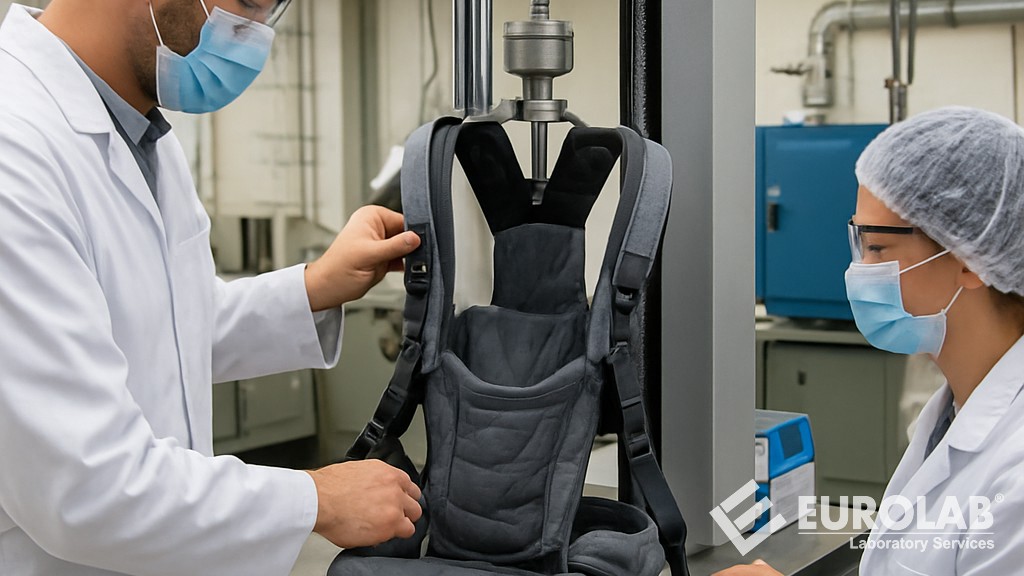
For many years, our organization, with its competent and experienced staff, has been understanding the needs of its customers, providing the advanced testing services they require, and assisting them in the establishment, implementation, and improvement of management systems. Within this framework, we also provide testing services to businesses in accordance with the "CEN/TR 16512 Child care products - Safety principles for child carriers" standard.
To get an appointment, to get more detailed information or to request an evaluation, you can ask us to fill in our form and reach you.

