

The European standard “EN 1630 Pedestrian doors, windows, curtain walls, railings and shutters - Burglary resistance - Test method for determining resistance to manual burglary attempts” describes a test method for assessing the burglary resistance of pedestrian doors, windows, curtain walls, railings and shutters by determining their resistance to manual burglary attempts.
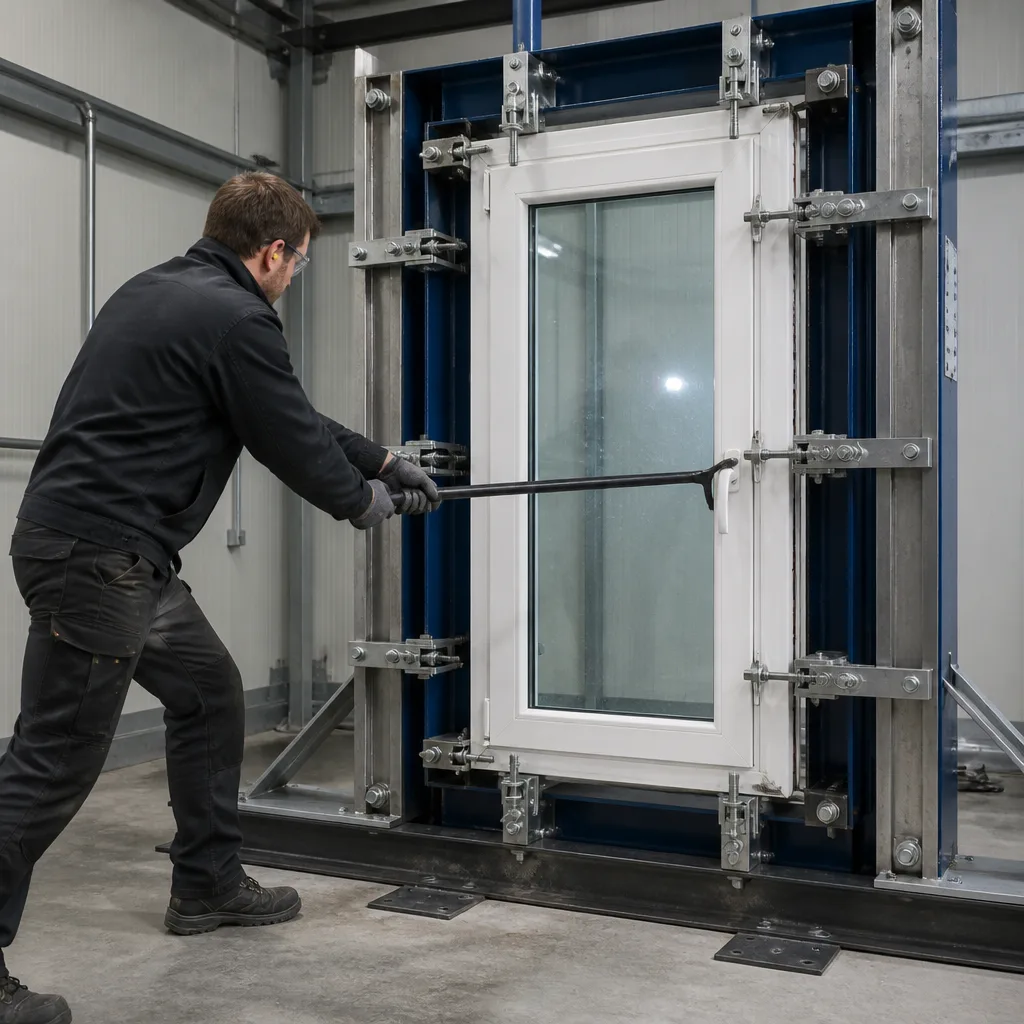
This method is applicable to the following opening functions: rotating, tilting, folding, rotating-tilting, top or bottom hanging, sliding (horizontal and vertical), hinged (horizontal and vertical), protruding and rolling, as well as non-opening structures.
This testing method does not directly cover the resistance of locks and cylinders to lockpicking attacks.
Furthermore, this does not include attacks on electrically, electronically, and electromagnetically operated burglar-resistant building materials using covert attack methods that can disable these features.
It is generally accepted that the burglary resistance performance of building products has two aspects: their normal resistance to forced entry and their ability to remain fixed to the building.
This testing method does not evaluate the performance of the fastening to the building.
The manufacturer's installation instructions guide you on how to secure the product.
This standard, unlike EN 13241, does not apply to walls and roofs, as well as doors, passageways and barriers, designed to provide safe access for goods and tools that people access or use in industrial, commercial or residential areas.
It is important to protect structural elements that vehicles can access or pass through with appropriate measures such as barriers, extendable ramps, and the like.
The EN 1630 standard defines laboratory test methods used to determine how well security products resist manual burglary attempts. It is part of the family of burglary resistance standards EN 1627, EN 1628, and EN 1629 used throughout Europe. The EN 1630 standard provides physical attack tests that support the resistance classifications defined in the EN 1627 standard.
The primary purpose of the EN 163 standard is to assess how effectively a building product can withstand a burglar using common burglary tools. This standard helps:
The EN 1630 standard covers numerous types of building products, including:
This standard covers both movable and fixed structures intended to be resistant to forced entry. However, it does not evaluate the following:
These issues are addressed by other standards or assembly requirements.
The EN 1630 standard is part of a coordinated series of European safety standards:
Together, these standards define a product's overall burglary resistance rating.
In principle, the EN 1630 standard simulates a real attempted burglary, unlike the EN 1628 and EN 1629 standards which use controlled mechanical loading.
Professional test operators attempt forced entry using a defined set of tools while following standardized procedures. The goal is to create an opening large enough for unauthorized access or to lock/unlock the product.
Depending on the resistance class being evaluated, the testing team uses increasingly sophisticated tools in these tests. For example,
Each resistance class specifies the permitted tool set and the maximum effective attack duration.
Generally, EN 1630 standard testing follows these steps:
The EN 1630 standard supports the resistance classes defined in the EN 1627 standard:
As the class progresses,
The EN 1630 standard examines the resistance of the following:
Overall performance is usually determined by the weakest point.
The EN 1630 standard is widely applied in the following areas:
Tests conducted according to the EN 1630 standard offer several advantages:
Manufacturers use the EN 1630 standard for the following purposes:
In conclusion, the EN 1630 standard is a key standard for evaluating the burglary resistance of doors, windows, curtain walls, railings, and shutters. By simulating realistic manual burglary attempts, it provides an objective measure of a product's resistance to forced entry. When used in conjunction with the EN 1627, EN 1628, and EN 1629 standards, it allows manufacturers to classify their products according to established resistance standards and helps architects, specifiers, insurers, and building owners select security solutions that meet the required level of protection.
For many years, our organization, with its competent and experienced staff, has been understanding the needs of its clients, providing the advanced testing services they require, and assisting them in the establishment, implementation, and improvement of management systems. Within this framework, we also provide testing services in accordance with the EN 1630 standard.
To get an appointment, to get more detailed information or to request an evaluation, you can ask us to fill in our form and reach you.

