

The European standard EN 16781 "Textiles for childcare products - Safety requirements and test methods for children's sleeping bags for use in children's beds" describes the safety requirements for children's sleeping bags designed for use in a child's sleeping environment (i.e., unsupervised) and intended to provide sufficient warmth to eliminate the need for an additional mattress while a child is sleeping in a crib or similar product (e.g., a bed or bassinet).
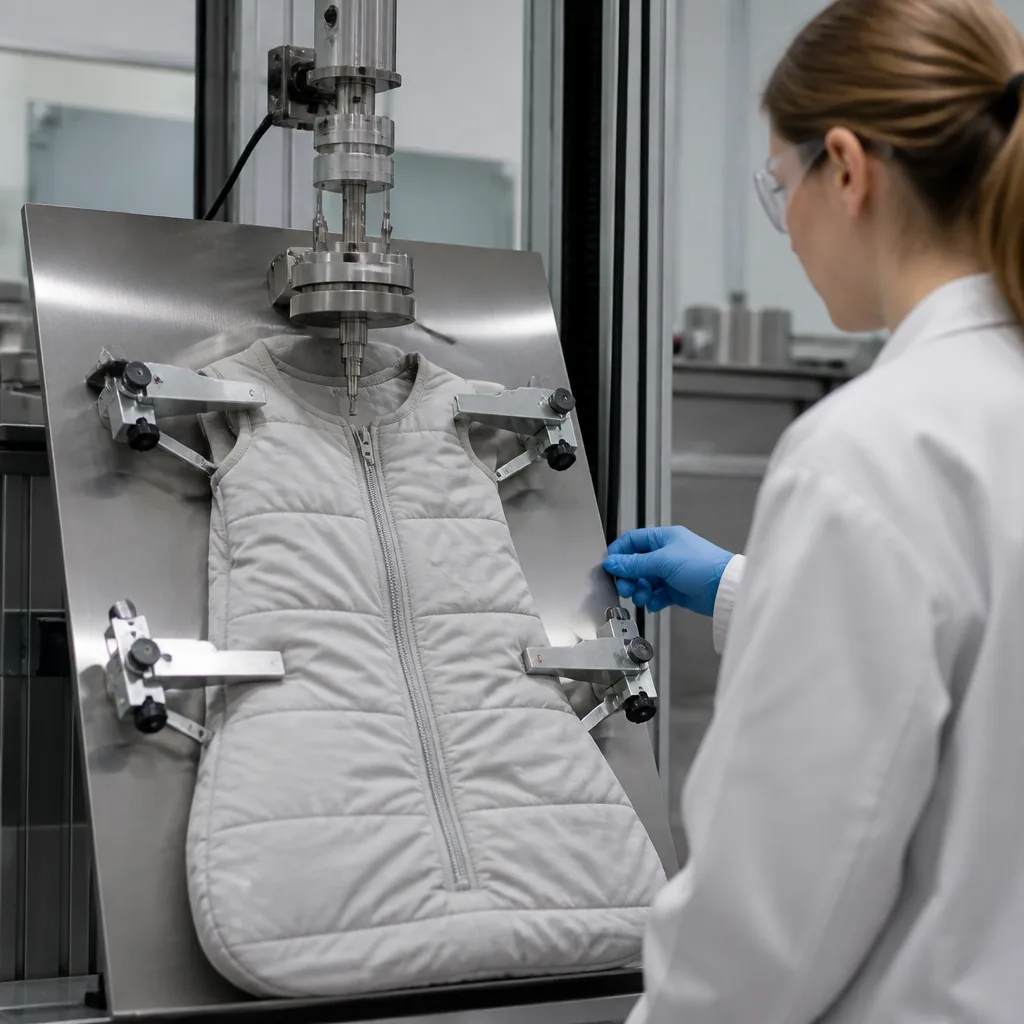
This standard does not apply to products designed for the care of premature or low birth weight children, or for outdoor use, or products designed to keep a child warm in a stroller or car seat (e.g., footmuffs).
If a section of a child's sleeping bag is designed to offer an additional function (e.g., a play function), that section is subject to the safety requirements of relevant standards in addition to the requirements described in this standard.
The aim of this standard is to minimize the main risks posed by products in the sleeping environment of infants and young children. These risks include:
This standard applies to sleep sacks designed for infants and toddlers, typically up to 24 months old, who are not yet able to get out of bed, and which feature a neck opening and armholes (or cuffs in some designs). Sleep sacks are designed to provide adequate warmth without the need for an additional loose bedding.
This standard replaces the older British standard BS 8510, which has been superseded. Compliance with EN 16781 helps manufacturers comply with general product safety regulations and reduces the risk of product recalls.
The basic safety requirements are defined in this standard as follows:
Products must undergo rigorous laboratory testing for these aspects and also include clear marking, labeling, and user instructions (e.g., sizing guide, temperature advice, and safety usage warnings).
This standard is part of a new series of European norms for children's sleep environment products:
In short, the EN 16781 standard is a textile and textile products-focused standard that deals with methods for evaluating specific chemical or performance properties to ensure product quality, safety, and regulatory compliance, particularly in the European market. The main objective of this standard is to provide a standardized test methodology so that laboratories, manufacturers, brands, and certification bodies can evaluate textile materials under the same technical conditions.
Without consistent standards, laboratories may use different sample preparations, reagent concentrations, test temperatures, or calculation methods. This can lead to inconsistent results. The EN 16781 standard reduces this variability by providing the following definitions:
This ensures that test results are repeatable and comparable across laboratories in different countries.
The main reasons why the EN 16781 standard is considered important are as follows:
The EN 16781 standard is used by:
Applications include testing raw fibers, yarns, fabrics, finished garments, and technical textiles.
Baby sleeping bags are popular because they reduce the risks associated with loose blankets (a known risk factor for sudden infant death syndrome). The EN 16781 standard ensures that these products are designed and manufactured to high safety levels for the EU market. Parents and retailers are encouraged to purchase products that are clearly marked as compliant with the EN 16781 standard.
In conclusion, the EN 16781 standard helps to create a common technical language for textile testing across Europe. Standardizing test procedures increases reliability, facilitates trade, supports regulatory compliance, and helps manufacturers maintain consistent product quality.
For many years, our organization, with its competent and experienced staff, has been understanding the needs of its clients, providing the advanced testing services they require, and assisting them in the establishment, implementation, and improvement of management systems. Within this framework, we also provide testing services in accordance with the EN 16781 standard.
To get an appointment, to get more detailed information or to request an evaluation, you can ask us to fill in our form and reach you.

