

The standard EN IEC 61770, "Electrical appliances connected to the water supply network - Prevention of back-siphonage and hose-set failure," based on a European standard and subsequently published by the International Electrotechnical Commission (IEC), specifies requirements for appliances used for household and similar purposes that prevent the back-siphonage of non-potable water into the mains water supply. Examples of such appliances include the installation of appliances in canteens, restaurants, laundries, and shared apartments.
This standard also specifies requirements for hose sets used to connect such devices to the mains water supply, the pressure of which does not exceed 1 MPa.
The following are outside the scope of this standard:
The device's connection to the water mains may be temporary or permanent. When referring to the water mains, this includes water supplied from a cistern or similar system. Many countries have requirements to prevent contamination of drinking water from contact with unsuitable materials upstream of the backflow prevention device.
Appliances must be equipped with a backflow prevention device. For appliances with a water softener located upstream of an air gap or pipe cutter, a dynamic backflow preventer must be installed upstream of the water softener. Other components that pose a hazard to drinking water, such as dispensers that add cleaning, rinsing, softening, or similar substances to the water, must not be installed upstream of the backflow prevention device. Piping containing drinking water located upstream of the backflow prevention device must not pass through non-potable water in the appliance. Compliance is verified by inspection.
For a given point in the hydraulic system, upstream refers to the side from which water flows, and downstream refers to the side from which water flows.
Backflow prevention devices must be integrated or fixed into the appliance, or mounted on the inlet side of a hose set. They can also be installed on water inlet valves. These devices must be designed to have the following features:
Compliance is checked by inspection and manual testing.
Hose assemblies used to connect appliances to the water supply network must be designed to eliminate the risk of flooding as much as possible. Compliance is checked by the tests described in this standard. Metal parts of the appliance's water connection system, if damaged, that could cause the appliance to fail to meet the requirements of this standard, must be resistant to abrasion, dezincification, oxidation, or corrosion. Compliance is checked by inspection. The resistance of brass to dezincification can be checked in accordance with ISO 6509.
When referring to normal conditions, the following applies:
When water pressures are specified, these are pressure differences resulting from atmospheric pressure.
When considering fault conditions, the device is inclined at an angle of 2 degrees relative to the horizontal in the most unfavorable position. In addition to the normal conditions, the following fault conditions are applied individually, as far as reasonably possible, taking into account the possible faults:
Unless otherwise stated, tests are performed in the order specified and,
Tests on air gaps, pipe cutters, and dynamic backflow preventers are performed on the device unless this is not possible or otherwise specified.
When determining the critical water level in devices with a program that allows multiple water inlets and simultaneous filling, each water inlet is sequentially closed, the other water inlets are opened.
Unless otherwise stated, tests are performed at an ambient temperature of 20 degrees plus/minus 5 degrees.
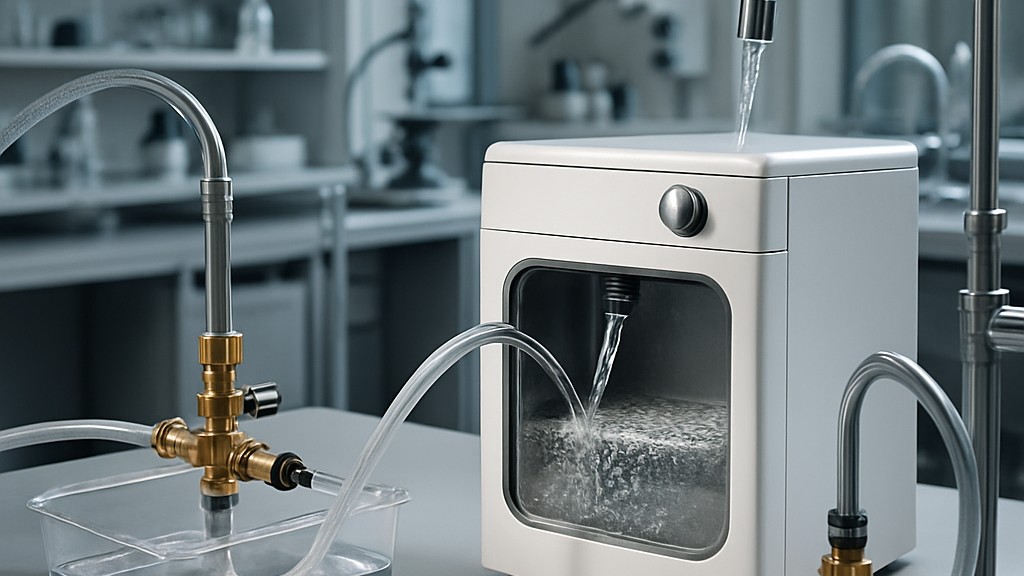
Air gaps must be constructed so that water can flow freely through the air section and that water downstream of the air gap cannot be drawn into the supply pipe. Compliance is verified by inspection and testing. The device is operated under fault conditions until the maximum water level is reached. The water outlet of the supply pipe must not come into contact with non-potable water. The device is operated under fault conditions until the critical water level is reached. The length of the air gap must be at least twice the smallest diameter of the water supply system within the device and at least 20 mm. Furthermore, a 20 mm gap must be maintained between the supply pipe outlet and other components in any downward direction. The thickness of any water film and the size of water droplets must be taken into account.
Pipe cutters must be designed so that the air inlet openings remain free and open to the atmosphere at all times. Under normal use, any water that may leak through the air inlet openings must flow into the device's sump, but not to a level sufficient to reduce the vertical dimensions below the values specified in this standard.
Pipe cutters must be protected against intentional obstruction or manipulation that could affect the test results. The total cross-sectional area of the air inlet openings must not be less than the cross-sectional area of the water inlet opening. The smallest dimension of each air inlet opening must be at least 3 mm. Dimensions are measured at right angles to the direction of air flow. Compliance is verified by inspection, measurement, and testing. However, if measurements cannot be made due to the device's construction, compliance is verified by testing.
Our organization, which has been supporting businesses across all sectors for years through a wide range of testing, measurement, analysis, and evaluation activities, has a strong team of employees who closely follow global developments in science and technology and are constantly improving themselves. In this context, we also provide testing services in accordance with the standard "EN IEC 61770 Electrical devices connected to the water supply network - Preventing the failure of back-siphonage and hose assemblies."
To get an appointment, to get more detailed information or to request an evaluation, you can ask us to fill in our form and reach you.

