EN 13832 Footwear Providing Protection Against Chemicals
The European standard "EN 13832 Footwear providing protection against chemicals" consists of the following subsections published under the same title:
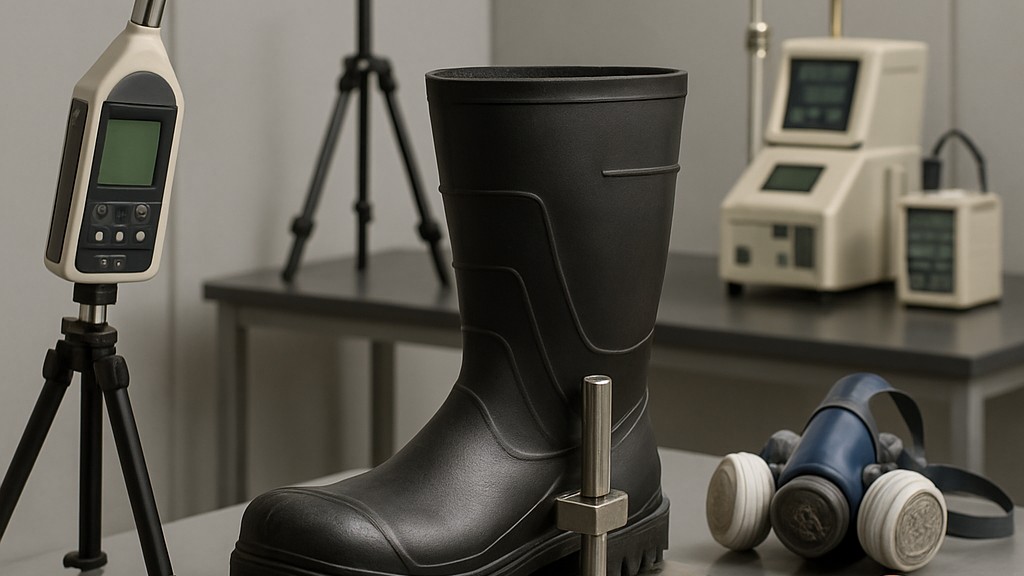
- The standard “EN 13832-1 Part 1: Terminology and test methods” describes test methods for determining the resistance of footwear to certain chemicals, such as splash, degradation and permeation.
- For the purposes of this standard, the following definitions apply, in addition to the terms and definitions described in EN ISO 20344 and EN 16523-1:
- Degradation is the detrimental change in one or more properties of a shoe material due to contact with a chemical. These changes can include: flaking, swelling, disintegration, brittleness, discoloration, dimensions, appearance, hardening, and softening.
- Permeation is the process by which a chemical passes through a shoe material at the molecular level. Permeation includes:
- Absorption of molecules of a chemical onto the contact (outer) surface of a material
- Diffusion of absorbed molecules into the material
- Desorption of molecules from the opposite (inner) surface of the material
- Splashing is contact after the chemical has been spilled on the shoe.
- A test chemical is a chemical used to evaluate the behavior of a shoe or shoe material after a defined exposure under laboratory test conditions. The chemical may cause adverse effects in the human body through skin contact.
The minimum number of samples to be tested to verify compliance with the requirements of EN ISO 20344, i.e., individual shoe components, is given in the table. The minimum number of test pieces taken from each sample is given in the table. Unless otherwise specified, test pieces should be taken from the entire shoe, whenever possible. If it is not possible to obtain a sufficiently large test piece from the shoe, a sample of the material from which the component is made may be used instead, and this must be stated in the test report.
Unless otherwise specified in the test method, all test pieces shall be conditioned in a standard atmosphere of 23°C plus/minus 2°C and 50 percent relative humidity plus/minus 5 percent for at least 24 hours prior to testing. The maximum time between removal from the conditioning atmosphere and the start of testing shall not exceed 10 minutes. For each required measurement performed in accordance with this standard, a corresponding estimate of the measurement uncertainty shall be evaluated. One of the following approaches shall be used:
- A statistical method (for example, as given in the ISO 5725-2 standard)
- A mathematical method (for example, as given in the ISO/IEC 98-3 standard)
- Uncertainty and conformity assessment (for example, as given in the ISO/IEC 98-4 standard)
- JCGM 100 Evaluation of measurement data - Guide to the expression of uncertainty in measurement
The standard "EN 13832-2 Part 2: Requirements for limited contact with chemicals" describes the requirements for footwear to protect the wearer against limited contact with specific chemicals. This standard covers the following risks: splash and chemical-induced degradation.For the purposes of this standard, the following definitions apply, in addition to the terms and definitions explained in EN 13832-1 and EN ISO 20345:
- Type U footwear for limited chemical contact: These are shoes designed and manufactured to prevent chemical splashes to the wearer's upper. Upper contact may be intermittent, not exceeding one hour.
- Footwear for limited chemical contact (US type): Footwear designed and manufactured to prevent chemical splashes on the wearer's upper and to prevent contact with the outsole. Upper-outsole contact may be continuous or intermittent, not exceeding one hour.
- Shoes for prolonged chemical contact: These are shoes designed and manufactured to protect the wearer from contact with chemicals. Contact can be continuous or intermittent. Prolonged contact means continuous contact lasting more than one hour.
Shoes that have limited contact with chemicals are classified according to the table given in the standard:
- Class I: Footwear made of leather and other materials, excluding all rubber and all polymeric footwear.
- Class II: All rubber (i.e., fully vulcanized) and all polymeric (i.e., fully molded) footwear.
This standard does not apply to shoes with leather soles. However, it does apply to hybrid shoes.
Footwear for limited chemical contact must comply with the requirements outlined in the table titled "Basic requirements for footwear for limited chemical contact." Footwear for limited chemical contact may or may not include a toe cap.
- The standard "EN 13832-3 Part 3: Requirements for prolonged contact with chemicals" specifies the requirements for footwear designed to protect the wearer from prolonged, continuous contact (more than 1 hour) with specific chemicals. Degradation and permeation of chemicals are addressed in this standard. Other requirements are addressed by reference to EN ISO 20345, EN ISO 20346, or EN ISO 20347, as appropriate.
For the purposes of this standard, the terms and definitions explained in EN 13832-1 and EN ISO 20345 apply, as well as the following definition: Footwear for prolonged contact with chemicals refers to footwear designed to protect the wearer from continuous or intermittent contact with chemicals for more than one hour.
Shoes that are in prolonged contact with chemicals should be classified according to the table titled “Classification of shoes”.
- Class II: All-rubber (i.e., fully vulcanized) and all-polymeric footwear (i.e., fully molded)
Footwear for prolonged contact with chemicals must comply with the requirements outlined in the table titled "Basic requirements for footwear for prolonged contact with chemicals." Footwear for prolonged contact with chemicals may or may not include a toe cap.
EN 13832 standards are deemed necessary for the following reasons:
- Chemical hazard protection: Workers in laboratories, pharmaceutical manufacturing, agriculture, cleaning, and the chemical industry are exposed to acids, solvents, and other corrosive or toxic substances. These standards protect feet by ensuring footwear is resistant to chemical penetration and degradation.
- Worker safety and health: Direct contact with chemicals can cause burns, skin damage, or systemic poisoning. Footwear that meets these standards helps prevent such incidents, reducing health risks and occupational illnesses.
- Compliance with legal regulations: Employers must comply with Directive (EU) 2016/425 on personal protective equipment and similar directives. Wearing footwear that complies with this standard helps meet these legal obligations.
- Performance classification: These standards provide a framework for categorizing footwear into three groups:
- EN 13832-1: Basic resistance to chemical degradation
- EN 13832-2: Footwear with limited resistance to certain chemicals
- EN 13832-3: High resistance to certain chemicals tested under more severe conditions
- Consistent quality and testing: This standard includes standard test methods (e.g. for chemical permeation and degradation) that ensure reliable and reproducible quality.
Our organization, which has been supporting businesses across all sectors for years through a wide range of testing, measurement, analysis, and evaluation activities, has a strong team of employees who closely follow global developments in science and technology and are constantly improving themselves. In this context, we also provide testing services to businesses in accordance with the EN 13832 Chemical Protective Footwear standard.



