

The European standard “EN 15051 Workplace exposure - Measurement of dustiness of bulk materials” consists of the following sub-sections published under the same title:
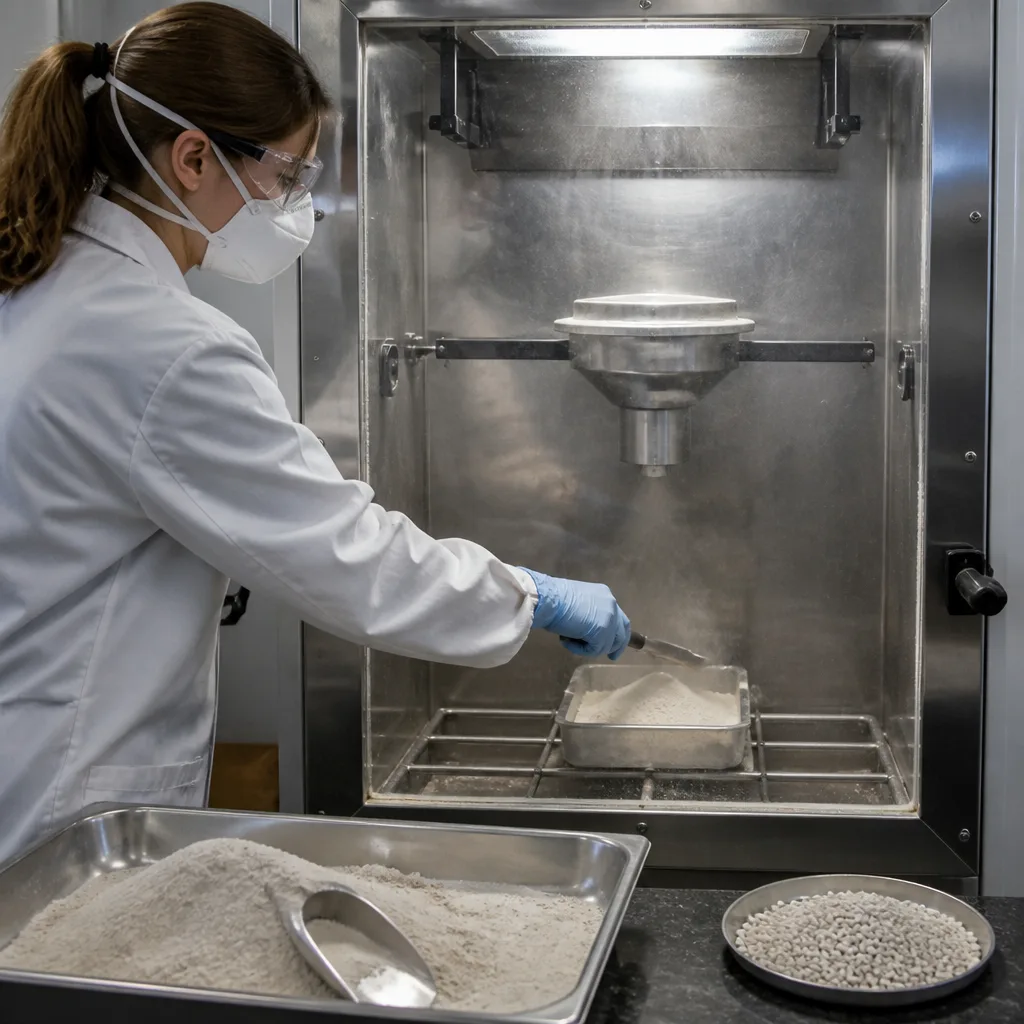
This standard establishes a classification scheme for dustiness to provide users of bulk materials with a standardized way of expressing and communicating the results. Details of the scheme for each method are contained in EN 15051-2 and EN 15051-3 standards.
This standard applies to bulk materials in powder, granular, or pellet form.
This standard is not applicable to testing the dust released during the mechanical reduction (e.g., cutting, crushing) of solid bulk materials or to testing application procedures for bulk materials.
For the purposes of this standard, it defines procedures for assessing the tendency of bulk materials to release dust under specified conditions. It covers respirable, thoracic, and inhalable fractions that are important for worker health.
The EN 15051-1 standard outlines the rationale for multiple test methods and provides recommendations for selecting the most appropriate one based on the material and workplace scenario.
This standard includes strict requirements for humidity, temperature, and sample conditioning. Emphasis is placed on proper sample representation and processing to ensure the reliability of results.
This standard facilitates the clear communication of test results within the industry by providing a uniform scheme for classifying dust levels as very low, low, medium, or high.
Detailed instructions are provided for comprehensive reporting, including environmental conditions, analytical methods, and dusting classifications.
The EN 15051-1 standard is invaluable for industries involving the handling, handling, storage, or transport of bulk materials of the following types:
This standard applies specifically to the dusting of bulk materials in powder, granular, or pellet form. It does not cover testing of dust generated during mechanical reduction processes (such as cutting or crushing) or application procedures for bulk materials.
By implementing the EN 15051-1 standard, organizations can:
Adopting this standard helps manufacturers, safety professionals, and employers create safer and healthier workplaces through effective dust assessment and control strategies.
This method is suitable for general bulk material handling processes, including all processes where bulk material is dropped or may be dropped. Unlike the continuous dropping method presented in the EN 15051-3 standard, where the same bulk material is dropped repeatedly, in the EN 15051-3 standard the bulk material is dropped only once, but continuously.
Furthermore, this standard specifies environmental conditions, sample processing and analytical procedures, and the method for calculating and presenting results. A dustiness classification scheme is specified to provide a standardized way for users of bulk materials to express and communicate results.
This standard applies to powdered, granular, or pelletized bulk materials. A standard sample volume is used. This standard is not applicable for testing dust released during mechanical reduction (e.g., cutting, crushing) of solid bulk materials or for evaluating handling procedures for bulk materials.
The continuous drop method aims to simulate dust-generating processes where continuous dropping operations (conveying, unloading, filling, refilling, weighing, bagging, measuring, loading, unloading) occur, and dust is released by swirling during the drop. This method can be modified to also measure the thoracic fraction, but this modification is not specified in this standard. The method presented in EN 15051-2 differs from the rotary drum method because in that standard the bulk material is dropped only once, but continuously, whereas in EN 15051-2 the same bulk material is dropped repeatedly.
Furthermore, this standard specifies environmental conditions, sample processing and analytical procedures, and the method for calculating and presenting results. A classification scheme for dustiness is specified to ensure that results are expressed and communicated to users of bulk materials in a standardized manner.
This standard applies to bulk materials in powder, granular or pellet form. This standard does not apply to testing dust generated during mechanical processing (e.g. cutting, crushing) of solid bulk materials.
EN 15051 standards are considered necessary for several important reasons:
The EN 15051 standard is widely applied in the following areas:
For many years, our organization, with its competent and experienced staff, has been understanding the needs of its clients, providing the advanced testing services they require, and assisting them in the establishment, implementation, and improvement of management systems. Within this framework, we also provide testing services in accordance with the EN 15051 standard.
To get an appointment, to get more detailed information or to request an evaluation, you can ask us to fill in our form and reach you.

